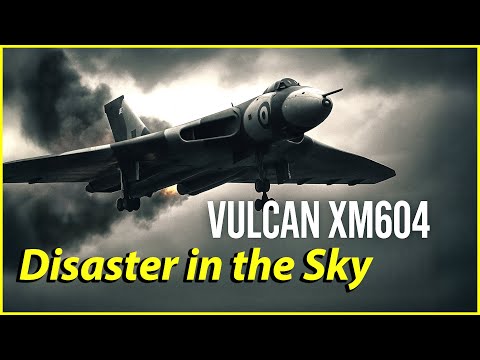
On a bright, crisp winter’s morning in January 1968, beneath clear blue skies, an Avro Vulcan bomber—symbol of Britain’s Cold War air power—roared off the runway at RAF Cottesmore. What began as a routine training flight would soon descend into chaos and catastrophe. Just 50 minutes after takeoff, the flight took a tragic and unexpected turn. This is the harrowing and unforgettable story of Avro Vulcan XM604: a compelling tale of extraordinary bravery, heartbreaking tragedy, and miraculous survival against impossible odds.
The Avro Vulcan was a jet-powered delta-wing strategic bomber that served as a critical component of the Royal Air Force’s strategic deterrence from 1956 until its retirement in 1984. Famous for its distinctive delta wing design, the Vulcan symbolized Britain’s airborne nuclear deterrent capability throughout much of the Cold War era. Designed by the innovative Avro company, the Vulcan quickly gained recognition for its combination of speed, agility, and advanced aerodynamics. The improved Vulcan B2 variant, which began entering RAF service in 1960, featured numerous advancements, including significantly more powerful engines, structurally enhanced wings to support greater payloads and higher altitudes, upgraded electrical and navigational systems, and sophisticated electronic countermeasures designed to evade enemy radar detection. This variant was notably capable of carrying and deploying the nuclear Blue Steel missile, enhancing its operational flexibility and strategic importance.
On January 30, 1968, under clear and calm winter conditions with a bright blue sky, Vulcan XM604 operated by Number 9 Squadron RAF was parked on its dispersal area at RAF Cottesmore, Rutland, England, awaiting its crew. The crew for today was pilot Flight Lieutenant Peter Tate, co-pilot Flying Officer Mike Gillard, and rear crew members Flight Lieutenant A.W. Bennett, Flying Officer B.D. Goodman, Flight Lieutenant S.R. Sumpter, and Flying Officer M.J. Wheelen. Following the crew-in and startup, XM604 was cleared by air traffic to taxi out to runway 22.
Flight Lieutenant Tate lined up the Vulcan, applied full power to its Rolls-Royce Olympus engines, and began the takeoff run. A few seconds later, XM604 took off into the clear sky from RAF Cottesmore for what was expected to be a standard training sortie. Climb-out from Cottesmore was normal, and XM604 proceeded to high altitude with nothing out of the ordinary. It was a beautiful day for flying.
However, not long into the sortie, the crew noticed a critical malfunction. A heating system intended to protect sensitive equipment in the aircraft’s bomb bay was showing signs of overheating. In fact, it wasn’t long before it began to overheat dangerously. Recognizing the severity of the situation, the crew quickly assessed their options and made the prudent decision to radio a pan-pan call and abort the mission, instead returning to RAF Cottesmore. However, due to the aborted sortie, the Vulcan still had a large fuel load, far too large to carry out a safe landing. So they would have to remain airborne to safely burn off several tons of fuel before attempting a landing—a standard but time-consuming safety precaution in such emergencies.
As much as it was a frustration to Tate and his crew that the sortie they had planned had been scrubbed, there was still value to be had by coming into the circuit at RAF Cottesmore and doing a series of practice approaches whilst at the same time burning off their fuel load. After a short while, XM604 was descending and making a standard approach into runway 22 at RAF Cottesmore. As the Vulcan arrived at the airfield, it leveled out at 100 feet, engaged takeoff power, retracted the gear and speed brakes, and slowly climbed away to enter the circuit for a second approach. It was thought a few of these would burn off the excess fuel and then get the aircraft on the ground so that 9 Squadron ground crew could fix the avionics heating system.
Turning on to final again for runway 22, Tate repeated the same procedures as the first approach: retract the gear, retract the speed brakes, and throttle up and climb out. As XM604 was clearing the far end of the runway, a loud explosion occurred, and severe vibration was felt throughout the aircraft. The Vulcan became uncontrollable, rolling sharply to port at an angle of over 90 degrees with a steep 15-degree nose-down angle. Co-pilot Mike Gillard wasted no time, and he pulled his black and yellow handle and ejected safely. Tate delayed his own ejection in a desperate attempt to stabilize the aircraft, hoping to give the rear crew—who did not have ejection seats and would therefore have to bail out of the entrance hatch in the floor—a chance to escape. There was to be no chance, however. The explosion had rendered XM604 totally uncontrollable. Realizing this, Tate pulled his handle and ejected with only seconds to spare.
XM604 impacted the ground in a huge fireball. It had narrowly missed buildings at Cow Close Farm but left a scene of utter devastation. Tragically, the four rear crew members—Flight Lieutenant Bennett, Flying Officer Goodman, Flight Lieutenant Sumpter, and Flying Officer Wheelen—could not escape, and they were killed instantly. Incredibly, when Tate finally ejected at about 300 feet, his parachute only partially deployed due to the extremely low altitude. And as he hurtled towards the ground, the parachute canopy snagged onto high-voltage power lines, instantly halting his rapid descent. The nylon material fused to the power lines due to the intense electrical current, effectively acting like an unexpected braking system. Remarkably, this bizarre twist of fate dramatically slowed Tate’s fall, allowing him to gently reach the ground and walk away without serious injury. A truly astonishing stroke of fortune amidst the devastating tragedy.
The subsequent investigation pieced together the events leading to the tragedy, concluding that a devastating fire had ignited within the number two engine’s low-pressure compressor during the second climb. This internal fire quickly escalated, causing the compressor to fail catastrophically. The resulting damage caused a turbine disc spinning at 25,000 revolutions per minute to violently separate from the engine housing. This high-velocity disc tore through the aircraft’s bomb bay, causing immense structural damage and critically severing crucial hydraulic systems and flight control lines. With vital control mechanisms severed, XM604 was rendered utterly uncontrollable, leaving the crew with no viable means to regain stability, let alone safely pilot the aircraft to an emergency landing.
But the story of XM604 did not end with the fireball that January morning. In the weeks that followed, the fields around Cow Close Farm became a site of quiet, meticulous recovery. Investigators combed the frozen earth for fragments of the number two engine, and engineers from Rolls-Royce were called in to examine what remained of the Olympus compressor. What they found would send a chill through the entire Vulcan fleet.
The low-pressure compressor had been the source of the fire—but the cause of the fire itself was something far more troubling. Investigators discovered that a component within the compressor had been fitted incorrectly during routine maintenance months earlier. A single, small error, made by hands that had worked on the aircraft countless times before, had planted the seeds of disaster long before Tate and his crew ever climbed aboard.
News of the finding spread quickly through the close-knit world of RAF bomber command. At Cottesmore, the mood among the ground crews was heavy. Many of them had worked on XM604 themselves; some had shared cups of tea with Bennett and Goodman only days before the flight. Now they found themselves poring over maintenance records, checking and rechecking every component on every Vulcan in the hangar, as if sheer diligence could undo what had already been done.
For Peter Tate, the weeks after the crash were a strange, suspended existence. He had walked away from an aircraft that had no business letting him live. His parachute, still fused in places to the power lines, had been recovered and examined; the investigation report would later describe his survival as “a combination of extraordinary luck and the peculiar physics of a partially deployed canopy catching on a live conductor.” The phrase felt absurdly clinical for what he had experienced.
He attended the funerals of his rear crew—four men who had trusted him completely, who had strapped themselves into seats they could not eject from, and who had died in the seconds it took him to realize there was nothing he could do. At each service, he stood at the back, said little, and left before the crowds dispersed. Fellow officers noticed that he never once spoke of his own escape. It was always the others he mentioned—their professionalism, their humor, the small details of their lives that the accident reports had no space for.
In the months that followed, the Air Ministry ordered a sweeping review of Vulcan maintenance procedures. The specific fault that had doomed XM604 was corrected across the fleet, and new inspection protocols were introduced for the low-pressure compressor assemblies. Every Vulcan crew in Britain owed a quiet debt to the four men who had died in that Rutland field. The changes were not dramatic or publicized, but they were real—and they lasted.
Mike Gillard, the co-pilot who had ejected first, returned to flying within a year. He would later say that the hardest part was not the explosion or the ejection, but the silence afterward—the long minutes in the field, waiting for word of the men he had left behind. He and Tate remained in contact for decades, bound by something that neither of them could quite put into words.
And the people of Rutland never forgot. A small memorial was eventually placed near Cow Close Farm, a simple stone marker in a quiet field where the only sound now is wind through the hedgerows. Farmers still occasionally turn up fragments of metal in their plowing—a rivet, a shard of casing, a piece of something that once roared through the sky at 25,000 feet.
The Cold War demanded vigilance, and the men of 9 Squadron gave it without hesitation. But XM604 stands as a reminder of something more human: that even in an age of nuclear deterrence and supersonic bombers, the margin between disaster and survival can be measured in seconds, in inches, in a single improperly fitted component. The four men who died that day did not die in vain—their loss reshaped the procedures that kept countless other crews safe.
Yet for all the investigation and reform, one question lingered in the minds of those who knew the story best. The fire had started during the second climb—but the aircraft had flown a full circuit before that, with the heating system already showing signs of trouble. What if the crew had landed immediately instead of burning off fuel? It was the kind of question that had no answer, only the heavy silence of a winter field and the memory of four men who never came home.
Decades later, the name XM604 still surfaces in Vulcan circles—not as a cautionary tale, but as a reminder of how thin the line between routine and ruin really is. Veterans of 9 Squadron raise a glass each January, and the toast is always the same: “To Bennett, Goodman, Sumpter, and Wheelen—gone, but never forgotten.”
Peter Tate lived quietly into old age, rarely speaking publicly of that morning. When he did, his voice never wavered on the details of the explosion—only when he spoke of the four men in the rear.
“They never had a chance,” he once said. “And I’ve carried that every single day.”
The stone marker near Cow Close Farm still stands, weathered now, its inscription fading. But the story endures—of a bomber, a fire, and the men who flew her.
What would you have done, strapped into a seat with no ejection handle, watching the ground rush up?
Report this article
Select a reason for reporting:






