In the fog of war, where steel monsters clashed and nations held their breath, one tank stood as the silent backbone of the German war machine. It wasn’t the fastest, the most heavily armored, or the most feared—but it was there, from the first thunderous shots of the Blitzkrieg to the final desperate defense of Berlin. The Panzer IV was Germany’s workhorse, a reliable beast that carried the weight of a empire’s ambitions.
While legendary Tigers and Panthers capture the imagination with their raw power, it was the humble Panzer IV that truly defined Germany’s armored strategy. Born from interwar designs, it was a forward-thinking marvel: spacious for five crew, mechanically dependable, and refreshingly uncomplicated compared to the over-engineered beasts that would follow.
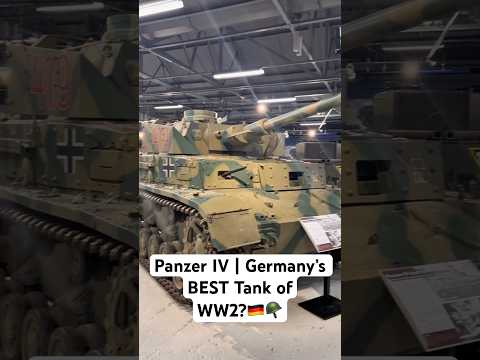
Its balance of firepower, armor, and mobility was a masterstroke. But as the war progressed, the Panzer IV began to struggle against new Allied tanks. Germany, ever adaptive, saw the need to upgrade—and the Panzer IV evolved, proving that sometimes, being solid and reliable is the most underrated asset of all.
This is the story of how a tank that was never meant to be groundbreaking became the unsung hero of World War II.
The Panzer IV’s journey began in the 1930s, a time when tank doctrine was still being written in the blood of previous conflicts. Germany, constrained by the Treaty of Versailles, had secretly developed armored forces, and the Panzer IV was designed as a support tank, intended to fire high-explosive shells at infantry and fortifications while the lighter Panzer IIIs engaged enemy armor.
But war has a way of rewriting plans. When the Panzer III proved inadequate against Soviet T-34s and KV-1s, the Panzer IV was thrust into the anti-tank role. Its turret ring was large enough to accommodate bigger guns, and its chassis could handle additional armor. This foresight in design became its salvation.
From the deserts of North Africa to the frozen steppes of Russia, the Panzer IV fought on every front. It was the only German tank to remain in production throughout the entire war, a testament to its adaptability and the desperate need for a reliable fighting vehicle.
Yet, as the Allies fielded ever more powerful tanks, the Panzer IV’s limitations became glaring. Its armor, even when upgraded, was insufficient against the 76mm guns of Soviet T-34/85s and the 75mm guns of American Shermans. The need for a new generation of tanks was urgent.
But the Panzer IV soldiered on, its crews learning to use terrain and tactics to compensate for its weaknesses. It was a tank that demanded skill and cunning, and its crews delivered. The story of the Panzer IV is not one of invincibility, but of resilience—a machine that, despite its flaws, became the backbone of an army and a symbol of Germany’s armored might.
The men who crewed these machines knew its quirks intimately. The transmission was a weak point, especially in the later, heavier models, and the gasoline engine strained under the added weight of up-armored variants. Yet, inside the cramped fighting compartment, a well-trained crew could make the Panzer IV sing. The commander, gunner, loader, driver, and radio operator formed a symphony of destruction, each relying on the others to survive another day.
On the Eastern Front, the Panzer IV’s baptism by fire against the T-34 was brutal. The Soviet tank’s sloped armor and wide tracks gave it an edge in mobility and protection, and its 76mm gun could punch through the Panzer IV’s frontal plate at range. German crews learned to ambush, to use their superior optics and radio coordination to strike from the flanks. It was a deadly game of cat and mouse, where the Panzer IV often had to be the cat—or die as the mouse.
Upgrades came in waves. The Ausf. F2, armed with the long-barreled 75mm KwK 40, finally gave the Panzer IV the punch to knock out T-34s at normal combat ranges. Later models added thicker armor, wider tracks, and improved engines, but the fundamental balance was always precarious. Every added kilogram of armor strained the chassis, every bigger gun taxed the turret, and the tank’s reliability—once its greatest strength—began to erode.
In North Africa, the Panzer IV danced with British Crusaders and Grants under the searing sun. The desert was a harsh teacher: dust clogged air filters, heat overheated engines, and supply lines stretched thin. Yet the Panzer IV’s robust design held up better than many of its contemporaries. Its crews joked that as long as you had fuel and ammunition, the tank would keep rolling—even if it complained the whole way.
By the time of the Normandy invasion, the Panzer IV was outclassed by the Sherman Firefly and the Soviet IS-2, but it was still deadly in the hands of veterans. Hidden in the bocage, a single Panzer IV could halt an entire column of Allied armor, its 75mm gun barking death before slipping away to fight again. The tank that was never meant to be a hero had become a phantom, haunting the hedgerows and forests of Europe.
Production numbers told the story of its importance: over 8,500 units built, more than any other German tank. It was exported to allies like Romania and Bulgaria, and its chassis was repurposed for self-propelled guns, anti-aircraft platforms, and even bridge-layers. The Panzer IV was not just a tank; it was a versatile weapons system, a chassis that refused to die even as the Third Reich crumbled around it.
In the final months of the war, Panzer IVs were thrown into battle with under-trained crews and dwindling fuel. They fought in the ruins of Berlin, in the snows of Hungary, and in the desperate defense of the Rhineland. They were no longer the hunters; they were the hunted, but they fought on with a grim determination that belied their obsolescence.
The end came not with a single decisive battle, but with a slow, grinding attrition. Spare parts ran out, fuel depots were captured or bombed, and the factories that once churned out Panzer IVs lay in ruins. Crews cannibalized damaged tanks to keep a handful running, stripping one machine to feed another. It was a grim, unglamorous end for a workhorse that had once symbolized the height of German armored prowess.
Yet even in those final days, the Panzer IV could still bite. In the rubble-strewn streets of Berlin, hastily formed crews used the tank’s last shells to ambush Soviet columns, firing from behind collapsed buildings before retreating into the smoke. There were no grand offensives left, only small, desperate stands—and the Panzer IV was there for every one of them.
What made the Panzer IV endure? The answer lay not in any single specification, but in its philosophy. It was designed to be a team player, not a showstopper. The five-man crew allowed the commander to focus on the battlefield rather than loading shells or aiming the gun. The radio in every tank meant coordinated attacks and rapid responses—a luxury many Allied tanks lacked early in the war.
Its modularity was another quiet triumph. A damaged Panzer IV could be repaired in the field with basic tools, and its components were standardized enough that swapping parts between models was possible. Where the Tiger demanded a dedicated maintenance crew and the Panther suffered from teething troubles, the Panzer IV just kept going.
Historians often debate whether the Panzer IV was a ‘good’ tank. By 1944, its armor was thin, its engine overworked, and its gun outranged by the latest Soviet and Western designs. But ‘good’ is a relative term in war. The Panzer IV was good enough to fight for six years across three continents, good enough to be produced in greater numbers than any other German tank, and good enough to earn the respect of the men who crewed it and the enemies who faced it.
After the war, surviving Panzer IVs found new lives in the armies of Syria and other Middle Eastern nations, where they fought in conflicts far removed from the European battlefields of their birth. The tank that had been the backbone of the Wehrmacht now served new masters, a testament to its ruggedness and the simple fact that a well-built machine outlasts the cause it was built to serve.
In the end, the Panzer IV’s legacy is not one of glory, but of quiet, relentless service. It was never the star of the propaganda reels—that role belonged to the Tigers and Panthers. But when the cameras stopped rolling and the real fighting began, it was the Panzer IV that carried the load.
In the end, the Panzer IV’s story is a reminder that wars are not won by wonder weapons alone. They are won by the machines that show up, day after day, and do the job asked of them. The Tiger may have inspired fear, and the Panther may have inspired awe, but the Panzer IV inspired something far more valuable in a long war: confidence.
Its crews trusted it. They knew its limits, its moods, its creaks and groans. They knew that if they did their part, the tank would do its own. That kind of trust is not built by specifications on a sheet of paper; it is built in the mud, the snow, and the dust.
Today, a handful of surviving Panzer IVs sit in museums, their paint faded and their engines silent. Visitors walk past them, often drawn to the massive Tigers nearby. But those who pause and look closely see something else: a machine that was never meant to be legendary, yet became indispensable.
Perhaps that is the quiet lesson of the Panzer IV. Greatness is not always loud. Sometimes it is a workhorse, plodding forward, carrying the weight of an army on its shoulders. And when the history books close, it is the workhorse that history quietly thanks.
What do you think—was the Panzer IV truly the unsung hero of World War II, or does another tank deserve that title? Share your thoughts in the comments below.
Report this article
Select a reason for reporting:






