Heinrich Himmler stood by the window of the Reich Ministry, the warm spring air of 1942 brushing his face. Outside, Berlin hummed with triumph. German armies had crushed France in six weeks, Norway in two months, and the Soviet Union seemed to buckle under the weight of German steel. In aircraft factories across the Reich, workers smiled as they built the Messerschmitt Bf 109 and the Focke-Wulf 190—machines so advanced that Allied pilots feared to meet them in the sky. Himmler believed in German superiority with every fiber of his being. Quality would always defeat quantity. The war was as good as won.
Then the first intelligence reports arrived from the West. Small groups of American bombers—B-17 Flying Fortresses and B-24 Liberators—had appeared over occupied Europe. They looked clumsy, slow, and crude compared to German engineering. Himmler’s assistant had scribbled in the margins: “Flying coffins—death traps for their crews.” The planes flew in straight lines during daylight, making them easy targets for German fighters. Their defensive guns seemed weak, their armor thin. Himmler laughed. The Americans built cheap goods that fell apart. These flying coffins would drop from the sky the moment they faced real German pilots.
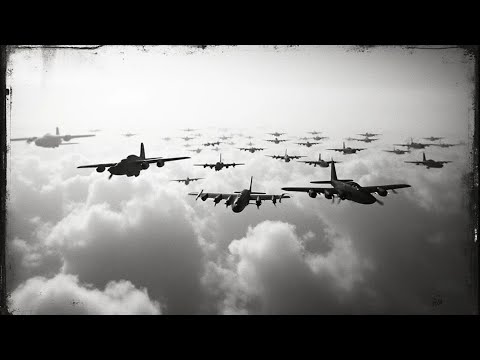
But something nagged at him. The Americans were building these planes in enormous factories—Boeing in Seattle, Consolidated in San Diego, Douglas in California. Each plant was larger than anything in Germany. The numbers seemed impossible. Himmler put the report aside. American industry produced shoddy goods. German quality would prevail. Yet outside his window, the first air-raid sirens of the war began their ghostly wail.
Colonel Weber’s hands trembled as he spread the reconnaissance photos across his desk. The Boeing factory in Seattle stretched for miles. Rows upon rows of B-17s stood on the tarmac like silver beetles. He had never seen so many aircraft in one place. The American plant was ten times larger than Germany’s biggest aircraft factory. Weber hurried to Himmler’s office, his boots clicking loudly on the marble floors. Outside, he could hear the distant rumble of engines. More American bombers were coming—not the small groups of last year, but formations of 50, sometimes 100 planes. The flying coffins were multiplying like angry wasps.
In the interrogation room below, Captain Müller faced a young American airman. The boy looked maybe twenty, his flight jacket torn and bloody from his parachute landing. But his eyes were calm—too calm for someone just shot down. “How many crews are trained back home?” Müller asked in careful English. The American smiled. “Thousands, sir. We graduate new bomber crews every week. For every plane you shoot down, we build ten more. My training base had 5,000 men when I left.” Müller felt cold despite the warm room. Five thousand men on one base. How many bases did America have?
Down in the factory district, Haircrantz watched black smoke rise from his aircraft plant. American bombs had hit exactly three buildings—not the workers’ houses nearby, not the hospital across the street. Only the three buildings where they made fighter engines. The bombs had fallen as if they knew precisely where to go. His workers stood in the rubble, faces gray with dust and fear. Yesterday they had laughed at the easy targets. Today they swept up the remains of their machines and counted their dead friends.
Luftwaffe pilot Hans Richter landed his damaged Messerschmitt and climbed slowly from the cockpit. His mechanic ran to inspect the bullet holes in the wings. Richter had shot down two B-17s in seconds that morning. But there had been 300 bombers in the formation. Even after losing 20 planes, the Americans had dropped their bombs and flown home. “They filled the entire sky,” Richter told his commander. “I’ve never seen so many aircraft at once. We shot down as many as we could, but there were always more behind.”
That evening, Himmler stood by his window and watched searchlights probe the dark sky. The air-raid sirens wailed again. Somewhere above the clouds, American engines droned like hungry thunder. He thought of the photos on his desk, the endless rows of bombers in American factories, the reports of new crews arriving every day. Perhaps the Americans were not building flying coffins after all. Perhaps they were building something far worse.
The ground shook beneath Himmler’s feet as he stood in the concrete bunker. Above, a thousand American bombers darkened the February Sunday. The sound was like standing inside rolling thunder that never stopped. Through the thick walls, he heard the whistle and crash of falling bombs. With each explosion, dust rained from the ceiling.
His adjutant counted the formations through a periscope. “1,050 B-17s, sir. Another 800 B-24s behind them.” The young officer’s voice trembled with fear. “They stretch from horizon to horizon.” Himmler closed his eyes and remembered his words from two years ago. Flying coffins. Death traps. Crude American junk that would fall from the sky. Now those same planes flew in numbers so vast that a German response was impossible.
The Luftwaffe had perhaps 200 fighters left. The Americans had committed more than 1,800 bombers to this single raid. The bombing lasted four hours. When the all-clear finally sounded, Himmler climbed the bunker stairs into the daylight. The aircraft factory that had employed 10,000 workers was gone. In its place lay only twisted metal and burning rubble. The precision was perfect. The Americans had wasted no bombs on empty ground.
He walked carefully through the debris. Remains of German fighter planes lay scattered like broken toys—the same machines that were supposed to be the best in the world. Now they would never fly again. The workers who built them would never work again. An old factory foreman sat on a broken wall, tears cutting tracks through the dirt on his face. “Herr Himmler,” the man said quietly, “how do we fight this? They have more planes than we have bullets.”
That night, Himmler sat alone in his office and opened his personal diary. His hands trembled as he wrote: “We called them flying coffins and laughed at American weakness, but we were blind fools. Every day they return in greater numbers. We shoot down 50 and 100 take their place. These are not the soft Americans of our propaganda. These are the destroyers of the Reich.”
He set down his pen and stared at the words. Everything he believed about German superiority was crumbling, just like the factories outside his window. American bomber crews were not poorly trained weaklings. They were part of an enormous machine that could replace losses faster than Germany could inflict them. The realization struck him like a physical blow. The thousand-year Reich was being systematically torn apart from ten kilometers above.
The flying coffins had never been coffins at all. They were the instruments of Germany’s downfall. Outside his window, searchlights swept the empty sky. The Americans had already left, flying safely back to England. Tomorrow they would return with even more planes. And there was nothing Germany could do to stop them. The airspace over the Reich now belonged to America.
Two thousand bombers flew overhead like a moving silver cloud that stretched beyond the horizon. Himmler watched from his prison cell as formations of B-17s and B-24s passed without fear. No German fighter rose to meet them. The Luftwaffe was dead. The factories that built their planes were mountains of rubble. American guards walked the prison corridors with calm confidence. Their boots were made of sturdy leather. Their uniforms were clean and pressed. They carried chocolate bars and chewing gum as if such things cost nothing.
A guard offered Himmler an American cigarette through the bars of his cell. The tobacco was better than anything Germany had produced even before the war. In the prison yard, Himmler met other Nazi leaders who had once ruled Europe. Göring had grown thin without his luxurious meals. Speer stared at the ground and spoke in whispers. They all understood the same terrible truth. They had lost to a nation they had never truly understood.
The American prosecutor laid the photographs across the table one by one during the trial preparations. Himmler studied them in silence. Auto plants in Detroit converted to build bombers. Workers in Seattle assembling B-17s on lines that ran like clockwork. Women in overalls welding aluminum while their children played in the company nursery. The scale was larger than the Reich had ever imagined.
“Your intelligence reports called our bombers flying coffins,” the American lawyer said, tapping a yellowed German document. “But you built the real coffin. You buried your own country in it.”
Himmler said nothing. There was nothing left to say. The lawyer’s words were not an accusation—they were simply the truth, spoken without anger, which made them cut deeper than any shout.
That evening, Himmler sat in his cell and wrote his final thoughts with the small pencil the guards had given him. It felt heavy in his fingers, heavier than any pen he had ever held. Through the barred window, he watched American transport planes land on German airfields. Planes full of food and medicine for the people his government had led into the abyss.
He wrote slowly, choosing each word with care. We called them flying coffins and laughed at their weakness. But the coffin was never theirs. It was ours. When the sky filled with their bombers, we were already dead. We simply did not know it yet.
He paused, staring at the page. American power was not crude quantity without quality. It was quality on a scale Germany could never match. That was the true lesson of the war, and they had learned it too late.
The next morning, the guards found his cell empty. Himmler had chosen his own end rather than face the full weight of his failures. His final diary lay open on the small table. The last entry was a single sentence.
The flying coffins taught us who was truly dying.
Outside the prison walls, American bombers still flew over Germany—but now they carried food and supplies instead of bombs. The same aircraft that had destroyed the Reich were helping to rebuild it. The irony was not lost on those who survived.
In the ruined cities, German families gathered around small radios to hear the news of the trials. An old factory worker who had once swept rubble from his bombed plant listened in silence. He remembered the foreman who had wept on the broken wall, asking how they could fight an enemy with more planes than they had bullets.
Now he knew the answer. They could not. No one could. The Americans had not won because of superior courage or superior intelligence. They had won because they had built a machine that could not be out-produced, and they had fed that machine with the labor of millions who believed in what they were building.
The worker turned off the radio and looked at his hands—hands that had once assembled Messerschmitt wings, now scarred and idle. He thought of the young American airman who had smiled in the interrogation room and spoken of five thousand men on a single training base.
We never understood them, he whispered to himself. We never even tried.
Across the Atlantic, in a Seattle factory that had once run day and night, the assembly lines were quiet. The war was over. The women who had welded bombers had gone home to their families. But the machines remained, and the memory of what they had built remained too—a reminder that the world had changed forever, and that the nation which called others inferior had been buried by its own arrogance.
The flying coffins had done their work. And history would remember them not as death traps, but as the instrument of a terrible and necessary justice.
Years later, a young German historian stood in the same Seattle factory, now a museum of industry. She traced her finger along a photograph of women welders, their faces bright with purpose. Her grandfather had flown a Messerschmitt in the war, and he had never spoken of it.
“They didn’t outfight us,” he had finally confessed one evening, his voice thin. “They out-built us. We were fighting a nation that could turn butter into bombers.”
She looked up at the last B-17 suspended from the ceiling, its silver skin gleaming. It was not a coffin. It was a mirror—one that showed the Reich exactly what it had refused to see.
What would you have done, standing in Himmler’s shoes, the day the sky turned silver?
Report this article
Select a reason for reporting:






