July 1945. The war in the Pacific is grinding toward its bloody conclusion, but on the island of Borneo, one final, ferocious battle is about to erupt. Off the coast, over 33,000 Australian troops sit poised in landing craft, the largest amphibious force ever assembled by Australia. Their target: Balikpapan, a city transformed into a fortress by thousands of Japanese defenders who have sworn to fight to the death. What unfolds on those beaches and in those streets will become one of the most harrowing and heroic chapters of World War II.
The Japanese have had years to prepare. Bunkers bristle from the cliffs, minefields line the beaches, and every building in the urban center has been turned into a stronghold. They are cut off from reinforcements, low on supplies, but far from defeated. For the Australians of the 7th Division, this is not just another mission—it is a brutal fight for every inch of ground, a test of courage that will demand everything they have.
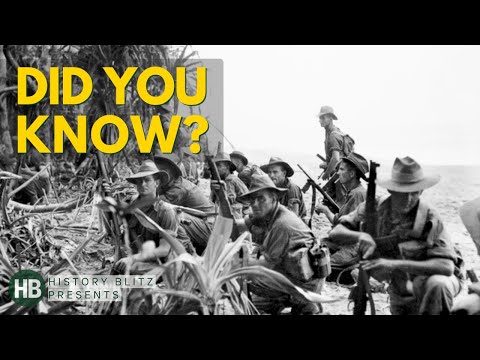
For two weeks, Allied ships and aircraft have pounded Balikpapan relentlessly. Over 3,000 tons of bombs, 7,000 rockets, and 38,000 shells have rained down on Japanese positions. The objective: disrupt communications, destroy supply lines, and demoralize the enemy. But as the first wave of Australian troops hits the beaches on July 1st, they are met with a withering hail of machine-gun fire and artillery. The air is thick with smoke and explosions, and casualties mount almost immediately.
Amid the chaos, individual acts of valor shine through. Captain Raymond Jesse Alsop, a medical officer with the 2/5th Commando Squadron, charges into open ground swept by enemy fire to rescue wounded soldiers. He drags a trooper to safety, treats the wounded, and repeatedly ventures back into the line of fire. Despite being wounded himself, he continues to carry water to dying men and bring comfort until he is mortally struck. His commanding officer later writes, “I have never known a braver man.” Alsop’s sacrifice saves at least three lives and earns him the Star of Gallantry decades later.
On the beaches, engineers work under fire to clear mines and barbed wire, while the 18th Brigade, led by Brigadier Frederick Chilton, pushes inland. The Japanese have turned the city into a maze of ambushes and hidden strongpoints. The Australians, unused to urban combat in the Pacific, adapt quickly. Tanks from the 2/9th Armoured Regiment rumble forward, their guns blasting bunkers and machine-gun nests. Flamethrowers and satchel charges clear house after house. The 2/16th Battalion distinguishes itself with disciplined, precise tactics, but the cost is high.
By July 3rd, much of Balikpapan is in Australian hands, but the Japanese retreat into the jungle, launching guerrilla attacks on supply lines. The Australians respond with coordinated patrols and airstrikes, systematically rooting out resistance. Major General Milford Yamamoto’s forces suffer over 2,000 killed, with the remainder captured or scattered. Organized resistance collapses by July 21st.
Yet even as victory nears, the question lingers: was this battle necessary? Japan’s empire is crumbling, its hold on Borneo already severed. But for the men who fought and died, it was never about strategy—it was about survival, liberation, and bringing the war to its final, bloody end.
With organized resistance broken, the Australians turned to an unexpected weapon: psychology. Leaflets fluttered down over the remaining Japanese positions, printed with precise instructions—the exact time to monitor their radios, the frequencies to use, the call sign for contact. In a display of characteristic Australian humor, the call sign assigned to the Japanese headquarters was “Drango”—a colloquial term meaning idiot or fool. Unaware of the insult, the Japanese complied, and radio communication was established.
Two Japanese soldiers, blindfolded for operational security, were escorted to an Australian advanced headquarters to formalize the surrender arrangements. The methodical approach minimized further bloodshed on both sides. By the time the negotiations concluded, the Australians had secured Japan’s last stronghold in Borneo.
The victory came at a steep price. Over 229 Australian soldiers were killed and 634 wounded. But the cost wasn’t measured only in military lives. The Japanese occupation had left thousands of civilians and prisoners of war in dire conditions—malnourished, sick, and broken. Australian troops moved swiftly to liberate these survivors, bringing an end to years of suffering.
Just weeks later, the Russians entered the Pacific War in the north, and the atomic bombs fell on Hiroshima and Nagasaki. Japan surrendered. The battle for Balikpapan, one of the last major Australian ground operations of the war, was over—but the work was far from finished.
In the weeks following the cessation of hostilities, Australian forces remained in Borneo to assist with recovery. Their priorities were clear: the liberation and care of Allied prisoners of war and civilian internees, many of whom had endured severe hardships under Japanese captivity. Troops facilitated medical care, nourishment, and repatriation, ensuring survivors could return home.
Rebuilding was another matter entirely. Australian engineers worked to restore essential services—water supply, health care, and the oil facilities that had once fueled Japan’s war machine. Martial law was initially imposed to maintain order, but over time civil administration was reinstated under the British Borneo Civil Affairs Unit.
By late 1945, Australian forces began withdrawing from Borneo, with the majority having left by early 1946. Their efforts during this transitional period were instrumental in stabilizing the region and facilitating a return to normalcy for its inhabitants.
The Battle of Balikpapan stands as a testament to the courage and determination of the Australian 7th Division. Against formidable defenses and treacherous conditions, they triumphed—liberating a region and crippling an empire. Today, their sacrifices are remembered not just in history books but in the lives they saved and the freedom they restored.
Balikpapan’s oil may no longer fuel a war, but its story fuels our understanding of the cost and the necessity of peace. The men who fought there—the medics like Captain Alsop, the engineers under fire, the infantrymen clearing house after house—left behind a legacy that echoes through the decades.
But the story of Balikpapan does not end with the guns falling silent. In the months that followed, a quieter battle began—one fought not with bullets but with patience, compassion, and an unshakeable sense of duty. The men of the 7th Division who had stormed the beaches now found themselves walking through the shattered streets of a city they had helped destroy, carrying rice, medicine, and hope to the very people caught in the crossfire.
Among them was Sergeant Thomas Whitfield, a sapper from the 2/11th Field Company. He had spent the landing clearing mines under fire, his hands steady even as shells screamed overhead. Now, he found himself using those same hands to rebuild a village well that his own artillery had collapsed. “Funny thing,” he wrote to his wife back in Adelaide, “we came here to break things. Now all I want to do is fix them.”
The prisoners of war were the first priority. In camps scattered around the oil fields, Australian troops discovered hundreds of Dutch and British internees—many barely alive, their bodies ravaged by years of forced labor and starvation. The scenes they encountered would haunt the soldiers for decades.
Private Arthur Penrose, a young stretcher-bearer, later recalled the moment his unit reached one camp. “There were men who hadn’t stood upright in months. Their eyes—I’ll never forget their eyes. They looked at us like we were ghosts, like they couldn’t believe anyone had come.” The Australians shared their own rations, wrapped the survivors in blankets, and carried those too weak to walk to the waiting hospital ships.
But rebuilding a city was no simple task. Balikpapan’s oil refineries—the very prize that had made the city so valuable—lay in ruins, their pipelines twisted like broken bones, their storage tanks blackened husks. Japanese engineers had sabotaged much of the infrastructure before retreating, and Allied bombing had done the rest.
Australian and Dutch engineers worked side by side with local laborers, many of whom had been forced to work for the Japanese only months before. The irony was not lost on anyone. “Yesterday they were the enemy’s slaves,” one Australian officer noted. “Today they’re our partners. War makes strange bedfellows.”
Yet the most delicate work fell to the medical teams. Captain Alsop’s sacrifice on the beach had saved lives, but now a different kind of heroism was needed—the slow, grinding work of healing. Australian medics treated everything from malaria and dysentery to wounds that had festered for months without proper care.
Lieutenant Colonel Margaret Hargreaves, one of the few female medical officers in the campaign, established a makeshift hospital in a former Dutch colonial building. “We had no electricity, no running water, and barely enough morphine,” she later wrote. “But we had the will. That was enough.” Her team worked eighteen-hour days, performing surgeries by lamplight and delivering babies in the same wards where they treated battle casualties.
The local population, initially wary of the Australians, began to trust them. Children who had hidden from Japanese patrols now clustered around the soldiers, begging for sweets and marveling at their strange language. “They called us ‘Orang Australia,'” one corporal remembered. “I don’t think they’d ever seen anyone so tall or so pale. We must have looked like giants to them.”
But beneath the surface of recovery, tensions simmered. The Dutch, eager to reclaim their colonial empire, clashed with Indonesian nationalists who had tasted freedom during the Japanese occupation. The Australians, caught in the middle, found themselves navigating a political minefield they had never anticipated.
Major General Milford, the commander who had led the assault, issued strict orders: the Australians would not take sides in the emerging Indonesian independence movement. Their job was to keep the peace, not to determine the future. “We came to liberate, not to occupy,” he told his officers. “Remember that.”
It was a difficult line to walk. Some Australian soldiers sympathized openly with the Indonesian nationalists, seeing parallels to their own nation’s struggle for independence. Others, bound by orders and alliance, maintained a careful neutrality. The tension would only grow in the months ahead.
By November, the Australians were preparing to leave. The city was still scarred—buildings pockmarked with bullet holes, the harbor littered with wreckage—but it was alive again. Markets had reopened. Schools were holding classes in repaired rooms. The oil fields, though far from restored, were producing again under Dutch supervision.
On the morning of the final withdrawal, Sergeant Whitfield stood on the pier where he had landed five months earlier. The beach was quiet now, the sand swept clean of mines and debris. “I came here a soldier,” he wrote in his last letter from Borneo. “I leave as something else. I’m not sure what to call it. But I know I’ll never forget the faces of the people we saved.”
The 7th Division sailed home to a nation still celebrating victory, still grieving its dead. The Battle of Balikpapan was largely forgotten in the shadow of Hiroshima and Nagasaki, its strategic necessity debated by historians for decades. But for the men who fought there—and for the thousands of civilians and prisoners they liberated—the battle mattered.
Captain Alsop never lived to see the peace he helped secure. But the men he saved went home to families, to lives, to futures that might otherwise have been erased. The Star of Gallantry awarded to him more than seventy years later was a recognition not just of his courage, but of a simple truth: in the worst moments of war, the greatest heroism often comes from those who choose to save rather than destroy.
Today, on the beaches of Balikpapan, a small monument stands facing the sea. It bears no grand inscription, no list of victories. Just a simple plaque, placed by the people of Borneo, that reads: “To the soldiers who came as enemies of our enemies, and left as friends. We remember.”
The war is long over. The oil still flows. And the story of what happened on those beaches—of sacrifice, of compassion, of men who fought and then healed—continues to echo through the decades.
But it leaves us with a question that still resonates today: when the guns finally fall silent, what is the true measure of victory—the ground we take, or the lives we restore?
Report this article
Select a reason for reporting:






