The German pilot never saw it coming. One moment, the night sky over occupied Europe was empty; the next, a burst of cannon fire tore through his cockpit, and his plane spiraled toward the ground. The attacker was as silent as a ghost and as fast as a rumor—a wooden aircraft the Germans called the “Bandit of the Air.” This is the story of the de Havilland Mosquito, the most versatile and feared Allied aircraft of World War II.
In the desperate early years of the war, the Allies had no answer to the Nazi war machine. “They got shot down rather easily,” one veteran recalled of the RAF’s early bombers. Then, in 1941, a radical solution emerged: a bomber made almost entirely of wood, stripped of defensive guns, and flown by just two men. It was a gamble that would change the course of the air war.
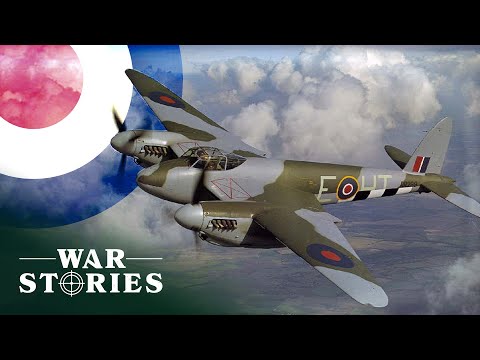
The Mosquito was a marvel of engineering. Powered by two Merlin engines, it could hit 400 miles per hour—faster than any German fighter—and carry a payload of four 500-pound bombs. “There was nothing like it,” said one pilot. “At full power it could do almost 400 miles an hour, which is faster than anything else.” With its speed and agility, the Mosquito could slip through enemy defenses, strike deep into the heart of Germany, and be gone before the flak gunners could react.
But the Mosquito’s true genius lay in its versatility. It served as a fighter-bomber, a photo-reconnaissance plane, and a pathfinder for heavy bombers. “It was used in photo reconnaissance operations which are terribly important for intelligence,” explained one historian. “They were used as pathfinders, fire droppers for the heavy bomber missions, and they were used as fighter bombers.” The aircraft took on missions so dangerous they seemed suicidal—low-level intruder raids on German airfields, precision strikes on Gestapo headquarters, and daring attacks on V-1 rocket sites.
One of the most legendary missions was Operation Jericho. In February 1944, 19 Mosquitoes took off from Hunsdon airfield with a single objective: to break open the walls of Amiens prison and free over 100 French Resistance fighters awaiting execution. The raid was a masterpiece of precision bombing, but it came at a cost. The leader, Group Captain Charles Pickard, was shot down and killed. “Pickard lost his life in the most amazing air raid of the entire Second World War,” said one historian. Yet the mission succeeded—more than 250 prisoners escaped, and the Mosquito’s reputation was cemented.
But the Mosquito’s greatest challenge was yet to come. In June 1944, Germany unleashed its V-1 flying bombs—the first cruise missiles—on London. These pilotless aircraft were fast and deadly, and the Allies had no effective defense. Once again, they turned to the Mosquito. “The real danger was if you’d picked up a piece of debris in the radiator,” one pilot recalled. “The other problem was that it produced a very vivid white flash would blind you.” Despite the risks, Mosquito pilots learned to intercept the V-1s, tipping them over with their wingtips or shooting them down in mid-air. By the end of the war, they had destroyed nearly 2,000 of these terror weapons.
The Mosquito’s story is one of innovation, bravery, and sacrifice. It was never as famous as the Spitfire or the Lancaster, but its contribution to the Allied victory was immeasurable. “It was a different airplane altogether,” said one veteran. “I felt very safe in it, and it got us save brothers back.” As the war in Europe drew to a close, the Mosquito’s reign as the Allies’ most versatile aircraft came to an end. But its legacy—and the courage of the men who flew it—would never be forgotten.
“We were gaining some because the fire coming out of the ass end of the V-1 was getting big,” one pilot remembered. “The Mosquito was screaming at every joint, I thought the wings would never stand it.” He leveled out at 400 miles per hour, too close, and shut his eyes as the cannons began banging away. When the explosion came, the blast scorched the paint clean off the Mosquito’s belly. “There wasn’t an inch of paint anywhere,” he said. “The Mosquito was black—no numbers, no letters, nothing.”
But the V-1 was only the beginning. By the autumn of 1944, the Germans had introduced something even more terrifying: the V-2 rocket, a ballistic missile that fell from the sky without warning, faster than sound, impossible to intercept. There was no engine to hear, no flame to chase. The Mosquito, for all its speed, could do nothing against a weapon that struck before its victims ever knew it was coming.
Yet the Mosquito’s war was not over. As Allied armies pushed toward Germany, the aircraft took on new roles—striking bridges, strafing convoys, and hunting trains in the frozen winter of 1944–45. “After that, if you had any ammunition left, you were allowed to go anywhere you like,” one veteran said with a grin, “and beat their transport on the ground.” They attacked at treetop height, where the flak was thickest and the margin for error was zero.
One such mission, flown in the final weeks of the war, nearly ended in disaster. A Mosquito crew was returning from a low-level sweep over the Ruhr when they were jumped by a pair of Focke-Wulf 190s. The pilot threw the wooden bomber into a violent dive, skimming so low over a forest that the propellers chewed through the tops of the pines. “The navigator was screaming at me to pull up,” the pilot recalled, “but I knew if I did, we were dead.” They escaped, but the aircraft came home with pine needles wedged in its radiators.
Back at Hunsdon, the ground crews worked through the night, patching bullet holes with fabric and dope, swapping out engines, and loading belts of ammunition by hand. “Those men never got the credit they deserved,” said one pilot. “We flew the missions, but they kept us alive.” The airfield, with its arrow-shaped runway and its pub where drinkers once ducked their heads as Mosquitoes roared overhead, had become a symbol of the quiet, relentless war the aircraft waged.
By April 1945, the end was in sight. The Luftwaffe was a shadow of its former self, its airfields bombed into craters, its pilots short of fuel and training. The Mosquito crews, who had once been the hunters, now found the skies nearly empty. “It was strange,” one navigator admitted. “For years we’d been the ones sneaking around in the dark. Suddenly there was nobody left to sneak up on.”
But there was one final mission that no one would forget—a raid so audacious that it would be spoken of for decades. It would come not over Germany, but over the dark waters of the North Sea, and it would test the Mosquito and its crews in a way they had never been tested before.
The target was a German radar station on the Dutch island of Walcheren, a fortress of concrete and steel bristling with anti-aircraft guns. But this was no ordinary raid. The station was housed inside a massive bunker, its walls five feet thick, and the only way to destroy it was a direct hit with a 4,000-pound bomb—a weapon the Mosquito had never carried before.
The crews trained for weeks, practicing low-level runs over the English countryside, the bomb slung beneath the belly of their wooden aircraft. “We knew it was going to be tight,” one pilot said. “The bomb was so big we had to fly with the bomb doors removed. The whole aircraft felt different—sluggish, heavy.” On the morning of the raid, the weather was foul, with low cloud and driving rain. But the mission went ahead.
They came in over the sea, skimming the waves at fifty feet, the grey water blurring past their wings. The radar station loomed ahead, a dark shape against the dunes. The pilot pulled up sharply, the bomb released, and the Mosquito leapt upward as if relieved of a great weight. “The explosion was enormous,” the navigator recalled. “A column of smoke and debris shot into the sky, and when it cleared, the bunker was gone.”
But the anti-aircraft gunners were quick, and the Mosquitoes ran a gauntlet of fire on the way out. One aircraft was hit in the engine, its propeller feathering as flames licked along the wing. The pilot, a young Canadian named Bill Sneddon, kept the aircraft in the air by sheer will, coaxing it back across the North Sea until the English coast appeared through the mist. “We landed with the engine on fire,” his navigator said. “The ground crew had the fire trucks waiting. We climbed out and just stood there, shaking.”
Sneddon was awarded the Distinguished Flying Cross, but he never spoke of the raid again. Like so many of his generation, he put the war behind him and returned to a quiet life in Ontario. It was only after his death, when his family found a box of letters and photographs in his attic, that the full story emerged.
The Mosquito crews were not the glamorous fighter pilots of the Battle of Britain, nor the stoic bomber boys of the Lancaster. They were something else entirely—a breed apart, flying alone into the dark, relying on speed, surprise, and each other. “We were a team,” one navigator said simply. “The pilot and I. That’s all there was. We trusted each other with our lives.”
As the war in Europe ended in May 1945, the Mosquitoes flew their last missions—not bombing, but dropping food to the starving people of Holland and bringing home prisoners of war. The aircraft that had been designed to destroy was now used to heal. “We flew over the Dutch towns and the people came out into the streets,” one pilot remembered. “They were waving and crying. We dipped our wings and flew on.”
In the years that followed, the Mosquito faded from memory, overshadowed by the Spitfire’s elegance and the Lancaster’s thunder. Yet those who flew her never forgot. “You could feel the wood flex when you pulled her hard,” one veteran said. “She was alive in a way no metal plane ever was.”
Today, only a handful of Mosquitoes survive, silent in museums, their Merlin engines cold. But on quiet evenings at old airfields like Hunsdon, where the arrow runway still cuts through the grass, locals swear you can hear a distant drone—a low, fast hum skimming the treetops, gone before you can point.
“The Germans called us the Bandits of the Air,” a navigator recalled, smiling. “I rather liked that.” They were bandits indeed—thieves in the night, stealing the enemy’s confidence, one wooden wingbeat at a time.
The Mosquito never sought glory. It simply did the impossible, quietly, and came home. “It got us save brothers back,” one pilot said. Perhaps that is the finest epitaph any aircraft could earn.
So the next time you hear an old pilot speak of a wooden wonder that outran the enemy and brought its crew home, ask yourself: what would you have flown—the fame of the Spitfire, or the ghost that won the war in silence? Tell us in the comments below.
Report this article
Select a reason for reporting:






