When the British tanks rolled through the gates of Bergen-Belsen on April 15, 1945, the soldiers expected to find prisoners of war. Instead, they stepped into a nightmare that would haunt them forever. The air was thick with the stench of death, and the ground was littered with corpses—more than 13,000 unburied bodies lay scattered like broken dolls. The living were barely distinguishable from the dead, their skeletal frames draped over piles of rotting flesh. This was not a camp; it was a graveyard of the living.
For the first time, the Western Allies witnessed the full scale of Nazi brutality. Until then, reports from the Soviet Red Army had been dismissed as propaganda. But here, in the heart of Germany, the truth was impossible to ignore. “Normal was death,” survivor Katarina Hardy would later say. “I belong to the dead of Bergen-Belsen.” Her words echoed the unspeakable reality that thousands had endured.
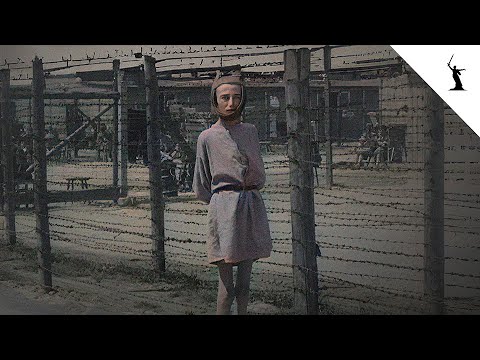
The liberation of Bergen-Belsen was not just a military victory; it was a revelation. BBC reporter Richard Dimbleby, who accompanied the troops, described the scene in words that shook the world: “Here, in more than an acre of ground, lay dying people. It was impossible to distinguish one from the other. The living lay with their heads resting on corpses.” His broadcast forced the world to confront the horrors of the Holocaust.
But how did this camp come to exist? Its origins were deceptive. In 1935, the Wehrmacht began building a military complex near the village of Belsen. The barracks that housed construction workers later became a prisoner-of-war camp, Stalag XI-C, where tens of thousands of Soviet soldiers perished from starvation and disease. By 1943, the SS had taken over part of the camp, transforming it into a concentration camp with a special status: a transit camp for Jews who might be exchanged for German civilians or hard currency.
Under the command of Josef Kramer, known as the “Beast of Belsen,” the camp descended into chaos. As the war neared its end, prisoners from evacuated camps in the East poured in by the thousands. The already dire conditions collapsed entirely. Typhus, starvation, and brutality killed hundreds each day. “The camp had turned into a true hell,” one survivor recalled. Between 1943 and 1945, around 120,000 people passed through Bergen-Belsen, but only 55,000 names are known. The rest vanished into the smoke of the crematoria.
Among the victims were Anne Frank and her sister Margot, who died in February or March 1945, just weeks before liberation. Their story, like so many others, became a symbol of the senseless tragedy. When British troops arrived, they found survivors like 16-year-old Katarina Hardy, who weighed just 29 kilograms and could neither stand nor swallow. She was one of the lucky few who recovered.
The liberation of Bergen-Belsen exposed not only the physical horrors but also the twisted medical experiments performed on Jewish women. SS doctors, obsessed with preserving the Aryan race, subjected prisoners to sterilizations, X-ray overdoses, and chemical injections. “The pain was immense, and the damage permanent,” one survivor testified. Many were murdered so that autopsies could compare the results.
As the world watched, General Dwight Eisenhower ordered that every corner of the camp be documented. German officials were forced to tour the grounds and confront the truth they claimed to know nothing about. The images of emaciated corpses and mass graves became irrefutable evidence. In the Bergen-Belsen trial, 11 defendants, including Kramer, were sentenced to death. But most of the guards received reduced sentences, and some were acquitted.
The story of Bergen-Belsen is one of unimaginable suffering and improbable survival. It is a reminder of what happens when hatred is allowed to flourish unchecked. But it is also a story of resilience—of those who lived to tell the tale. As we delve deeper into the testimonies and secrets of this camp, we will uncover the individual fates behind the statistics, the acts of cruelty, and the moments of humanity that shone in the darkest of times.
Among those who survived was Gina Turgal, a Polish woman who had already escaped the gas chambers of Auschwitz. Her testimony painted a picture of the chaos that engulfed Bergen-Belsen in its final months. “We were told to enter a huge empty tent with no beds, mattresses, or blankets,” she recalled. “There were no windows, only glassless openings. My mother and I found a corner and slept there exhausted. The next morning, I woke up and couldn’t believe what I saw—literally walking skeletons and piles of bodies heaped together. It was impossible to tell if they were men or women.”
Gina’s words echoed the experiences of thousands. The camp, originally designed for 20,000 prisoners, held over 60,000 by April 1945. Typhus spread like wildfire, and the crematoria could not keep up with the dead. “The living lay with their heads resting on corpses,” Richard Dimbleby had reported, and his description was no exaggeration. Babies had been born in this hell—tiny, withered creatures that could not survive. One mother, driven mad, screamed at a British guard for milk and pushed her bundle into his arms before running off. When he opened it, he discovered the baby had been dead for days.
The British soldiers, many of them young and unprepared for such horror, did what they could. They distributed food and water, but the prisoners’ bodies could not handle it. Some died from overeating, their starved systems unable to process the sudden intake. Medical teams arrived, but they were overwhelmed. “We were told to expect the worst, but nothing could prepare us,” one British medic later wrote. “These were not people anymore; they were ghosts.”
As the days passed, the scale of the tragedy became clearer. The SS guards, now prisoners themselves, were forced to carry the dead to mass graves. Among them was Josef Kramer, the camp’s commander, who had earned the nickname “The Beast of Belsen.” He showed no remorse. “I was only following orders,” he claimed, a defense that would become chillingly familiar in the trials that followed.
But the liberation of Bergen-Belsen was only the beginning of the story. The world needed to understand how such a place could exist. The British government invited journalists and politicians to witness the camp firsthand. Among them was a delegation of German officials, who were forced to tour the grounds and see the corpses piled like cordwood. “We did not know,” they stammered, but their denials rang hollow. The evidence was everywhere—the gas chambers, the mass graves, the emaciated survivors.
In the months that followed, the Bergen-Belsen trial would bring some of the perpetrators to justice. But for many survivors, justice was a hollow word. Katarina Hardy, the Hungarian violinist who had weighed just 29 kilograms at liberation, struggled to rebuild her life. “I survived, but a part of me died in that camp,” she said. “I can never forget the faces of those who did not.”
The story of Bergen-Belsen is not just about the horrors of the past; it is a warning for the future. As the survivors grow fewer, their testimonies become ever more precious. They remind us that hate, when left unchecked, can lead to unimaginable cruelty. And they remind us that even in the darkest of times, there are those who risk everything to help others—like the British soldiers who gave their rations to starving prisoners, or the German nurses who, despite their own fears, tended to the sick.
But the liberation of Bergen-Belsen was not the end of the nightmare for its survivors. Many carried invisible wounds that would never fully heal. The psychological scars of starvation, torture, and the loss of entire families left deep marks on those who emerged from the camp’s gates. “I survived, but a part of me died in that camp,” Katarina Hardy would later say. “I can never forget the faces of those who did not.”
For the British soldiers who liberated the camp, the experience was equally transformative. Many had never encountered such horror, and the images of skeletal prisoners and piles of corpses would haunt them for decades. Some soldiers broke down in tears; others vomited at the sight and smell. “We were told to expect the worst, but nothing could prepare us,” one medic wrote. “These were not people anymore; they were ghosts.”
The medical teams that arrived faced an impossible task. Starving prisoners could not simply be fed; their bodies had lost the ability to process food. Some died within hours of eating their first proper meal in months. Doctors had to resort to intravenous drips and liquid nutrients, but even these measures often came too late. Typhus continued to claim lives even after the camp was liberated, and the death toll climbed for weeks.
Among the survivors was Gina Turgal, whose testimony had already revealed the chaos of the camp’s final months. She and her mother had somehow endured, though her mother was too weak to move. Gina spent her days searching for food and water, often risking her life to sneak into abandoned SS storehouses. “I was not brave,” she insisted later. “I was desperate. Hunger makes you do things you never thought possible.” When the British arrived, Gina weighed less than 30 kilograms. She was taken to a military hospital, where she slowly began to recover. But the memories of what she had seen—and what she had done to survive—would follow her forever.
The liberation of Bergen-Belsen also exposed the world to the twisted medical experiments conducted on Jewish women. SS doctors, driven by Hitler’s obsession with racial purity, had subjected prisoners to horrifying procedures. Some women were injected with caustic chemicals that burned their reproductive organs from the inside. Others were exposed to massive doses of X-rays, leaving them sterile and in constant pain. “The pain was immense, and the damage permanent,” one survivor testified. Many of the victims were killed after the experiments so that SS doctors could perform autopsies and compare the results. Their bodies were dissected like laboratory specimens, their humanity stripped away in the name of science.
As the world learned of these atrocities, the demand for justice grew. The Bergen-Belsen trial, held in Lüneburg from September to November 1945, was one of the first major war crimes trials. The defendants included Josef Kramer, the camp’s commander, along with 16 SS men, 16 female guards, and 12 former heads of various camp sectors. The courtroom was packed with journalists and observers, many of whom had never heard of Bergen-Belsen before. The testimony was harrowing. Survivors described beatings, starvation, and arbitrary executions. “We were treated worse than animals,” one witness said. “At least animals are not tortured for fun.”
Kramer, nicknamed the “Beast of Belsen,” showed no emotion throughout the trial. He insisted that he had only followed orders and that the conditions in the camp were beyond his control. “I was not responsible for the food shortages or the typhus,” he claimed. “The war made things impossible.” But the court was not convinced. On November 17, 1945, Kramer and 10 others were sentenced to death. The executions took place on December 13 in Hameln. Another 14 defendants were acquitted, while the remaining 20 received prison terms ranging from one year to life. Most of the sentences were later reduced on appeal, a fact that infuriated survivors.
For many of the prisoners, liberation did not bring the closure they had hoped for. Families had been torn apart, homes destroyed, and communities erased. Katarina Hardy, who had been just 16 when the camp was liberated, struggled to rebuild her life. She had lost her parents and siblings in the gas chambers of Auschwitz and had witnessed horrors that no child should ever see. “I survived, but I was not the same person,” she said. “The girl who entered that camp never left it.”
Yet even in the darkest moments, there were acts of humanity. British soldiers shared their rations with starving prisoners, even though they themselves had little to spare. German nurses, forced to assist in the aftermath, wept as they tended to the dying. And survivors like Gina Turgal and Katarina Hardy found the strength to tell their stories, ensuring that the world would never forget what happened at Bergen-Belsen.
As the survivors dispersed across the globe, they carried with them the memories of the camp—the stench of death, the cries of the dying, and the silence of the dead. But they also carried a message: that hate must never be allowed to triumph, and that the truth, no matter how painful, must always be told. The story of Bergen-Belsen is a warning from history, a reminder of what happens when humanity turns its back on its own.
In the decades that followed, Bergen-Belsen became a memorial and a place of pilgrimage for survivors and their families. Yet the question of justice remained unresolved. Many SS guards returned to ordinary lives, their crimes buried under post-war bureaucracy. “The world wanted to move on,” one historian noted. “But the dead do not move on.”
Anne Frank’s diary, published after her death, gave a face to the six million. Her words echoed across generations, turning a young girl’s hope into a global conscience. Bergen-Belsen, where she perished, became synonymous with the silence that followed.
Today, the site is a quiet field of heather and stone markers. Visitors walk where corpses once lay, reading names carved into memorial walls. “We must never forget,” survivors repeat. But as the last witnesses fade, who will carry their voices?
What will you do to ensure that the lessons of Bergen-Belsen are never lost? Share your thoughts below.
Report this article
Select a reason for reporting:






