In the silent, steel-walled darkness of a sunken warship, a diver’s torchbeam trembles over a small, rectangular object wrapped in blackened cloth. It is not machinery. Not tooling. It is something a person once carried in a pocket. And it has been waiting there, 110 feet beneath the surface of Chuuk Lagoon, for fifty-five years.
Ray Callahan had made this dive more than two hundred times. He knew the Heian Maru the way a man knows his own boat—every corridor, every companionway, every pocket of silt that would swallow the light. But on that November afternoon in 1999, he drifted further aft than he meant to, into a passage he rarely entered. And there, bolted to what had been the deck and was now the wall, he found a row of lockers. Most were empty. One was not.
Inside, fused to the back panel by a thick orange crust of corrosion, was a small book. Its shape stopped him cold. He did not touch it. He hung there in the dark, his torch beam trembling slightly, and he looked at it for a long time. Then he checked his gauges, backed out of the passage the way he had come, and surfaced.
What Callahan had found would take American and Japanese researchers the better part of five months to explain. It would produce a name that had been missing from the world since the winter of 1944. A father who had refused for twenty-four years to perform a single act of mourning. And an old man in a Chicago apartment who would open a book he had never seen before and read from it out loud for an hour without stopping.
To understand any of it, you have to go back to a tailor shop on Roosevelt Road. Chicago’s West Side, before the war, was a dense, noisy, deeply religious place. Around Douglas Park and North Lawndale, there were dozens of synagogues within walking distance of one another, bakeries that shut at sundown on Friday, and streets where you could hear four languages between one corner and the next.
Aaron Klein had a shop there with his name painted on the glass in gold letters. He had come from a village outside Kovno as a boy. He pressed suits, turned collars, and let out trousers for men who could not afford new ones. And he did it for thirty years without ever taking a full week off. He had two sons, Benjamin and David. Benjamin was the careful one. David was different. David could not sit still. He fixed radios, took apart clocks, climbed onto the roof on summer nights to listen to broadcasts from stations in Iowa and Kentucky that only came through after dark. He was good with his hands and impatient with everything else.
In the autumn of 1942, David Klein was nineteen years old and he wanted to fly. The Navy took him, not as a pilot—his eyes were not quite good enough and his mathematics was worse—but as an aviation radioman. He would sit in the back of a torpedo bomber with a radio set and a machine gun, and he would be, in his own words in a letter home, “the man who tells the pilot where the ocean is.”
The night before he left for training, his father gave him a book. It was a small thing, about the size of a deck of cards and half again as thick. Dark leatherette cover, gilt lettering on the front, the corners already softening because Aaron Klein had bought it second hand rather than wait for the new ones to come in. During the war, the National Jewish Welfare Board distributed hundreds of thousands of these to Jewish servicemen. An abridged volume of Hebrew scripture with English translation facing, small enough for a breast pocket, printed on paper thin as onion skin.
On the inside cover, in fountain pen, in the careful upright hand of a man who had learned to write English as an adult, Aaron Klein wrote seven words. To David, come home, Father, 1942. Not a blessing, not a verse—an instruction.
David wrote home nineteen times in the fifteen months that followed. In eleven of those letters, he mentioned the book. In one, he complained that the pages were so thin he had torn Psalm 91 getting it out of his pocket in a hurry. In another, written somewhere north of the Solomons in December 1943, he told his father that he read it before every flight and that he had started reading it out loud because the other men in his squadron had asked him to. Most of them were not Jewish and did not care. They just liked hearing something read out in a steady voice before they went up.
That was the last thing he ever wrote about it. By February of 1944, the war in the Central Pacific had turned. The Americans had taken Tarawa at terrible cost in November, then the Marshall Islands in a few weeks at far less. And the next name on the list was one that had frightened Allied planners for two years. Truk.
The Japanese called the anchorage Truk; today it is Chuuk. It is not one island but a scattering of high volcanic peaks inside a barrier reef nearly forty miles across, an enormous natural harbor with only a few navigable passes. For most of the war it had been the forward base of the Imperial Japanese Combined Fleet. Western newspapers called it the Gibraltar of the Pacific. American air crews were told they were attacking the most heavily defended anchorage in the world. The operation was called Hailstone.
It began before dawn on 17 February 1944, when carrier aircraft from Task Force 58 came in low from the east with the sun behind them. Over the next two days, the Americans sank something in the order of forty to fifty ships inside the lagoon and destroyed around 250 Japanese aircraft, most of them on the ground. It was one of the most lopsided naval air actions of the war. The combined fleet had already withdrawn its heavy units westward days earlier, warned by reconnaissance. So what the American pilots found and destroyed was largely the supply chain rather than the fleet itself. Freighters, tankers, tenders—the ships that fed a war.
The Heian Maru was one of them. She had been built in 1930 as a passenger liner for the Japan–Seattle route, taken over by the Navy and converted into a submarine tender. On the morning of 17 February, she was anchored off Dublon, the island the Japanese used as their headquarters, with her holds full of torpedoes and spare periscopes and the accumulated paperwork of a fleet.
David Klein’s aircraft came in on the second strike of that first morning. He was in the rear seat of a Grumman Avenger, a big single-engine torpedo bomber that the men who flew in it called the turkey because of the way it wallowed. Ahead of him sat the pilot, Lieutenant Junior Grade Harold Voss, twenty-three, from Duluth. Between them, in the belly of the aircraft, sat the turret gunner. Their target was shipping in the southern anchorage.
They never dropped. An Avenger on a torpedo run does something that no pilot enjoys and every pilot practices. It comes down to two hundred feet, levels off, and flies straight at the target at 160 knots without deviating. For roughly forty seconds, the aircraft is a slow, predictable, unarmored thing in a straight line, and every gun in the anchorage knows exactly where it will be.
Klein sat facing backwards. That is worth sitting with for a moment. The radioman’s position in an Avenger faced aft, toward where the aircraft had already been. He could see the water they had crossed, the smoke rising off the islands behind them, and the tracer coming up at them from a direction he could do nothing about. He could not see the target. He could not see the sea rushing at the windscreen. He had a radio, a hatch gun, and a view of the past.
Anti-aircraft fire from the shore batteries on Eten caught them at around six hundred feet. What the other aircraft in the flight reported afterwards was that the Avenger’s engine began trailing white smoke, that it turned east toward open water in a shallow descent, and that it went into the lagoon about a mile off Dublon in a controlled landing rather than a crash. Two men were seen in the water. One was not. Voss went down with the aircraft. The turret gunner, a man named Perry, was picked up nine hours later by an American submarine on lifeguard station outside the reef.
And it was Perry, sitting in a wardroom that evening wrapped in a blanket, who reported the last thing anyone in an American uniform saw of David Klein. He said that Klein had got clear of the aircraft, that he had been perhaps two hundred yards away and swimming, and that a Japanese picket boat had come out from the direction of the island and taken him aboard. Perry said he saw Klein stand up in the boat. He said Klein was moving under his own power. Then the boat turned back toward Dublon and Perry lost sight of it.
And for fifty-five years, that was the end of the record.
What the Klein family in Chicago received six weeks later was a telegram containing the words missing in action. Not killed. Missing. In the language of the Navy Department, that word carried a specific legal meaning and a completely different emotional one. And Aaron Klein seized on the difference and would not let it go for the rest of his life. His son had not been reported dead. Therefore, his son was not dead.
Here is what happened on Dublon that afternoon, reconstructed decades later from Japanese personnel records, a repatriation file, and one letter. Prisoners taken during an air attack were of some value. A downed American air crewman might know the name of his carrier, the composition of his air group. So captured flyers at Truk were held on Dublon and questioned, and their personal effects were removed, cataloged, and sent to the naval headquarters staff for examination. David Klein’s effects went out to the Heian Maru in a canvas satchel late on the afternoon of the 17th, along with the effects of two other men taken that day.
The petty officer who received them was named Kenji Sato. He was thirty-four, a clerk, and before the war he had worked six years in the Yokohama office of a shipping company that handled American cargo. He could read English. Not well, and not quickly, but well enough. There were four items. A wristwatch with a cracked face, a folded photograph water-damaged past recognition, a leather wallet containing nothing of interest, and a small dark book swollen with seawater, its pages already beginning to cockle.
Sato’s orders were straightforward. Anything of intelligence value was to be forwarded. Anything else was to be destroyed. He opened the book. He could not read the Hebrew on the right-hand pages. He could read the English on the left slowly, and he understood after a moment what kind of book it was. Then he turned to the inside of the front cover and found seven words in fountain pen. To David, come home, Father, 1942.
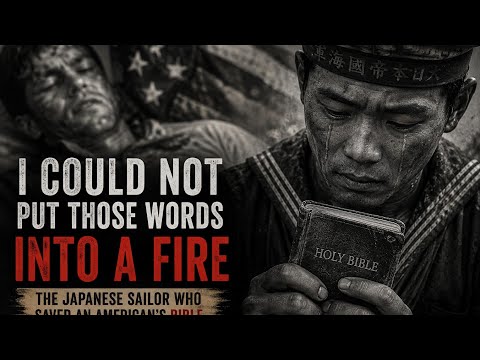
What Kenji Sato did next was against his orders. It took him perhaps four minutes and was almost certainly the only reason any of this story exists. He did not forward the book because it had no intelligence value. He did not destroy it either. He took a square of oiled cloth from the supply cabinet and folded the book into it. Then he put it into a steel document locker on the second deck, closed the door, and went back to his work. He said in his letter, written forty-one years later, that he had a son of his own, age four, and that he could not put the words come home into a fire.
The American aircraft came back at first light on the 18th. The Heian Maru was hit repeatedly and went down in the anchorage off Dublon, settling onto her port side in 110 feet of water, where she has remained ever since. Sato survived. He was on shore that morning and watched his ship die from a beach two miles away. He was repatriated to Japan in 1946, raised his son, and did not speak of the war for four decades.
David Klein was still alive at that point. He was ashore. He was in Japanese hands. Dublon, which the Japanese called Natsushima, was the administrative heart of the base. Prisoners taken at Truk were kept there under the naval garrison, questioned, and then held while somebody higher up decided what to do with them. And then the situation on the island changed catastrophically for everyone on it.
Hailstone did not capture Truk. It gutted it and left it. After February 1944, Truk was simply cut off, blockaded, and bombed at intervals for the remaining eighteen months of the war. No ships came in, almost nothing went out. The garrison, some thirty to forty thousand men, was left to feed itself on an atoll with almost no arable land. By 1945 there was documented starvation among the garrison itself. If you are a prisoner on an island where the guards are starving, you are not going to be the last one fed. That is the honest shape of it.
There is no further Japanese record of David Klein. No repatriation file, no camp roster, no burial detail, no grave. Whether he died of wounds or illness or in one of the later air raids, nobody has ever established. In 1946, the Navy Department changed his status from missing to presumed dead, effective a date chosen by regulation rather than by evidence. His father never accepted it.
Aaron Klein kept the shop open. He went to shul. He was, by his surviving son’s account, not visibly broken and not obviously strange. He talked about David in the present tense sometimes and corrected himself. And he wrote letters. Between 1946 and 1966, he wrote to the Navy Department, the Bureau of Naval Personnel, the American Red Cross, two Illinois congressmen, the Japanese Embassy in Washington, and twice to the International Committee of the Red Cross in Geneva. Benjamin kept the carbon copies in a shoebox. There were, when he counted them in 1998, 141.
The letters are polite. That is the thing that gets you. They are not the letters of a man raging at a bureaucracy. They are the letters of a tailor who believed that if he was courteous enough and patient enough, someone would eventually check a file that had not been checked and find his son’s name on it.
He never said the mourner’s kaddish for David. For anyone unfamiliar with Jewish practice, this is not a small thing. When a Jew dies, the immediate family sits shiva for seven days. The mourner’s kaddish is recited daily for eleven months and then each year on the anniversary. It is a formal, communal way of saying, This person is gone and I am the one left to say so. Aaron Klein would not say it. He would not sit shiva. He would not permit a memorial stone. Because to say kaddish for David was to state in front of God and the congregation that David was dead. And the Navy had never told him that. The Navy had told him missing. He held that line for twenty-four years. He died in November 1968 at seventy-three, in the back room of the shop on Roosevelt Road. He was fitting a jacket. Benjamin found him. They sat shiva for the father. Nobody sat shiva for the son.
Back in Chuuk, Ray Callahan had done the right thing, which is rarer than it should be. The wrecks in Chuuk Lagoon are war graves. Under the law of the Federated States of Micronesia, the wrecks are protected historic sites and removing anything from them is prohibited. Callahan surfaced, went back to Weno, and reported the find to the FSM Historic Preservation Office.
It took eleven weeks and a Japanese conservation specialist flown in from Guam before anyone touched it. An object that has spent five decades saturated in seawater cannot simply be dried, because as the water leaves, the salt crystallizes inside the fibers and tears the material apart from within. So it is desalinated first, soaked in successive baths of progressively fresher water over weeks. Paper is the worst case. Paper wants to become mud. The conservator gave it a poor prognosis.
What came out of that locker was a black, swollen, largely fused brick of paper. Most of it beyond saving. The team was able to separate perhaps a third of the pages. The Hebrew was almost entirely gone. But oiled cloth inside a sealed steel cabinet in cold dark water with almost no oxygen and no light had held off the worst of it. And the front cover, pressed flat against the folded cloth for fifty-five years, had been protected better than anything else in the book. The iron gall ink of the inscription had bitten into the paper the way iron gall ink does. Two of the seven words were unreadable. Five were not. David. Home. Father. 1942. And the mark of the National Jewish Welfare Board stamped into the leatherette in the lower corner.
That mark is what cracked it open. It narrowed the search from every American serviceman in the Pacific to a much smaller group, and combined with a first name and a date, it was enough for the American authorities to begin working the casualty records seriously. The Navy’s casualty office cross-referenced Jewish servicemen named David lost in the Truk operation of February 1944. There was one. Aviation radioman second class David Klein, of Chicago, Illinois. Missing in action 17 February 1944, presumed dead 1946, no remains recovered. No grave. The file was fifty-four years old and it contained near the back 141 letters from a tailor on Roosevelt Road.
It also contained something nobody had connected to it before. In 1985, a Japanese veterans association had forwarded to the American Embassy in Tokyo a short letter from a retired shipping clerk in Shizuoka Prefecture named Kenji Sato, who wrote that he had been a petty officer aboard the Heian Maru, that on 17 February 1944 he had been given the effects of a captured American flyer, and that among them was a religious book which he had not destroyed as ordered, but had hidden in a locker on the second deck, and that he had thought about it every year since. He asked whether the American authorities could tell him the man’s name. He wrote that he was sixty-five years old and would like to know before he died. The letter had been translated, filed, and never answered. There was no way in 1985 to connect an unnamed book in a sunken ship to anything at all. It sat in a folder for fifteen years until a search on the words Truk and Bible and 1944 pulled it up alongside a report from a dive operator in Truk.
Kenji Sato died in 1993, seven years before the book came up. His son was located in Shizuoka and told what his father had done. He said he had never heard the story. He said his father had never talked about the war at all, not once, and that the only thing he had ever said about the Americans was that they had been young.
Finding a living relative of a man declared dead in 1946 is not usually easy, and in this case it took four days, because Benjamin Klein had lived at the same address since 1971 and was listed in the telephone directory. He was called on a Tuesday afternoon in April 2000 by a casualty officer who had rehearsed what she was going to say and got about a third of the way through it. Benjamin later said that he did not cry on the phone and did not understand most of what she told him. And that after he hung up, he sat in the chair by the window for a long time and then went and got the shoebox down from the closet and read his father’s letters until it got dark.
Ray Callahan flew to Chicago himself. Nobody asked him to. The book, having been conserved, had to be transferred to the family, and there were established procedures for that involving diplomatic pouches and formal ceremonies and an officer in dress uniform. Callahan said he would rather just take it. He paid for his own ticket. He was forty-four years old, he had never been to Chicago, and he had spent eleven weeks thinking about a locker on the second deck of a ship he had swum through two hundred times.
He arrived on a gray morning in the third week of April. The conserved fragments were in a shallow archival box with a glass lid. The front cover and inscription visible through it. The salvaged pages interleaved with tissue underneath. It weighed almost nothing. There were seven people in Benjamin Klein’s apartment in Skokie that morning. Benjamin, his two daughters, three of his grandchildren, and a rabbi from the congregation he had belonged to for thirty years, who had been invited because Benjamin had not known what else to do and had wanted somebody there who would know.
Callahan said afterwards that he had prepared something to say and did not say it. He said that the old man opened the door and looked at the box under his arm and that the whole speech went out of his head. He put it in Benjamin’s hands. There is a version of this moment that would be easier to tell, in which the old man weeps and the room weeps with him and something is released. That is not what the people who were there describe. What they describe is that Benjamin Klein took the box and looked at Callahan and asked him a question that nobody had expected. He asked how deep it was. Callahan told him, “110 feet to the sand, about 90 to the locker.” Benjamin nodded and said that he had never learned to swim.
Then he carried the box across the room the way you carry something you have been told is fragile, holding it out slightly in front of him with both hands. And he set it down on the kitchen table between the sugar bowl and a stack of unopened mail, and he sat. Benjamin Klein put on his reading glasses and looked at the inscription through the glass for a long time without saying anything. His daughter said later that what he finally said was that the handwriting was smaller than he remembered, and that his father had always written smaller when something mattered. Then he asked the rabbi to open the case.
What happened next lasted a little over an hour, and nobody in the room interrupted it. Benjamin Klein began to read out loud. Not all of it, because most of it could not be read. He read from the fragments that had survived in English, because his Hebrew had faded over fifty years and he did not trust it. He read the pieces of Psalms that the conservators had recovered. He read the 23rd, which was mostly intact, and the 91st, which was not. And where the page broke off, he stopped and went to the next one. His voice, according to everyone who was there, did not shake.
He read badly at first. He stumbled on words he had known his whole life. One of his granddaughters, who was nineteen and had come mostly because she had been told to, said later that the first few minutes were almost unbearable to sit through. An old man fighting with a page. And that she had wanted to leave the room. And then somewhere around the fifth or sixth minute, he found the rhythm of it, and it stopped being an old man reading and became something else. He read for an hour and four minutes.
Somewhere in the middle of it, he explained, without looking up, why he was doing it. He said that his brother had read this book out loud to men who were not Jewish and did not care before they flew, because they liked hearing a steady voice. He said that as far as he knew, nobody had read out of it since 17 February 1944. He said that it had been under the ocean for fifty-five years with nobody to read it, and that this seemed to him like something that should be corrected.
When he finished, he closed the case and then he asked the rabbi to say Kaddish. He said it with him, standing at the kitchen table in a two-bedroom apartment in Skokie in April of the year 2000, for a twenty-year-old aviation radioman who had died somewhere on Dublon Island in the spring of 1944. The first Kaddish anyone had ever said for David Klein. Fifty-six years late. Said by his brother because his father would not, because his father had spent twenty-four years refusing to close a door that he could not prove was closed.
Benjamin Klein died in 2004 at eighty. The conserved book was donated by his daughters to a museum collection, where it is held in controlled storage and displayed occasionally. There is still no grave. David Klein’s name is carved on a wall among the missing, the way tens of thousands of names are, and that is all there is.
War is remembered for its violence—the numbers, the tonnage, the maps with arrows on them. Hailstone alone put something like fifty ships onto the floor of that lagoon in two days, and you can dive most of them today, and the coral has made them beautiful in a way that feels almost indecent. But sometimes what survives a war is not the wreckage. Sometimes it is a decision that took four minutes.
A thirty-four-year-old Japanese clerk was ordered to burn a dead enemy’s belongings. He could read just enough English to understand two words of it, and those two words were an instruction from a father to a son, and he could not do it. So he wrapped it in oilcloth and put it in a locker and went back to his desk. And his ship sank the next morning, and he never told anyone for forty-one years, and he died seven years before he found out the man’s name. He was not a hero. He did not save David Klein. He could not have. He only made sure that when the ocean finally gave something back, it gave back something legible.
They were enemies. One was ordered to destroy the other’s belongings, and instead preserved the only object in the world that could one day carry a dead man’s name back to his brother. Fifty-six years passed before that mattered to anyone. It mattered anyway. Aaron Klein wrote seven words in fountain pen in 1942 and spent the rest of his life waiting for them to be obeyed. In the end, they were not. His son did not come home, but the words did. And they came home carried by the hands of the people who were supposed to burn them, and that is not nothing. That may be the most that war ever gives anybody.
If you had been Kenji Sato at that desk on the 17th of February, holding a book you were ordered to burn, and you could read just enough of it to understand what it said — what do you think you would have done?
Report this article
Select a reason for reporting:






