The sky over Korea was a deadly chessboard, and the arrival of the Soviet MiG-15 had just flipped the board. American pilots, once confident in their F-80 Shooting Stars, suddenly found themselves outmatched. The MiG’s swept wings and heavy cannons tore through formations, leaving a trail of smoke and fear. In the chaos of November 1950, the MiG-15 announced a new era of air combat—one where speed and agility were king. But far to the south, another nation watched with growing unease. Australia, a loyal ally, had been begging for the F-86 Sabre, the only American jet that could challenge the MiG. Their request was repeatedly denied, pushed aside as the U.S. rushed its own squadrons to the front lines.
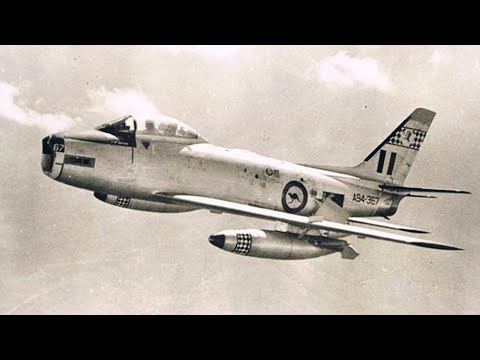
Yet, necessity breeds innovation. In a twist of fate, Australia was granted permission to build its own Sabre—a variant that would become the deadliest jet fighter the Royal Australian Air Force had ever seen. This is the story of the CAC Sabre, a machine born from desperation, refined through ingenuity, and destined to carve its own legend.
The Korean War was a brutal awakening. American F-86 Sabres, rushed into combat, initially struggled against the MiG-15. The early Sabres lacked speed, ceiling, and turn rate compared to their Soviet counterparts. But the Sabre had one crucial advantage: the APG-30 gunsight, a cutting-edge targeting system that gave American pilots a lethal edge. With hydraulic controls and better high-speed handling, the Sabre could outmaneuver the MiG in a dogfight. Still, the margin was thin. The MiG’s heavy 23mm and 37mm cannons could tear a Sabre apart with a single hit, while the Sabre’s six .50-caliber machine guns often required multiple bursts to bring down an enemy.
As the war dragged on, the F-86F variant arrived, finally matching the MiG’s performance. By the end of the conflict, the Sabre had achieved a kill ratio that, while debated, cemented its place in aviation history. But even as the Sabre proved itself in Korea, Australia’s dream of owning the jet remained unfulfilled. The U.S. prioritized its own forces, leaving the RAAF to wait.
Finally, in 1951, the Australian government secured a deal: Commonwealth Aircraft Corporation would produce a custom Sabre, the CA-27. This was no mere copy—it was a radical redesign. Sixty percent of the airframe was reengineered, the air intake widened by 25%, and the armament upgraded to two 30mm Aden cannons. But the most significant change was the engine: the Rolls-Royce Avon RA.7, which delivered 50% more thrust than the standard J47. This gave the Australian Sabre a thrust-to-weight ratio that made it a rocketship compared to its American cousin.
The first CAC Sabres entered service in 1958, and soon saw action in the Malayan Emergency, supporting British forces against communist insurgents. Armed with powerful cannons and blistering acceleration, the Sabre proved devastating in ground-attack roles. By 1962, tensions in Southeast Asia escalated, and eight Sabres were deployed to Ubon Air Base in Thailand. There, they stood guard, ready to defend against any threat from neighboring countries.
As the Vietnam War expanded, Ubon became a hub of American air power. The Sabres of No. 79 Squadron flew alongside U.S. aircraft, their presence a reassuring sight for the Thai and American crews. But the Australians had strict rules of engagement: they could not pursue enemies beyond Thai airspace. This limitation, combined with the Sabre’s growing obsolescence, signaled the beginning of the end.
In 1968, No. 79 Squadron was disbanded, and the Sabres were gradually retired. Yet, their story was far from over. The remaining aircraft were transferred to Malaysia and Indonesia, where they continued to serve into the 1980s. Over its career, the Sabre achieved more than 500 kills, with some estimates exceeding 700. From the skies of Korea to the jungles of Malaya, the Sabre’s legacy was written in fire and steel. But for Australia, the Sabre was more than a fighter—it was a symbol of national pride, a testament to what a small nation could achieve with determination and ingenuity.
But the story of the Sabre did not end with its retirement from Australian service. Its influence rippled across the globe, shaping the air forces of nations that could never have afforded cutting-edge American jets. In Malaysia, the Sabres of No. 11 Squadron became the backbone of the newly formed Royal Malaysian Air Force, patrolling the Strait of Malacca and deterring regional threats. In Indonesia, No. 14 Squadron operated their Sabres with distinction, using them during the Konfrontasi conflict and later as advanced trainers. For these nations, the Sabre was not just a weapon—it was a statement of sovereignty.
Meanwhile, in the United States, the Sabre’s legacy was being written into the history books. The F-86 had spawned a dizzying array of variants: the F-86D Dog Sabre with its rocket armament and radar nose, the F-86H fighter-bomber with a larger engine, and even the FJ-2 Fury for the Navy. Each variant pushed the design further, proving the Sabre’s airframe was as versatile as it was elegant. But no version was more beloved by pilots than the F-86F, the definitive day fighter that dueled MiGs over the Yalu River.
Yet, the Sabre’s greatest contribution may have been its role as a bridge between generations of aviation. It was the last American fighter to rely primarily on guns, and the first to truly master the swept wing. The lessons learned from its design—the importance of hydraulic controls, the need for a bubble canopy, the value of a reliable ejection seat—were incorporated into every fighter that followed. When the F-100 Super Sabre took to the skies in 1953, it was a direct descendant of the F-86, inheriting its wing sweep and its fighting spirit.
In the decades that followed, the Sabre became a fixture at air shows and museums. Veterans of the Korean War would gather around static displays, their eyes misting as they recalled the roar of the J47 engine and the smell of cordite in the cockpit. For them, the Sabre was not a relic—it was a comrade. And for the pilots of today, it remains a reminder of an era when air combat was decided by skill, guts, and the machine you flew.
But even as the Sabre faded from active duty, its story took one final, unexpected turn. In the 1980s, a small number of Sabres were refurbished and sold to civilian operators, where they became prized warbirds. These aircraft, stripped of their military gear and painted in bright civilian colors, still flew with the same grace that had once dominated the skies over Korea. And in Bolivia, the last operational Sabres soldiered on until 1994, a testament to the design’s incredible durability.
Today, the Sabre is remembered as more than just a fighter. It was the first true jet fighter of the West, the aircraft that proved swept wings were the future, and the machine that saved Australia’s air force from obsolescence. Its legacy lives on in the museums and airfields where it still flies, and in the hearts of those who flew it. For the Sabre, like the pilots who flew it, was never just about speed or firepower—it was about the courage to face the unknown.
But to truly grasp the Sabre’s impact, one must look beyond the kill ratios and the airframe statistics. The F-86 was not just a machine—it was a philosophy made tangible. Its designers understood that in the jet age, a fighter had to be more than fast; it had to be predictable, forgiving, and lethal all at once. The Sabre delivered on all three counts.
Consider the cockpit. The F-86 was one of the first fighters designed with the pilot’s comfort in mind. The bubble canopy offered near-panoramic visibility, a stark contrast to the cramped, tunnel-like cockpits of earlier jets. Hydraulic controls meant the stick moved with a smoothness that reduced fatigue during long patrols. Even the ejection seat—a novelty in the late 1940s—was a lifesaver that gave pilots confidence to push their aircraft to the limit.
These details mattered in combat. A pilot who could see the enemy first had a decisive advantage. A pilot who could maneuver without fighting the controls could out-turn a MiG. And a pilot who knew he could escape a crippled aircraft was more willing to take risks. The Sabre’s designers had built a fighter that made its pilot better.
Yet, the Sabre’s story is not complete without acknowledging its adversaries. The MiG-15 was a formidable opponent, and the men who flew it were no amateurs. Soviet pilots, many of them veterans of the Great Patriotic War, brought a level of skill and aggression that tested the Sabre’s mettle. The air battles over the Yalu River were not one-sided affairs; they were brutal, exhausting duels that often ended in stalemate or mutual retreat.
It was in these duels that the Sabre’s true character emerged. American pilots learned to exploit the MiG’s weaknesses—its unstable high-speed handling, its slower roll rate, its limited visibility from the cockpit. They developed tactics: the Thach Weave, the scissors, the high-speed yo-yo. Each maneuver was a calculated gamble, a dance of death performed at 600 miles per hour.
The Sabre’s gunsight, the APG-30, was a crucial equalizer. This early radar-ranging device computed the correct lead angle for a shot, turning a difficult deflection shot into a manageable one. Pilots who mastered the gunsight could score kills that would have been impossible with iron sights. It was a taste of the future—a future where technology and skill merged into a single, lethal package.
But technology alone does not win wars. The Sabre’s success was ultimately a triumph of training and doctrine. The U.S. Air Force invested heavily in its pilots, rotating them through combat tours that honed their skills and spread their knowledge. By the end of the Korean War, the average Sabre pilot was better trained and more experienced than his opponent.
This was not an accident. It was a deliberate strategy, born from the hard lessons of World War II. The Americans had learned that air superiority was not won by machines alone—it was won by the men who flew them. The Sabre was the right aircraft at the right time, but it was the pilots who made it legendary.
That legacy endures because the Sabre was never just a weapon—it was a promise. To the pilots who flew it, it was the machine that made them believe they could win. To the nations that bought it, it was proof that a small air force could still stand tall. And to the historians who study it, it remains the hinge on which the jet age turned.
Today, when a restored Sabre roars down a runway at an airshow, the crowd falls silent. For a few seconds, the sound of the J47 or the Avon carries them back to a time when the sky was a battlefield and the stakes were everything.
But the Sabre’s final lesson is quieter. It teaches us that innovation is not always about building something new—sometimes it is about reimagining what already exists. Australia took an American design, reshaped it, and created a fighter that outclassed its origin. That is the true story of the Sabre: not just a jet, but an idea that refused to be limited by borders.
So the next time you see a Sabre in a museum, look closely at its swept wings and its bubble canopy. Ask yourself: what else could we build if we dared to improve what we already have?
What is your favorite variant of the F-86 Sabre, and why?
Report this article
Select a reason for reporting:






