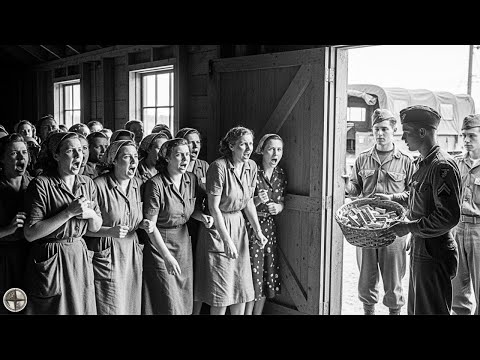
The knock on the barrack door was sharp, sudden, and final. Twenty German women froze. They had been told this moment would come—the Americans, the monsters, the cruelty. But when the door creaked open, it wasn’t rifles that entered. It was baskets. Young guards, barely men themselves, stepped inside carrying chocolate bars, apples, and cookies. For a heartbeat, no one breathed. Then a woman screamed. And then she cried.
This was Camp Ruston, Louisiana, August 1944. The air was thick with heat and fear, but what these women were about to discover would dismantle everything they thought they knew about their enemies—and themselves.
Spring 1943. The deserts of North Africa burned with defeat. The proud Africa Corps, once on the brink of Egypt, was collapsing under Allied fire. Among the captured were hundreds of young German women—nurses, radio clerks, secretaries—many barely in their twenties. They had been raised on stories of American savagery. “We were told they shot prisoners for fun,” one nurse later wrote. “So we hid our faces when they passed.”
Instead of beatings, they received water. White bread. Oranges stamped with U.S. Army. The contrast was impossible to process. How could the enemy said to be corrupt have so much—and share it so freely?
As they boarded Liberty ships bound for America, the women stared at the giant flags painted on the hulls. The sea air smelled of salt and diesel. Behind them, Africa burned. Ahead waited the land they had been taught to hate. “We did not know if we were going to a factory or a prison,” one recalled. “All we knew was that it smelled like soap, not blood.”
Below deck, they found bunk beds instead of chains. Meals instead of beatings—2,800 calories a day, the standard for U.S. soldiers. Meat, potatoes, butter, even coffee. For women who had survived on thin soup and dark bread, the first bite of soft white bread was a miracle. “It tasted like clouds,” Helga wrote. “I did not know bread could be sweet.”
Seasickness hit hard, but the guards brought pills and blankets. A young guard named Miller noted, “They stare at us as if waiting for a blow. When we hand them fruit, they flinch.” Day by day, the fear began to crack.
When the ship reached Norfolk, Virginia, the women crowded the rails in silence. Cranes lifted mountains of cargo. Trains and trucks moved in perfect rhythm. The air smelled of oil and roasting coffee. “If this is poverty,” a nurse whispered, “then we have never seen wealth.”
They were fingerprinted, examined, and handed clean uniforms. A tall medic said softly, “You’re safe now.” Lau wrote later, “I did not understand the words, but I understood the tone. It was the first kind voice I had heard in months.”
Trucks carried them to trains—not cattle cars, but Pullman coaches with cushioned seats and open windows. As they rolled south, they saw fields of corn, children waving from porches, people laughing in cafes. No ruins. No hunger. “We had been told the Americans were animals,” one woman wrote. “But the animals were feeding us.”
When the train slowed at Camp Ruston, barbed wire gleamed in the sun. But inside the fences, lawns were green and trimmed. Flower beds lined the walkways. It looked more like a village than a prison.
Each woman received a bed with clean sheets, soap, hot showers—luxuries they hadn’t seen since the war began. A guard joked, “You have better plumbing than we do.” They did not laugh, but they noticed he was smiling, not sneering.
Breakfast was oatmeal, eggs, sometimes bacon. “It was the first time I could eat until I was full,” one nurse wrote. “I felt guilty for it.” They worked in laundry, kitchens, sewing rooms, earning a few cents a day for the canteen. Some learned English from the guards, practicing under dim lights. Fear took time to fade—every knock made them freeze—but the walls of propaganda were beginning to crumble.
Then came that warm August evening. The sun was setting behind the pines, turning the camp gold. Inside the barrack, the women sat sewing and writing letters. The knock made them freeze. “When the Americans come, hide,” they had been warned. “They will hurt you.”
The door opened. Two young guards stepped in—not with rifles, but with baskets. One smiled shyly. “Merry Christmas,” he said, early. None understood the words, but they saw the gifts: apples, chocolate bars, sugar cookies.
For a moment, no one spoke. Then one woman burst into tears. She reached out, took a piece of chocolate, and whispered, “I can’t believe this.”
That night, the camp filled with laughter and crying. They shared the treats like children. The smell of cocoa and apples hung in the air. One diary read: “We screamed when they knocked. Then we cried when we tasted chocolate. Everything we had been told about them fell apart in one bite.”
Kindness had broken fear more effectively than any speech. But outside the wire, the war still raged—and the women knew that somewhere far away, their brothers were fighting and dying. The thought filled them with guilt. Yet something had changed forever inside them. They had seen that mercy could exist, even between enemies.
As one wrote, “This was not propaganda. It was real, and that reality changed us more than any battle ever could.”
The winter of 1944 settled over Camp Ruston like a soft blanket. Frost glittered on the barbed wire, and the barracks windows fogged with warmth from the stoves inside. The women had never known a Christmas like this—not in Germany, where rationing had turned the holiday into a shadow of itself. Here, there was a small tree decorated with paper stars and colored ribbons. Someone played a harmonica, and voices rose in Silent Night, first in German, then in English. “For a few hours,” one woman wrote, “there were no sides in the war, only humans sharing warmth in a cold world.”
But the war outside did not pause for carols. News from Europe grew darker. Cities burned. Letters from home stopped arriving. The women felt torn—safe in body, heartsick in soul. “We thought we were the chosen,” one diary confessed. “But we were blind. The world we built was made of fear. The world they built was made of light bulbs, engines, and laughter.”
By early 1945, the camp had become a place of quiet discovery. The women worked on nearby farms and in camp workshops, and what they saw amazed them. Tractors that ran smoothly. Electric sewing machines. X-ray machines in the hospital that hummed with power. “They used a machine to see my broken ribs,” Greta wrote. “I thought it was science fiction. Then I realized this is normal for them.”
Penicillin saved lives in hours—something the wounded in Germany rarely saw. In the kitchens, black American cooks worked side by side with white guards, joking and sharing cigarettes. One prisoner whispered, “But the Nazis said America was broken by race.” She watched again and shook her head. Maybe not.
Each new day showed a different kind of power—not the power to destroy, but to build. “If America could make so much and still treat its prisoners humanely,” one woman asked, “what did that say about everything we had believed?”
The answer came slowly, like a thaw. In the hospital, a young American nurse named Anna helped a German prisoner deliver a baby on a cold morning. The mother, weak and trembling, whispered in broken English, “Why help me?” Anna smiled softly. “Because that’s what we do.”
Moments like these melted hatred built over years. The women began to realize the war had stolen more than land or lives—it had stolen their truth. At night, they stared at the stars and prayed. One said, “I used to think only Germans looked up at the sky with hope. Now I know everyone does.”
When newspapers arrived with pictures from Auschwitz and other camps, the truth hit like a storm. They wept, ashamed of what their country had done. Greta, who once called herself a proud Nazi, wrote in her journal: “I believed we were the good ones. I see now we were only blind. The Americans did not destroy us. They showed us what it means to be human.”
By the time victory was announced in May 1945, the camp was silent. No cheers, no songs—just quiet tears. Some women asked to stay longer, afraid to go home. They had entered as enemies, but were leaving as students of kindness, of truth, of humility.
But the hardest moment was still to come—saying goodbye to the land and the people who had changed their hearts forever.
The day of departure arrived with a pale Southern sun. The women packed their few belongings—drawings, letters, bits of chocolate wrappers saved like relics. Some hugged the nurses and guards goodbye. A few cried openly. One American officer said softly, “You came as prisoners. You leave as people will remember.”
On the train to the coast, they watched America pass by—clean towns, busy farms, children playing. “So this is what peace looks like,” one woman whispered. Then the ships carried them back across the Atlantic, and the view changed. Germany was gray and broken. Bridges fallen. Cities empty. Smoke still rose from piles of ruins.
Some found their homes gone, their families scattered. Others returned to neighbors who looked at them with suspicion. When they tried to speak of what they had seen—the food, the fairness, the kindness—people refused to believe. “The enemy treated you well?” they scoffed. “Impossible.” Yet the women knew it was true. They had lived it.
Years later, they wrote letters and memoirs. Many kept one piece of chocolate paper or a photo from camp. “We lost the war,” one former prisoner wrote, “but we found something bigger. Our humanity.” They told their children, “Never hate a nation you don’t know.”
They had come as proud followers of a cruel regime. They returned as humble believers in compassion. They had come as conquerors. They left as students. In the end, America’s greatest weapon was not its bombs or tanks. It was its kindness, its order, its chocolate.
So now I ask you: if a single bar of chocolate could shatter years of hatred, what small act of kindness might you offer today to someone you’ve been taught to fear?
Report this article
Select a reason for reporting:






