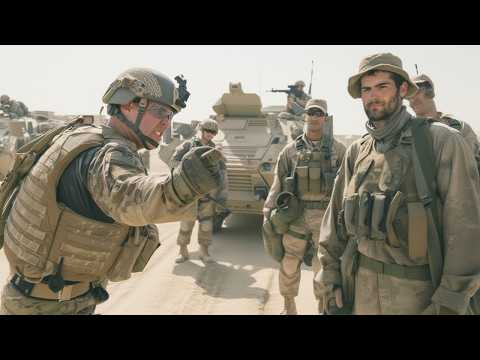
Staff Sergeant Colton stared at the classified after-action report, certain there had been a transcription error. Four operators. Two unarmored vehicles. Nine days. Fourteen confirmed high-value targets. The American task force assigned to the same sector had deployed 47 personnel, eight armored vehicles, and continuous drone coverage for three months. Their confirmed target count: three.
He read the equipment manifest twice. No error. The Australian patrol had operated with what Colton’s training called a death sentence—no armor, no quick reaction force, no overhead surveillance. Their entire supply chain fit into two long-range patrol vehicles. The cost: 47,000 Australian dollars. The American parallel operation: 6.3 million. Colton had spent 11 years in special operations, working with British SAS, Polish GROM, and Israeli Sayeret Matkal. The Australians did not fit on his spectrum.
Three weeks earlier, he had watched them arrive at the forward operating base in Uruzgan province. Four men climbed out of modified Land Rover 110s stripped of every non-essential component—no doors, no roof armor, no ballistic glass. Their vehicles sat low on oversized desert tires, painted in tan that seemed designed to disappear against the rock and dust. Colton’s first thought: they had arrived in training vehicles by mistake. His second: someone in Australian command had made a catastrophic logistics error.
But the men who climbed out moved with a certainty that contradicted both assumptions. They carried no visible body armor. Their chest rigs were minimal—ammunition, water, communication equipment, almost nothing else. One wore a modified civilian hiking pack. Another had a scarf wrapped around his face that looked like something from a Kandahar market stall. They unloaded their gear with the efficiency of men who had done this exact sequence thousands of times. Not one glanced toward the American armored vehicles parked nearby.
The American doctrine Colton had internalized rested on a simple foundation: protection enables mission success. Armor stops bullets. Armored vehicles survive IED strikes. Overhead surveillance prevents ambush. Quick reaction forces extract compromised teams. Every layer of protection increased survivability, and survivability meant operators could focus on the mission rather than staying alive. The mathematics seemed unassailable.
The Australians had apparently never received this briefing. Colton requested a meeting with the patrol commander within hours of their arrival. The conversation lasted 47 minutes and left him more confused than before. The Australian—a sergeant whose name never appeared in any document Colton would later file—explained their approach with the patience of a man who had answered these questions many times. His words were technical, specific, and completely contrary to everything Colton believed about modern special operations.
The Australian said that armor created a problem, not a solution. Colton asked him to explain. What followed would reshape Colton’s understanding of desert warfare. The Australian began with physics. An armored vehicle in the Afghan desert creates three signatures that cannot be concealed. First, visual: the silhouette of a Humvee or MRAP against the Afghan skyline is visible at distances exceeding 8 km on a clear day. Even with desert camouflage, the geometric shape registers as artificial to any observer. The human eye evolved to detect straight lines and right angles because they signal human construction. An armored vehicle is nothing but straight lines and right angles.
Second, acoustic: the engine produces a sound signature detectable at 4 to 6 km depending on terrain and wind. In the silence of the Afghan desert at night, that range extends considerably further. Third, thermal: an armored engine running hot enough to move a 7-ton vehicle across rough terrain produces a heat signature that any shepherd with knowledge of the land can identify. The vehicle becomes a beacon announcing its presence to anyone watching.
The Australian patrol’s vehicles produced none of these signatures at operationally significant ranges. Their modified Land Rover sat low enough to disappear into the visual clutter of rock formations beyond 2 km. The engines ran quieter than a standard civilian pickup. The thermal signature dissipated within minutes of stopping. But the more important factor was not detection—it was perception.
The Afghan desert had seen 40 years of continuous warfare by the time the Australians arrived. Every adult male in Uruzgan province had grown up learning to identify military vehicles. They knew the sound of Soviet BTRs, the silhouette of American Humvees, the dust cloud of an approaching convoy. Their survival depended on this knowledge. A vehicle that looked military attracted attention. Attention attracted surveillance. Surveillance attracted ambush or worse.
The Australians understood that their greatest asset was not firepower, but invisibility. An invisible patrol cannot be avoided. An invisible patrol cannot trigger the network of informants that protected every high-value target in the region. An invisible patrol arrives before the target knows to flee.
Colton listened and felt the ground shift beneath his assumptions. He had spent his career believing that more protection meant better outcomes. The Australian was telling him that protection was the enemy of the outcome he sought. But the physics of detection was only the first layer. The real shock came when the Australian explained what they did instead of carrying armor.
The weight savings from eliminating armor was not used for additional firepower or luxury items. It was converted entirely into range, duration, and adaptability. An American special operations team deploying into the Afghan desert typically planned for missions lasting 24 to 72 hours. Beyond that window, resupply became mandatory. The logistics tail required to extend an armored operation created its own detection signature—helicopters, convoys, predetermined landing zones that the enemy could monitor and mine.
The Australians planned operations lasting 7 to 14 days without resupply. Their vehicles carried fuel, water, and food for extended autonomous operations. Their medical supplies assumed casualties would be managed for extended periods before evacuation. Their communication equipment operated on frequencies that did not require continuous satellite uplink. The difference in operational planning was not incremental. It was categorical.
American teams operated within a support bubble that guaranteed certain capabilities at certain response times. Australian patrols operated outside that bubble entirely. They traded the security of knowing that help was 45 minutes away for the advantage of reaching locations that help had never seen.
Colton pulled the geographic data for American operations in Uruzgan province over the preceding 18 months. The pattern was immediately visible. American teams had operated within a consistent radius from fixed positions—forward operating bases, fire support bases, helicopter refueling points. The radius varied from 40 to 70 km depending on the specific operation. Beyond that radius, the logistics of recovery became prohibitive. Within that radius, the enemy had learned every American pattern. They knew where the helicopters landed. They knew where the vehicles patrolled. They knew the timing of resupply convoys. They had adapted their operations to exist in the spaces between American reach.
The Australians did not operate within the radius. They operated beyond it. Their patrol routes showed penetrations of 120 to 180 km from the nearest coalition position. They established observation posts in areas that American planners had marked as inaccessible. They remained stationary for 48 to 72 hours at a time, watching locations that had never been watched before. The targets they identified had considered themselves safe. The targets they identified had stopped taking precautions.
And this was the answer to the statistical anomaly that had brought Colton to the classified server. 14 confirmed targets in 9 days versus three in 3 months. The Americans had been hunting in waters where every fish knew the sound of their boats. The Australians had found waters where no boats had ever been.
But reaching those waters required accepting a risk that American doctrine explicitly prohibited. If something went wrong—vehicle breakdown, medical emergency, enemy contact—the Australians had no cavalry coming over the hill. Their extraction plan was themselves. Their backup was the equipment they carried. Their margin for error was the sum total of their training and judgment.
Colton asked the Australian sergeant directly, “What happens if you take casualties in a position 150 km from the nearest friendly force?”
The answer was delivered without hesitation, as if the question was expected. The sergeant said they had trained for that. They had planned for that. Every patrol member could operate every piece of equipment. Every patrol member could drive every vehicle. Every patrol member could provide combat medical care sufficient to stabilize casualties for extended periods. They did not plan for rescue. They planned for self-extraction under worst-case conditions.
The confidence in that statement was not bravado. It was the product of a selection process that Colton would only begin to understand in the weeks that followed. The Australians had not simply chosen to eliminate armor from their operations. They had built an entire system—selection, training, equipment, doctrine—around the principle that the operator was the primary survival mechanism, not the equipment surrounding him.
And Colton had not yet seen them operate.
The first patrol departed at 0317 on a Tuesday. Colton watched the two vehicles clear the wire and vanish into a wadi within 4 km. For nine days, the Americans received only position updates every 12 hours—short encrypted bursts, nothing more.
On day three, a single additional transmission arrived. The patrol had photographed a meeting between two high-value targets long believed relocated to Pakistan. They were 67 km northwest of the nearest American position. The Australians had watched the compound for 31 hours.
The room went quiet when confirmation came back. More actionable intelligence in 31 hours than three months of remote surveillance had produced. Colton stared at the imagery and understood: the Australians had found waters where no boats had ever been.
But the cost of that invisibility was written in the eyes of men who had trained themselves to feel nothing. Colton would carry that question for the rest of his career—did they lose their humanity to preserve ours?
So tell me: would you trade your armor for their ghosts?
Report this article
Select a reason for reporting:






