The jungle was a living, breathing predator—and the Americans were marching straight into its jaws with a dinner bell strapped to their heads.
In 1967, deep in the suffocating humidity of the Fuktui jungle, a company of American infantry from the 9th Division pushed through walls of emerald bamboo. Their M1 steel pots clattered against low-hanging branches with every step, a sharp metallic clack that echoed for hundreds of yards. They were noisy giants stumbling through a glass house, and less than fifty meters away, four Australian SAS operators watched in disbelief.
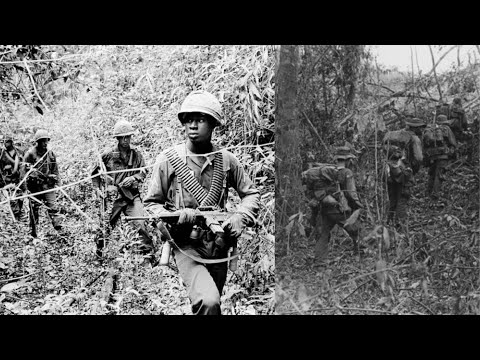
Sergeant McNeel signaled his men to freeze. Through the dense wait-a-minute vines, he studied the American lead scout—eyes fixed forward, ears completely encased in steel. The scout was deaf to the forest. He couldn’t hear the subtle shift in the cicadas’ rhythm that screamed human presence. He couldn’t hear the faint click of a Viet Cong safety catch being disengaged in a distant bunker line.
“They’re trusting their armor to do the work their senses should be doing,” McNeel thought.
The Australians looked nothing like the Americans. No steel domes. Just soft olive-drab gigi hats, canvas bush hats with short brims, or simple sweatbands torn from green fabric. They had stripped away the weight of armor for something far more precious in the deep bush: the ability to hear. To the SAS, the jungle wasn’t a place to be fought with steel and Kevlar—it was a sensory medium. They would rather hear the enemy coming than have a piece of metal protect them once the enemy had already found them.
For the American military establishment, the M1 helmet was more than gear. It was a psychological anchor—a symbol of industrial might and the lifepreserving commitment of the United States to its sons. On fire bases and city streets, it deflected shrapnel and provided a layer of security during artillery barrages. But in the claustrophobic depths of the Fuktui, this defensive mindset created a dangerous paradox. The American infantryman was trained to survive the hit. The Australian SAS was trained to avoid the hit entirely.
The primary flaw of the M1 in the bush was its devastating effect on situational awareness. The heavy steel shell functioned like an acoustic chamber. When a soldier wore it, the sounds of his own movement—the scrape of a pack strap, the crunch of a dry leaf, even the rhythm of his own heartbeat—were magnified and echoed back into his ears. Simultaneously, the wide flared rim acted as a barrier to external sounds, blocking the subtle directional cues needed to pinpoint a threat. In the jungle, where visibility was often limited to five or ten feet, sound was the only early warning system. By wearing the M1, the Americans were effectively hunting in the dark with earplugs.
“If you can’t hear the breeze change, you can’t hear the ambush,” McNeel whispered during a brief halt as they tracked the American company’s flank.
The weight—nearly three pounds when wet and caked in mud—also dictated posture. After hours of trekking through thick undergrowth, the neck muscles of the GIs inevitably fatigued. Their heads would droop, their gaze falling to the boots of the man in front. The M1 didn’t just heavy the head; it narrowed the world. It forced the wearer into a downward-looking, insular state of mind. They focused on the struggle of the march rather than the predatory scan of the environment. The Australian SASR viewed this as tactical suicide.
Their predatory mindset dictated that every sense must be tuned to the maximum frequency. By opting for the soft gigi hat or a simple headband, the SAS operators maintained a full 360-degree field of hearing. They could detect the snick of a safety catch or the unnatural silence of birds long before an enemy appeared in their sightlines. Their necks remained limber, their heads moving in a constant fluid sweep of canopy and shadow. For the SAS, protection was found in information, not in metal. They believed the best armor was the three seconds of warning provided by a sharp ear—enough time to drop into a firing position or melt into the ferns.
The Americans were prepared for the moment they were shot at. The Australians were prepared to ensure that moment never happened.
This fundamental difference in philosophy was about to be put to the test as the trail ahead narrowed into a classic Viet Cong kill zone. The SAS patrol moved deeper into the zone—and the jungle held its breath.
The transition from the American infantry’s path to Australian territory was marked by a sudden, absolute shift in volume. Sergeant McNeel’s team didn’t just walk—they flowed. Each man was a study in sensory immersion. Without the flared brim of a steel helmet to obstruct peripheral vision or heavy chin straps to chafe skin, they became extensions of the foliage itself.
The gigi hat was the SAS operator’s most trusted tool. Unlike the M1, which sat high and rigid, creating a distinct, unnatural dome shape the human eye was evolved to detect, the soft hat broke up the silhouette of the head. Its floppy brim dipped and sagged, blending into the jagged patterns of ferns and shadows. In a world of filtered light and chaotic textures, the SAS headgear was a masterpiece of passive camouflage.
Ears open, eyes moving, McNeel signaled with a subtle rotation of his wrist. The tactical advantage became undeniable when the patrol reached a choke point—a narrow corridor of ancient mahogany trees where the air felt unnaturally still. In an M1 helmet, a soldier’s hearing would be dominated by the tunnel effect, the internal echo of his own heavy breathing. But McNeel, wearing only a torn green sweatband, tilted his head. He didn’t just hear the jungle—he felt its vibration.
A hundred yards to their left, the cicadas had stopped their rhythmic buzzing.
To a helmeted soldier, this tiny acoustic shift would have been lost in the metallic resonance of his gear. To McNeel, it was a siren. He froze, his head moving in a slow, limber arc that was only possible without three pounds of steel on his skull. Because he wasn’t fighting the weight of a helmet, his neck muscles were relaxed, allowing his eyes to scan the upper canopy and the base of the trees with fluid precision. He spotted it—the faint geometric line of a bamboo tripod hidden behind a curtain of moss. A Viet Cong listening post.
The SAS team sank into the undergrowth like water into sand. Because they weren’t wearing helmets, they didn’t have to worry about the clunk of steel hitting a tree trunk as they took cover. They could press their heads flat against the earth, ears in direct contact with the ground to listen for the footfalls of an approaching enemy. This ground-mapping was a technique the Australians had perfected—a feat physically impossible while wearing the flared M1.
The Australians operated on the grim but logical math of the jungle. A helmet might save you from shrapnel once the ambush starts, but a soft hat and a sharp ear will let you see the ambush before the first shot is even fired. By shedding the steel, they had traded a false sense of security for the ultimate tactical edge: the ability to hear the forest breathe.
The tactical reality of the no-helmet policy was most starkly revealed an hour later. The American company, despite their bravery and superior firepower, had moved through this very sector minutes earlier, oblivious to the threat lurking in the sub-canopy. Their M1 helmets had acted like white-noise generators—the friction of the inner liners against their temples, the muffled resonance of the steel creating a sensory dead zone. They had marched right past a Viet Cong Regional Force squad, neither side realizing how close they had come to a bloody collision.
The SAS patrol, however, was tuned to a different frequency. McNeel halted the team. He didn’t need to see the enemy. He could hear the texture of the forest changing. Without the acoustic interference of a steel pot, the SAS operators could perform a technique they called sound-ranging. By slightly tilting their heads, they used their unobstructed ears to triangulate noises that were invisible to the Americans.
Movement, two o’clock, McNeel signaled, his hand barely moving.
He had caught a sound impossible to hear through a helmet: the faint rhythmic swish of an NVA rubber-tire sandal dragging across wet grass, and the dull wooden thump of an AK-47 stock bumping against a hip. These were soft, low-frequency sounds that the M1’s flared rim would have deflected or masked. To the Australians, they were as loud as a shout.
The VC squad was moving parallel to the American trail, preparing to close the gate and ambush the US rear guard. They were confident, believing the loud giants were the only ones in the area. They hadn’t counted on the four men who had shed their armor to become part of the wind.
Because they weren’t encumbered by the weight of the steel pot, the SAS team executed a hasty ambush with terrifying efficiency. In an M1 helmet, dropping prone often resulted in the helmet sliding forward over the eyes, momentarily blinding the soldier at the most critical second of a fight. The SAS in their soft hats hit the deck with their eyes already locked on their sights. Their heads remained steady, peripheral vision wide and clear.
McNeel watched as a VC scout emerged from a thicket of ferns. The enemy soldier was relaxed, his ears also uncovered, listening for the loud clatter of the Americans in the distance. He never heard the SAS. He never saw the four barrels leveled at him from the shadows.
The Australians remained perfectly still. They didn’t fire. Their mission was reconnaissance, not a firefight, and their ability to hear gave them the luxury of choice. They heard the rest of the VC squad pass by, counting their numbers, identifying their heavy weapons, and noting their direction—all while remaining less than fifteen meters from the enemy line.
As the VC moved off, McNeel realized the grim truth. A helmeted American unit in this position would have likely been spotted or forced into a panicked engagement, because they wouldn’t have known the enemy was there until they were on top of them. By taking their helmets off, the SAS had gained the ultimate hunter’s advantage. They knew the enemy’s position, strength, and intent—while the enemy still believed the forest was empty.
The steel pot was a promise of protection for the body. The soft hat was a guarantee of dominance for the mind.
As the sun climbed, the heat turned the jungle into a pressurized steam room. The American infantry, miles ahead, began to pay the weight tax. After six hours of climbing roots and ravines in triple-digit heat, the three-pound steel pot felt like a lead anvil. Necks cramped. Chins dropped. Their world shrank to a circle of dirt around their boots.
“Look at their trail,” Corporal Miller signaled, pointing at deep, heavy heel strikes in the mud. “They’re plodding. Blown out.”
The SAS moved with fluid, upright agility. Their soft gigi hats weighed mere ounces, even soaked with sweat. Necks limber, heads swiveling like periscopes, they kept their eyes at horizon level—the critical zone where ambushers hide. “The more you carry, the less you see,” McNeel often told his recruits.
The crossover came at a rally point near a free-fire zone. A team of American LRRPs—lean, haunted, elite—prepared to hand over the sector. Even they still cinched their M1s tight.
“You guys really go out there without the pots?” a young LRP sergeant asked.
McNeel smiled. “Your command worries about the bullet that hits you. We worry about the bullet that’s never fired.” He gestured at the tree line. “How many times did that rim snag a vine today? How many times did it slide over your eyes when you looked for a trip wire?”
The American rubbed raw red chafe marks along his jaw. Miller added quietly, “We hear you coming from a mile off, mate. Not to boast—but those pots turn every branch into a bell. If you’re looking down, you’re already dead. You just haven’t fallen over yet.”
The LRP leader looked at his exhausted men, then at the Australians—fresh, alert, eyes scanning. “Why don’t you wear them?” he asked one last time.
“Because we aren’t going into a fight,” McNeel replied, eyes on the horizon. “We’re going into our house. Nobody wears a steel pot in their own lounge room.”
The SAS vanished into the foliage—no stomp, no clatter. They simply ceased to be. For the Americans, the lesson was clear: in the deep jungle, the greatest armor wasn’t made of steel. It was the silence you kept and the sounds you were allowed to hear.
So tell us—if you were that young LRP sergeant, would you have ditched the helmet and trusted your ears?
Report this article
Select a reason for reporting:






