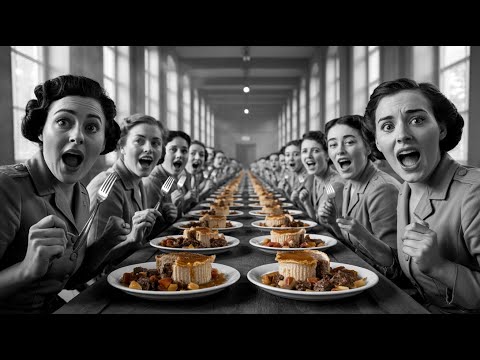
November 1944, Fort Lawton, Washington. The mess hall doors swung open, and Adelheid Kruger stopped breathing. She was 23, captured three weeks earlier during the chaos of the French retreat, and she had spent the last 72 hours expecting the brutality she’d been promised from American hands.
Instead, she stared at something that made no sense—something that violated every understanding she had of how the world worked in the fifth year of total war.
Golden pastry crusts, dozens of them, rose from white ceramic dishes, releasing clouds of steam into the cold November air. The scent hit her before her mind could process what her eyes were seeing: rich, fatty, impossibly abundant beef. Real beef. Not the memory of beef, not the rumor of beef, not the thin gray substitute that German rations had optimistically labeled as beef since 1942. Actual meat swimming in thick gravy, wrapped in butter-soaked pastry that looked like something from her grandmother’s kitchen in Essen before the war had consumed everything normal about living.
Beside her, Edeltrud Hofmann made a small sound in her throat. The 22-year-old nurse from Karlsruhe had steady hands that never shook during the worst field surgeries, had held dying soldiers without flinching, had walked through bombed hospitals with the calm efficiency that kept others alive. Now she was trembling, staring at the serving line where American soldiers in crisp uniforms were placing these impossible creations onto metal trays with the casual indifference of men who had never known hunger.
“It cannot be real,” Edeltrud whispered in German, her voice carrying the hollow quality of someone whose reality had just fractured. “It is a trick, a test. They want to see if we are animals who will fight over food.”
But Ingeborg Richter, 26 and practical to her core, was already moving forward. The records keeper from Mannheim had spent the last two years documenting supply shortages with mathematical precision. She knew exactly how many grams of fat, how many calories, how much protein the Reich allocated to its auxiliary corps. She had calculated her own slow starvation with the same careful attention she gave to filing systems.
Her hands, ink-stained and too thin, reached for the tray being offered by an American private who could not have been older than 19. He was smiling at her—actually smiling—as if serving food to enemy prisoners was a pleasant task rather than a grim duty.
The pot pie landed on her tray with a weight that felt obscene. Ingeborg looked down at it and felt something crack inside her chest. The crust was perfect: golden brown, flaking at the edges, steam escaping from a decorative vent cut into the center. Through that small opening, she could see chunks of beef, carrots, peas, potatoes—details suspended in gravy so thick it barely moved.
This single serving contained more meat than her entire family had seen in a month, more butter than her ration card had allowed in a year, more food than she had eaten in any single meal since 1942.
Adelheid’s mind traveled backward as she stood frozen in the serving line. The scent of beef pot pie pulled memories from places she had tried to seal shut. Essen, 1942. Her mother’s kitchen, once filled with the smell of Sauerbraten and fresh bread, had become a laboratory of substitution and scarcity. They had learned to make coffee from roasted acorns, to stretch a single egg across four people, to convince themselves that turnip soup was nourishing when served in her grandmother’s good china.
By 1943, even the turnips became precious. Adelheid remembered her younger sister Greta, 13 years old, crying not from sadness but from the constant, knowing emptiness that no amount of watered-down soup could fill. Their ration cards allowed 200 grams of meat per week—when meat was available, which it rarely was. Bread became darker, denser, stretched with sawdust and potato starch until it sat in the stomach like a stone, providing bulk without nutrition.
Her mother had developed the hollowed look that all German women wore by the war’s fourth year: skin stretched tight over bones, eyes too large in thinning faces, hands that trembled from lack of fat.
Adelheid had joined the Women’s Auxiliary Corps in 1943, partly out of patriotic duty, but also because military service meant better rations. As a communication specialist, she received an extra 100 grams of bread daily, sometimes real butter instead of the chalky margarine that civilians choked down. She had felt guilty about this small abundance, sneaking food home to Greta whenever possible, watching her sister devour a piece of military-issue bread with the intensity of someone dying of thirst finding water.
The propaganda had assured them that everyone was sacrificing equally, that the British were starving, that the Americans were suffering under their own rationing. The newsreels showed German soldiers well-fed and strong, never mentioned the desperate telegrams from the Eastern Front describing men eating leather boots and tree bark. Never acknowledged that by 1944, the average German woman was consuming fewer calories than a medieval peasant during famine.
Adelheid had been captured outside Strasbourg, too exhausted to run when American tanks rolled through their position. She had expected immediate execution or, at minimum, the same brutal starvation her government claimed was being inflicted on German prisoners. Instead, within six hours of capture, she had been given white bread. Actual white bread, soft and fresh with real butter. She had eaten it slowly alone in a transport truck and wept into her hands because something so simple should not have felt like a miracle.
That bread should have prepared her for what was coming, should have warned her that everything she understood about the war, about the enemy, about who was winning and who was suffering might be built on lies as substantial as sawdust stretched into bread. But nothing—not even that impossible white bread—could have prepared her for the sight of beef pot pie being served as ordinary prison food on an ordinary Tuesday evening in November.
The journey from Europe to America had taken three weeks, and every day of it had challenged what Ingeborg Richter thought she knew about how enemies treated their captives.
She had boarded the transport ship at Le Havre expecting a floating hell: cramped holds where prisoners were stacked like cargo, minimal food, perhaps beatings from guards who saw them as representatives of the regime that had killed their brothers and friends. Instead, she found herself in quarters that—while certainly not luxurious—were cleaner and more spacious than the barracks she had occupied while serving the Wehrmacht.
The ship’s hold had been converted into sleeping areas with actual bunks, thin mattresses that were nonetheless more comfortable than the straw pallets she had grown accustomed to. There were bathrooms with running water, a luxury that had become increasingly rare in Germany as infrastructure crumbled under Allied bombing.
The other women—58 of them, ranging from 18 to 34—had moved through those first days in a state of anxious confusion. They whispered to each other in German, trying to understand why their captors were not matching the image of brutal American soldiers that propaganda had burned into their minds.
Mechthild Schneider, the 25-year-old medical orderly from Dortmund, had been the first to voice what they were all thinking. “They feed us three times daily,” she said on the fourth day at sea, her voice low and uncertain. “Not scraps—actual meals. Bread, soup with vegetables, sometimes tinned meat. More food than I received while serving in field hospitals.”
The observation hung in the air like an accusation—not against the Americans, but against something larger that none of them wanted to examine too closely.
Lieselotte Bauer, 20 years old and still carrying the idealistic fervor that had led her to volunteer for the auxiliary corps, had tried to maintain the narratives they had all been taught. “It is strategy,” she insisted, her young face set with determination. “They fatten us for propaganda purposes, to show the world how humane they are while they bomb our cities and kill our families.”
But even as she spoke, doubt flickered in her eyes.
Roswitha Wagner had said nothing during these debates. The 23-year-old administrative specialist from Augsburg had spent the entire war processing paperwork, watching numbers that represented rations shrink month by month while official reports claimed Germany was thriving. She had learned to recognize the gap between what officials said and what reality showed. Now, eating her third meal of the day aboard an American transport ship, she understood that the gap was not a crack but a chasm—and that everything on the other side of it would require her to rebuild her understanding of the world from the foundation up.
Fort Lawton materialized through the gray November rain like something from a fever dream.
Edeltraut Hoffmann pressed her face against the transport truck’s canvas opening, watching American soil approach with a mixture of dread and exhausted curiosity. She had spent 25 months as a field nurse, had seen bombed cities and dying soldiers, had developed the hardened exterior necessary to function in a world of constant trauma. Nothing in that experience had prepared her for what she saw as they passed through the camp gates.
American soldiers were everywhere, and they looked healthy. Not the wan, stretched healthiness of people surviving on rations, but genuine vitality. Their uniforms fit properly, not hanging loose on frames depleted by inadequate nutrition. Some were laughing—actually laughing—as if joy was something still permitted during wartime.
One group sat outside a building eating sandwiches during their break, and Edeltraut watched in disbelief as one soldier took two bites, decided he did not want it, and casually tossed the remainder into a waste bin. “Did you see that? He threw away food. He threw it away.”
The women were processed through intake with an efficiency that felt almost gentle. American female officers conducted the paperwork and basic medical examinations—professional but not cruel, bored rather than hostile. One lieutenant with tired eyes actually apologized when the examination took longer than expected.
The barracks were simple but clean, with real beds and blankets that smelled of soap rather than mildew. Roswitha sat on her bunk, felt the thin but present mattress beneath her, and realized she was going to cry—not from fear or relief, but from the overwhelming dissonance of discovering that prison in America was more comfortable than service to the fatherland had been.
The second week brought routine, and with routine came the dangerous possibility of adjustment. It was Corporal James Mitchell, a skinny young man from Idaho, who first mentioned the special meal. “Big dinner tonight. Good food. Very good.”
The rumor spread like fever. A wedding, they decided—one of the officers must be marrying, and they would include their prisoners in the celebration. Roswitha cataloged details with administrative precision. “If it is a wedding, there will be a cake. Americans value cake highly.”
The mess hall doors opened at 1700 hours exactly. What they found was not a wedding. There was no bride in white, no decorated table—just the usual long benches and the usual guards. But the smell rolled over them like a physical force: butter, beef, herbs, pastry baking to golden perfection.
Then they saw the pies. Dozens of them, fifty or more, lined up in neat rows. Corporal Mitchell served generous portions, smiling, chatting, completely unaware he was presiding over a religious revelation. “Wedding? No, miss, just dinner. Beef pot pie. Cook makes it every couple weeks.”
Every couple weeks. The words penetrated slowly. This abundance—this extravagance of butter and beef—was routine. This was what Americans considered unremarkable enough to serve on a Tuesday evening to prisoners of war.
Adelheid cut into the crust and it yielded with a tender flakiness that came from proper butter. She lifted a forkful: a chunk of beef larger than her thumb, carrots, potato, all coated in gravy that clung with the weight of flour and fat. This single forkful contained more calories than some entire meals she had eaten in the last year.
She placed it in her mouth and closed her eyes. The explosion of flavor was almost painful. Her palate, accustomed to turnip soup and sawdust bread, recoiled from the richness before accepting it with desperate gratitude.
Around her, Mechthild was crying openly, tears streaming as she chewed. Lieselotte clutched her fork with both hands, shoveling with the mechanical intensity of a starving animal. Edeltraud ate slowly, eyes closed, her face showing something almost like pain.
Roswitha stopped after three bites. “I cannot. It is too much. My stomach has forgotten how to process real food.” But even as she spoke, she cut another piece.
Hildegard sat back from her half-finished pie, physically unable to eat more but unable to stop staring at what remained. In Germany, this amount would have been divided among four people and considered a feast. Here, it was one person’s ordinary dinner—and American soldiers around them were finishing their portions without difficulty.
Ingeborg’s analytical mind was already calculating. “If they feed their prisoners like this, how do they feed their civilians? Their soldiers?” The question hung in the air, and none of them wanted to follow the logic to its conclusion. But the conclusion was inevitable, written in the golden crust before them.
Germany was not winning the war. Germany had never been winning the war.
Mechthild spoke the thought they were all having. “Everything was a lie. Every broadcast, every speech, every promise that we were defending the fatherland. They were not trying to destroy us. We were destroying ourselves.”
Corporal Mitchell returned, concerned by their half-eaten trays and tear-stained faces. “You don’t like it? Cook’s real good at pot pie.”
Ingeborg searched for words to bridge the impossible gap. “It is very good. Too good. We are not accustomed to such food.”
Mitchell’s confusion deepened. “Too good? That don’t make sense, miss. It’s just pot pie.” Then, slowly, understanding crossed his farm-boy face. “Wait. You’re saying that back home in Germany regular folks don’t eat like this? Even before you got captured?”
The women nodded in unison. Mitchell sat down on the bench, guard duties forgotten. “Ma’am, I’m just a farm kid from Iowa. But even with rationing, my ma serves pot pie every Sunday. We got limits on some things, sure, but nobody’s starving. We got more food than we know what to do with most times.”
The simple statement landed like an artillery shell.
That night Adelheid lay on her bunk with her stomach uncomfortably full and her mind unable to rest. Mechthild broke the silence, describing her last meal in Germany: one slice of black bread measured with a ruler, twenty grams of watery margarine, ersatz coffee. Lieselotte’s sister’s baby had died in August—malnutrition, though officially they wrote respiratory failure. Edeltraud’s brother had written from Stalingrad about eating rats, making jokes to stay cheerful, starving with no supply line coming.
Ingeborg calculated aloud. “One serving of that pot pie contained perhaps six hundred calories. Our daily ration for civilians was twelve hundred by 1944—but actual distribution was less, perhaps nine hundred on good days.”
Roswitha put it in starker terms. “That means one American prison dinner equals more than half a day’s rations for German civilians—and they eat three meals like this daily.”
Adelheid thought of her family in Essen, wondered if they still lived. Were they dividing a single potato among three people, making soup from nettles, trading heirlooms for eggs on the black market? The guilt of her full stomach warred with the anger of understanding how unnecessary their suffering had been.
“We cannot go back,” Mechthild said suddenly—and they all understood she did not mean physically.
Morning brought scrambled eggs made with real eggs, white toast, crispy bacon, coffee that smelled like coffee. Adelheid watched Mitchell pour without measuring, filling her cup simply because there was enough that portions did not need calculating. The gesture was more devastating than the pot pie had been.
Three weeks later, the physical changes were undeniable. Mechthild’s dizziness had vanished. The tremor in Lieselotte’s hands had steadied. Roswitha’s hair had stopped falling out. Ingeborg’s persistent cough had finally cleared. Their faces were filling out, the sharp angles of starvation softening as their bodies remembered what adequate fat stores felt like.
Adelheid caught her reflection one morning and barely recognized herself. Her cheeks had color again. She looked like a woman in her twenties rather than someone decades older, worn down by deprivation.
Lieselotte, whose youthful idealism had been the last holdout, finally spoke what they were all recognizing. “If they can feed prisoners this well, then we were never a threat to America. We were fighting a war we could never win against a country that could afford to be generous even to its enemies.”
January 1945 brought news that Germany was collapsing from both East and West. Captain Helen Morrison, the WAC officer who supervised their barracks, called a meeting. “The war in Europe will end soon. When it does, procedures will begin to return prisoners to their home countries. However, repatriation is not immediate. There will be opportunities to understand what conditions you would be returning to before any final decisions are made.”
Decisions. Not mandates. The careful phrasing was not lost on them.
May 8th, 1945. Victory in Europe Day arrived with the strange quietness of an ending everyone had seen coming. In the barracks, the women gathered around a radio as President Truman’s voice crackled through static announcing the defeat of Nazi Germany.
Some wept. Some sat in stunned silence. Lieselotte clutched a letter from her mother confirming that Stuttgart still stood and that she was desperately awaiting her daughter’s return.
When Captain Morrison asked for final confirmation of the repatriation list, five women did not raise their hands. Adelheid stood first. “Captain Morrison, I wish to request consideration for displaced person status. I do not wish to return to Germany at this time.”
Beside her, Mechthild rose. Then Ingeborg, then Edeltraud. Finally Roswitha, her administrative mind having calculated every angle and reached a conclusion that felt both terrifying and inevitable.
Lieselotte was bitter in her final days. “You are choosing American food over German family. You are letting beef pot pie matter more than your own people.”
Mechthild responded with weary patience. “We are choosing life over death. We are choosing to believe we can contribute more by becoming something new rather than returning to maintain something fundamentally broken. That is not betrayal. That is survival.”
1970. Twenty-five years after that November evening, Adelheid stood in her kitchen in Portland, Oregon, teaching her twelve-year-old granddaughter Emma to make the same dish that had changed her life.
“Oma, why do you always cry when you make pot pie?”
Adelheid paused, her fingers pressed into the golden dough. “Because this dish taught me the most important lesson of my life. It taught me that everything I believed could be wrong—that my enemies could show me more kindness than my own government, that food is not just sustenance but a form of truth.”
Emma frowned. “But it’s just pot pie, Oma. We have it all the time.”
“Exactly.” Adelheid smiled, sliding the dish into the oven. “You have it all the time. When I was your age in Germany, I was slowly starving while being told everyone was starving, that our suffering was necessary and shared. That pot pie showed me the lie.”
Mechthild had died three years earlier, a successful surgical nurse who spent her career healing others. Ingeborg had become a State Department translator. Edeltraud had married an American doctor and raised four children in Minnesota. Roswitha had returned to Germany in 1960—not as a failure, but as a success, carrying the lessons of American democracy to help build the new Federal Republic. Only Adelheid had stayed in the Pacific Northwest, finding in the rainy climate and forested mountains something that felt like home.
The timer rang and she pulled the pot pie from the oven, its crust golden and perfect, steam rising from the decorative vents. Emma leaned forward, breathing in the scent, and Adelheid saw in her granddaughter’s casual appreciation the gift of a life lived without deprivation, without propaganda, without the kind of lies that required beef pot pie to shatter.
So tell me—if a single meal could expose every lie you had ever been told, would you have the courage to take that first bite?
Report this article
Select a reason for reporting:






