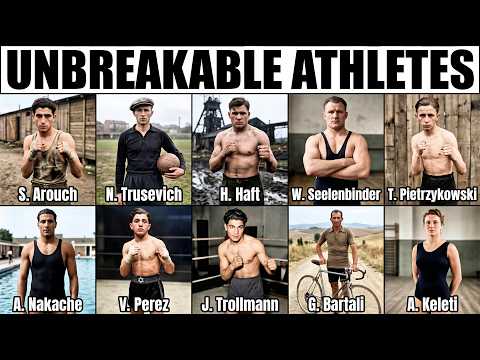
What does it take to break a human being? The Nazis thought they knew. They built an entire system of death and degradation designed to strip a person of everything: their family, their dignity, their name. They turned men into numbers, and then into ashes. But for a handful of athletes, the system met something it could not crush. In the mud of a coal mine, in the cramped barracks of Auschwitz, and on a football pitch ringed by armed guards, they found a different kind of fight.
These are the stories of ten athletes who looked the architect of the Holocaust in the eye and refused to fall. Theirs are not tales of soldiers or politicians. They are stories of boxers and footballers, swimmers and cyclists, whose weapons were their fists, their feet, and their unyielding spirit. They were forced to compete for the amusement of their captors, but every match became a silent rebellion. Every victory, a defiant declaration that the spirit cannot be imprisoned.
Salamo Arouch stood in the dirt at Auschwitz, his fists raised. He knew the rule: win, and you eat. Lose badly, and you go to the gas chamber. He fought over 200 times and was never beaten. He once knocked out a man a foot taller. He fought while sick with dysentery, barely able to stand, and still held his own. Every time he climbed into that ring, the price of failure was a man’s life.
But Arouch was not the only one. In the summer of 1942, in occupied Kiev, a team of half-starved bakers called FC Start took the field against the German Luftwaffe’s finest. They were told to lose. They won 5-1. A rematch was ordered. Guards and dogs ringed the pitch. Before the game, a German officer warned them to remember who was in charge. They won again, 5-3. The legend says they were shot on the field. The truth is darker: within months, several were arrested, tortured, and killed.
Harry Haft survived by becoming the most visible prisoner in the camp—the one the guards bet on. In bare-knuckle fights with no rules, he beat men just as victimized as he was, because the alternative was the gas chamber. He fought 76 times and won. The winning kept him alive; it also haunted him until he died. After the war, he stepped into a professional ring with Rocky Marciano, a man who would become world champion.
Werner Seelenbinder was different. He was a German, a celebrated wrestler who could have saluted and kept his title. Instead, he refused the Hitler salute on the podium and was banned for 16 months. He used his fame as cover to carry messages for the communist resistance. He was executed for treason in 1944, weighing only 132 pounds, but he never broke.
These are just the first of ten. Their names are Salamo Arouch, FC Start, Harry Haft, Werner Seelenbinder, Tadeusz Pietrzykowski, Alfred Nakache, Victor Young Perez, Johann Trollmann, Gino Bartali, and Agnes Keleti. Each faced the machinery of genocide and found a way to fight back. The Nazis took almost everything from them. But they could not take who they were.
Tadeusz Pietrzykowski was prisoner 77, one of the first Poles ever caged in Auschwitz. He weighed ninety pounds when a German Kapo named Walter Dunning, a former middleweight, challenged him to box. The crowd laughed at the skinny Pole. Teddy slipped and dodged and bloodied the bigger man’s face so badly that Dunning simply stopped, lowered his gloves, and asked what work detail he wanted. He won a loaf of bread and shared it with his friends.
That fight changed everything. The SS used him for entertainment, searching new transports for fighters to put against him. He fought between forty and sixty matches and lost only once. The Germans called him the white fog because they could never land a clean punch. Every time he beat a German, the prisoners lifted their heads. It meant the supermen could bleed. He used his extra food to smuggle medicine to the sick and passed information for the camp resistance. In one fight, he deliberately held back to save a Jewish opponent’s life. He survived the war and became a teacher, living until 1991.
Alfred Nakache swam in front of Hitler at the 1936 Berlin Olympics. In 1941, he set a world record in the 200-meter breaststroke. But by 1943, the Vichy regime had stripped his family of their rights. He was arrested with his wife and two-year-old daughter and deported to Auschwitz. His wife and little girl were murdered in the gas chamber. The guards, knowing he was a champion, forced him to swim in the camp’s freezing, filthy water reservoirs for their amusement.
He survived, was liberated from Buchenwald weighing ninety pounds, and within months was back in the water. Less than a year after walking out of the camp, he was part of a French relay team that broke a world record. In 1948, he swam at the London Olympics. He competed for the country that had once thrown him out. They called him the swimmer of Auschwitz. He died in 1983, at sixty-seven, while swimming in the sea off the coast of France.
Victor Young Perez was the youngest world champion in boxing history, a flyweight from Tunis who insisted on wearing a Star of David on his trunks. In Auschwitz, he was assigned to the camp kitchen and used it to steal food. Night after night, he smuggled out a barrel of soup through a side door to feed his starving friends. Friends warned he would be hanged. He waved them away. “A man does not live for himself,” he told them. In January 1945, on a death march, he found bread in a kitchen and tried to carry it back to share. A guard saw him and shot him dead. He was thirty-three.
Johann Trollmann understood exactly what they wanted from him. In July 1933, the German boxing authorities ordered him to fight in the proper German style—no dancing, no slipping, no evasive footwork. They wanted him to stand still and lose like a good Aryan. So he walked into the ring with his face caked in white flour and his dark hair dyed blonde, a living mockery of the master race. He fought flat-footed in their style and let himself be knocked out. It was a surrender that was really an accusation.
They stripped his title, sterilized him in 1935, and sent him to Neuengamme. There, a violent capo named Emil Cornelius challenged him to a fight. Even broken and starving, Rukeli beat him. The humiliated capo took his revenge, working Trollmann to exhaustion and beating him to death. He was thirty-six. In 2003, seventy years after that crooked fight, the German Boxing Association finally recognized him as the rightful champion of 1933.
Gino Bartali was the most famous cyclist in Italy, a two-time Tour de France winner and a devout Catholic. When Germany occupied Italy in 1943, the Archbishop of Florence brought him into a secret rescue network. Jews in hiding needed forged identity papers, and those papers had to be moved past fascist police and German checkpoints. Hidden inside the hollow tubes of his bicycle frame, Bartali carried the documents that would let Jewish families disappear into new identities.
When guards stopped him, he played the part of the friendly sports star, chatting about racing and politely asking them not to touch his bike—every part was tuned exactly for competition. They waved the national hero through. He rode thousands of kilometers on these missions, and he never spoke of it. Not after the war, not for decades. He believed good deeds should be kept quiet. He died in 2000, and only then did the full story begin to come out. In 2013, Yad Vashem honored him as one of the Righteous Among the Nations.
And then there is Agnes Keleti. In 1941, because she was Jewish, she was thrown off Hungary’s national gymnastics team. In 1944, her father and several relatives were taken to Auschwitz and never returned. She bought the identity papers of a Christian woman and vanished into a village, working as a maid, hiding in plain sight while the world she knew burned. When the war ended, she picked herself up and went back to the gym.
At the 1952 Helsinki Olympics, she made her debut at thirty-one—ancient for a gymnast—and won gold in the floor exercise. Four years later, at thirty-five, she won four gold medals and two silvers, becoming the most successful athlete at the entire Melbourne Games. While she was winning those golds, Soviet tanks rolled into Hungary. She did not go home. She defected and settled in Israel, where she helped build the country’s gymnastics program from the ground up.
She lived to see herself become the oldest surviving Olympic champion in the world. On the eve of her hundredth birthday, she said the century had felt like sixty years, that she had loved life and was grateful to still be healthy. She trained with young gymnasts well past ninety. On January 2, 2025, Agnes Keleti died in Budapest at 103, a week shy of her 104th birthday.
The regime that tried to erase her did not last. The men who murdered her father and banned her from her team are long gone, their thousand-year empire reduced to rubble in twelve. And she outlived all of it by eighty years. She won her golds. She built a sport in a new nation. She held great-grandchildren. That is the deepest kind of victory there is—not a punch, not a finish line, but a long, full, joyful life lived in spite of everyone who wanted it cut short.
These ten were not soldiers. They carried no rifles and commanded no armies. They were boxers and wrestlers, swimmers and runners, footballers and a cyclist and a gymnast. The Nazis took almost everything from them—their titles, their families, their freedom, and from some of them, their lives. But every single one held on to the one thing the regime wanted most and could never seize, no matter how many fights they forced or how many camps they built.
They held on to who they were.
That is the thread that runs through all ten. Not superhuman strength, not luck, but the stubborn refusal to let a number tattooed on an arm become the whole of a person. Arouch climbed back into that ring knowing the stakes. FC Start chose to win knowing the cost. Haft carried his scars honestly, without pretending they weren’t there. Seelenbinder kept his arm down. Pietrzykowski shared his bread. Nakache returned to the water. Perez fed the starving. Trollmann mocked them with flour and dye. Bartali rode in silence. Keleti simply kept living, decade after decade, until she had outlasted every one of her tormentors.
None of them asked to be heroes. They were asked to be less than human, and they refused.
Their stories survive because people kept telling them. A son wrote a book. A family fought for a stolen title. A nation named an arena. A race started in a country that honored a quiet cyclist. Memory is its own kind of resistance, and every time we say these names, the men who built the camps lose a little more of the thing they wanted most: silence.
The Nazis took their titles, their families, their freedom, and from some, their lives. They could not take who they were. And the fact that we still say their names, all over the planet, all these years later, is itself a kind of victory.
So here is the question worth asking: if the world tried to erase you, what would you hold on to?
Report this article
Select a reason for reporting:






