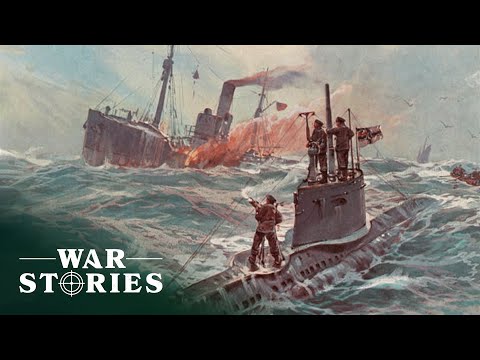
The torpedo struck the tanker’s bow, and within seconds, a pillar of fire turned the night into day. The crew of U-96 watched from the conning tower as the vessel broke in two, its cargo of aviation fuel igniting in a roar that echoed across the black Atlantic. It was October 1940, and for the men of the Kriegsmarine, this was the ‘Happy Time’—a period when the wolf packs hunted with near impunity, sending hundreds of thousands of tons of Allied shipping to the ocean floor.
But this night, something was different. The escort ships were faster, their depth charges more accurate. As the U-boat dove, the crew held their breath, waiting for the explosions that could crush the hull like an eggshell. They had no idea that this patrol would mark the beginning of the end.
Three years earlier, in 1939, the German navy was a shadow of its former self. Hitler, obsessed with the coming land war, had sacrificed naval expansion for the Luftwaffe and the Wehrmacht. Grand Admiral Erich Raeder, commander-in-chief of the navy, watched in frustration as his requests for more U-boats were repeatedly denied. “Give me 300 U-boats,” Admiral Karl Dönitz, the aggressive commander of the submarine fleet, had pleaded with Hitler. “And I will win you the war.” Hitler laughed. He didn’t believe the war would be decided on the oceans.
But Dönitz knew better. A U-boat ace from the First World War, he had seen firsthand how submarines could strangle an island nation. Britain, with its vast empire, depended on imports—food, fuel, raw materials—to survive. Cut those lifelines, and the island would starve.
In the first months of the war, the U-boats proved him right. On the night of October 13, 1939, Captain Günther Prien slipped his U-47 into the supposedly impregnable anchorage of Scapa Flow. In a daring attack, he sank the battleship HMS Royal Oak, killing more than 800 sailors. The shockwaves reverberated through the Admiralty. Winston Churchill, newly appointed First Lord of the Admiralty, understood the gravity of the threat. “The only thing that ever really frightened me during the war,” he later wrote, “was the U-boat peril.”
Churchill immediately reintroduced the convoy system, grouping merchant ships together under the protection of naval escorts. But the escorts were too few, and the U-boats were too many. By the summer of 1940, after the fall of France, the Germans had gained new bases along the Atlantic coast, allowing their submarines to reach the shipping lanes more easily. The ‘Happy Time’ had begun.
Otto Kretschmer, known as the ‘Wolf of the Atlantic,’ was one of the most successful U-boat commanders. “We were the elite of the navy,” he recalled. “We had undergone four years of rigorous training and were very keen to serve.” His tactics were audacious—he would penetrate the convoy’s columns on the surface at night, when ASDIC, the British sonar, was ineffective. Between July and October 1940, U-boats sank 217 ships, totaling over 1.5 million tons.
For the merchant seamen, the terror was relentless. John Harvey, who sailed in 12 Atlantic convoys, remembered the constant fear. “If you were carrying a cargo of aviation fuel, you knew the ship would go down in about 20 seconds,” he said. “So you slept fully clothed, your cabin door wedged open, a life jacket alongside you.” The slow death in oil-choked water was a fate worse than a sudden explosion.
But the tide was about to turn. In the spring of 1941, the British perfected new tactics and technologies. Escort groups, trained by men like Commander Donald Macintyre, began to strike back. Depth charges, improved radar, and the growing number of escorts started to take a toll. In March 1941, two of Dönitz’s top aces, Prien and Schepke, were sunk in a single engagement. “Half an hour later, my U-boat followed that of Schepke’s to the bottom,” Kretschmer recalled. “Altogether, the two of us had managed to sink 1.3 million tons of shipping.”
The ‘Happy Time’ was over. But Dönitz was not finished. He had a new plan: the wolf packs would concentrate their attacks, overwhelming the escorts. And he had a new target—the American coast, where ships sailed unescorted, their lights blazing.
When the United States entered the war in December 1941, Dönitz saw his opportunity. He dispatched his U-boats to the Eastern Seaboard, where the Americans were utterly unprepared for submarine warfare. Ships sailed alone, coastal cities glowed with lights that silhouetted merchant vessels against the horizon, and the U.S. Navy had almost no anti-submarine capability.
Captain Peter Cremer, one of the wolf pack survivors, recalled the ease of the hunt. “I went to the Florida coast, Miami Beach, and on occasion so close to the coast that I could see car headlights,” he said. “One night I picked up a convoy, sank three ships, and a few hours later one more. I was in so close that the tanker actually touched me as it went down.”
The numbers were staggering. In the first six months of 1942, U-boats sank more than 600 ships off the American coast. Crews called it the ‘Second Happy Time,’ and the tankers of the Gulf of Mexico and the Caribbean became their favorite prey. In June alone, 121 ships went to the bottom. The Americans, slow to learn, finally imposed blackouts and organized convoys, and the slaughter began to subside.
But Dönitz had another weapon in his arsenal. In mid-1942, he introduced the supply U-boat—nicknamed the ‘Milch Cow’ by the crews. These massive submarines carried fuel, torpedoes, and provisions, allowing the attack boats to remain at sea for months at a time. The sea wolves could now prowl the far reaches of the Atlantic, striking convoys far beyond the reach of Allied air cover.
Life aboard a U-boat was brutal. The air was almost unbreathable, reeking of oil and diesel fumes. There was little fresh water, hardly any space, and men had to eat and sleep in shifts. There were only two bunks for every three sailors. On deck, the watch had to lash themselves to the conning tower—more than one man had been swept away by an unexpected wave without anyone below even noticing.
Yet the crews remained fiercely loyal to Dönitz. “My leader, you have led us, the navy, and a whole grateful nation out of the darkness of night towards the sunrise,” Grand Admiral Raeder had declared. Dönitz, in turn, demanded absolute devotion. He inspected every returning boat, shook hands with every commander, and awarded Iron Crosses with theatrical ceremony. The men called him ‘the Lion,’ and they believed in him even as the odds against them mounted.
By the end of 1942, the balance was shifting. American shipyards were producing Liberty ships at a rate of one per day—a feat of industrial might that Dönitz could never match. The Germans had sunk 1,664 ships that year, but the Allies had built 7 million tons of new shipping. The race for time had been lost, though few in the Kriegsmarine were willing to admit it.
In January 1943, the Allies met at Casablanca and made the defeat of the U-boat their highest priority. Long-range aircraft, escort carriers, and new radar systems were rushed into service. The wolf packs, still confident, prepared for what they believed would be their greatest triumph. Instead, they sailed into a slaughter.
The spring of 1943 brought a change in the weather—and in the war. For the first time, convoys enjoyed continuous air cover across the entire Atlantic gap, the dreaded ‘Black Pit’ where U-boats had once hunted with impunity. Liberators and Sunderlands, flying from bases in Iceland, Northern Ireland, and Newfoundland, could now reach every corner of the ocean.
Commander Peter Gretton, then a young escort group leader, remembered the transformation. “In March 1943, the situation was very serious. We were not depressed, but we were worried,” he recalled. “Then suddenly, by a combination of circumstances, the situation seemed to change very quickly.”
Gretton’s group fought three convoy battles in quick succession. In the first, they lost several ships but sank three U-boats. In the second—the largest convoy battle of the war—60 German submarines tried to break through. Twelve merchant ships were lost, but seven U-boats were destroyed, including two that collided in the confusion and sank each other.
The third battle was decisive. Attacked by a pack of 20 U-boats, Gretton’s escorts did not lose a single ship. Five submarines were sent to the bottom—three by the escorts, two by aircraft. “We reckoned that we had won a good victory,” Gretton said quietly.
May 1943 became known as ‘Black May’ among the U-boat crews. In that single month, 25 submarines were destroyed by surface and air escorts. Dönitz, reading the reports, confessed that losses had reached “unbearable heights.” On May 24, he recalled all boats from the North Atlantic. The wolf packs, for the first time, had been driven from the field.
But Dönitz refused to surrender. He turned to new technologies—weapons that he hoped would reverse the tide. The acoustic torpedo, which homed onto the noise of propellers, was rushed into service. The snorkel allowed U-boats to run submerged on diesel power, hiding from radar. And in the shipyards, a revolutionary new boat was taking shape: the Type XXI, capable of traveling faster underwater than on the surface.
“Already he has one in service, seven in training, and 90 under construction,” the Allied intelligence reports warned. The British, aware of the threat, launched massive bombing raids on the underground factories where the new boats were being built. But Dönitz, ever the optimist, believed he could still turn the war around.
In the Arctic, the U-boats continued to harass the convoys bound for Russia. Despite appalling weather and relentless air attacks, 250 ships got through in the last year of the war, carrying enough war material to equip 60 Soviet divisions. The Arctic run was the most dangerous of all—ships that were torpedoed had only minutes to launch lifeboats before freezing to death in the icy water.
One French corvette, the Aconit, achieved a remarkable feat in a single engagement: she sank two U-boats in one action. The French navy, rebuilt after the fall of France, had crews that fought with a fury born of exile.
The end came suddenly. On May 4, 1945, Dönitz—now Hitler’s successor as head of state after the Führer’s suicide—gave the order for all U-boats to return to Germany. Four days later, he sent his final signal: “You have fought like lions. Now I must give you the hardest order of your career: rise to the surface, hoist a large black flag, and surrender to the enemy.”
Few commanders could believe it. Of the 700 U-boats built during the war, 221 scuttled themselves rather than surrender. Only 156 were ever found and taken into Allied ports. When the British boarded them, they found crews who were exhausted, hollow-eyed, and utterly defeated.
The final tally was staggering. During six years of war, the U-boats had sunk 2,771 Allied ships—14.5 million tons of shipping. But the cost to the Kriegsmarine was even more terrible. Of the 39,000 German submariners who went to sea, 32,000 never returned. It was the highest casualty rate of any branch of the German armed forces.
Otto Kretschmer, the ‘Wolf of the Atlantic,’ survived the war as a prisoner in Britain. Years later, he returned to the Hecht, the last U-boat used in the battle, and stood on her deck in silence. “We were the elite,” he said softly. “But we were also the doomed.”
Winston Churchill, who had feared the U-boat peril more than any other threat, summed up the battle in a single sentence: “The only thing that ever really frightened me during the war was the U-boat peril.” The Battle of the Atlantic was over—and Britain, barely, had won.
But the sea had claimed its own. The Atlantic, vast and indifferent, held the wrecks of thousands of ships and the bodies of tens of thousands of men. For the survivors, the memories would never fade—the flash of torpedoes, the screams in the water, the long, cold nights on watch. The battle was won, but the scars remained.
In 1945, when the U-96 surrendered at Wilhelmshaven, her crew walked down the gangway into a gray, uncertain peace. They had survived—but the sea had taken most of their comrades. Otto Kretschmer, the ‘Wolf of the Atlantic,’ later returned to the Hecht and stood on her rusted deck, remembering the men who never came home.
Admiral Karl Dönitz, the architect of the wolf packs, was tried at Nuremberg and served ten years in Spandau prison. He never repented. “We fought for Germany,” he insisted, “and we fought honorably.” But the 32,000 dead submariners—and the 14.5 million tons of Allied shipping at the bottom of the ocean—told a different story.
The Battle of the Atlantic was over. Britain had survived, but barely—and the cost was staggering. The sea, vast and indifferent, held the wrecks of thousands of ships and the bodies of tens of thousands of men. For the survivors, the memories would never fade.
Was the U-boat campaign a strategic failure, or did it come closer to winning the war than we like to admit? Share your thoughts below.
Report this article
Select a reason for reporting:






