At 5 a.m. on February 1, 1968, the Viet Cong slipped into Baria under the cover of a ceasefire they themselves had declared. It was the third day of Tet, the lunar new year, and the truce was supposed to last two more days. But as dawn broke, the flag of the National Liberation Front already fluttered over the provincial capital, and a small group of men inside the American advisory compound were firing back from behind the walls.
Among them was Australian Warrant Officer Antonino Barriello, attached to the American team. Later that morning, he asked an American named Robert Head—a World War II veteran—to cover him. Head opened fire, and Barriello sprinted across the road to a house, returning with beer for the men defending the compound. It was a small act of defiance in a town that had suddenly become a battlefield.
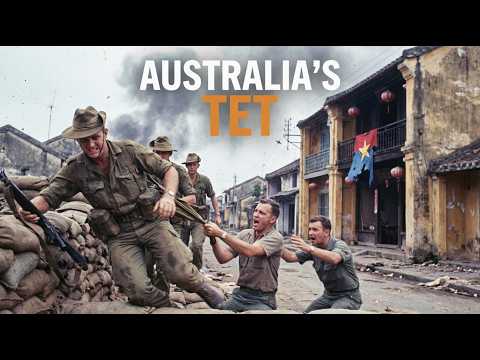
Just a short drive away, at Nui Dat, the Australian task force base was dangerously thin. Most of its troops were out on Operation Coburg, cutting off approaches to Saigon. What remained was the 3rd Battalion, Royal Australian Regiment—a unit that had been in the country for only five weeks, missing one company, and desperately short on experience. They were about to face a full Viet Cong battalion in a street fight.
At 8 a.m., Major Brian “Horry” Howard led two platoons and his company headquarters out of the gate on armored personnel carriers. Intelligence suggested a single Viet Cong company was loose in the town. In reality, the enemy had committed over 600 fighters, including the local D445 Battalion, and they had the Australians outnumbered and surrounded.
The road to Baria was a gauntlet. Viet Cong fighters waiting at the edge of Hoa Long tried to stop the column, but the carriers’ machine guns scattered them. By 9 a.m., the vehicles reached the outskirts of Baria, and snipers opened fire. The column didn’t stop. It punched straight through to the provincial headquarters, where the Americans had their advisers.
Howard received his orders there. The 3rd Platoon was sent to the ammunition dump, while 2nd Platoon, under Second Lieutenant Peter Fraser, was dispatched to the area where American and Australian advisers lived. They were told to expect one enemy company. Instead, they found a town crawling with Viet Cong. The Americans were defending multiple buildings, and the first word on one group was that they might still be alive.
Inside the advisory area, 2nd Platoon moved under sniper fire. Regional reconnaissance unit members told the Australians that three Americans might be alive in a building about 20 meters east. Fraser’s men fought their way in and pulled all three out. Howard’s advice on how to assault a Viet Cong-held house was blunt: use your grenades, then go in behind them. By the next morning’s radio report, 2nd Platoon had killed 14 enemy soldiers, but paid for it with shrapnel and sniper wounds.
At 10:07, American helicopter gunships arrived over Baria, followed by more teams. The fight was far from over. The Australians had come to rescue the Americans, but the enemy was everywhere, and the town was far from secure. What happened next would be written in American reports and Australian honors—and would cost the life of the man who had run for beer just hours earlier.
By early afternoon, 2nd Platoon had pushed through to the cinema at the corner of Route 15—a building that a Viet Cong platoon had seized at dawn. The call that reached them there was about Johnson, the CIA officer working under the cover of the ambassador’s special assistant office. His house, known as the O S A house, was a block away from the others and under heavy attack. His Nung guards were still holding out, but they couldn’t last much longer.
At 1:30 p.m., Fraser left the cinema with two sections in carriers, accompanied by Tingley’s vehicle. They reached the Barriello compound, where Barriello and Head climbed aboard and guided them to Johnson’s house. The Australians had been in Baria for four and a half hours, and these two men had been fighting since the first shots.
The plan was to load Johnson and his Chinese guards into a carrier and get them out. But as they approached the house, an anti-tank rocket slammed into one carrier’s engine. The crew was wounded, and the vehicle sat stranded in front of a house full of people who had to be evacuated. Barriello ran inside and found Johnson. On the way out, the two of them helped a wounded Vietnamese guard reach the carrier.
Tingley’s vehicle moved toward the disabled carrier to extract the wounded, while Barriello and Johnson fired from the top hatch. A second rocket struck. Johnson was killed there. Barriello was gravely wounded, along with two other Australians. Davis, the company medic, tried three times to reach Barriello under enemy fire—a fact written plainly in his citation. Barriello lost consciousness and died shortly after. Tingley was also hit.
While the carriers were stuck, a Viet Cong company was gathering in a creek bed to assault the compound. Aircraft spotted them. One man from A Company later described three American jets flying low and dropping napalm and cannon fire into the creek bed. The battalion log records that the air strikes hit a company-sized enemy force as it massed. The attack on the compound never came.
Not everyone agrees the strike on the creek bed happened. Whatever hit the creek, the assault was broken up. A company of South Vietnamese Rangers tried to reach the two damaged carriers in mid-afternoon but faltered under fire. According to the platoon’s account, the Rangers took dozens of casualties. Around that time, 3 RAR took over the operation from task force headquarters.
Tingley directed American gunship fire against the Viet Cong around the vehicles, and his citation credits that fire with recovering both damaged carriers. 3rd Platoon moved to cover 2nd Platoon as it withdrew from the CIA compound, with a team of gunships overhead, and the withdrawal succeeded.
As night fell, the two platoons regrouped with their wounded in a town that had not been cleared. A large American Huey couldn’t land in the market because of power lines and a water tower, but a small Australian Sioux from 161 Reconnaissance Flight could. The Sioux was a light aircraft with a bubble cockpit, designed for reconnaissance and liaison—yet it went in, because the wounded had to be evacuated before dark.
Its pilot, Captain John Coogan, call sign “Possum,” landed in the town square three times under heavy fire and pulled out the most seriously injured. The official history states it plainly: “three times under heavy fire.” Soldier David Johnston from 2nd Platoon, known as “Johnno” to his mates, told his family years later that if there was one hero that day, it was the pilot of that little helicopter. No one who rode in it disagreed.
Night belonged to the flares. New Zealand gunners from 161 Battery fired more than 500 illumination rounds over the town, according to the battalion’s veteran account. The company’s after-action report notes that the artillery fired only illumination that night. The men on the ground were not complaining. They had seen what happened when the shooting stopped and the darkness took over.
By 8 p.m., 3rd Platoon was on the east side of the bridge. Just after 9:30, 2nd Platoon’s group checked in by radio. Both platoons held their positions and waited for the next attack. It never came. At some point during the night, D445 Battalion slipped out of Baria along the road it had come in on, leaving the town to the Australians.
In the morning, the firing from the houses stopped. At least 30 enemy soldiers had fallen on the first day. According to the radio count announced on February 2, nine had been killed by the carriers, 14 by 2nd Platoon, and seven by 3rd Platoon. B Company came in to help sweep the town. The two damaged carriers were dragged out, and A Company rolled back through the gates of Nui Dat that evening.
The battalion association’s account records that the exhausted company returned to base knowing it had done a very good job. The final figures from the Department of Veterans’ Affairs list 19 Australians wounded, 40 enemy killed and at least 14 more wounded, with one Australian dead—Barriello. The official historian described it as an entirely new experience for any battalion of that time. Sixty-six houses in Baria burned to the ground.
The American survey of the population came from the pacification organization, dated February 15 and filed with field force papers on the 24th. It counted five civilian employees and 32 civilians killed, 29 seriously wounded and 34 lightly wounded. There were 461 families—2,731 people—living in four refugee centers.
Before the attack, the survey says, the population had partly supported the Viet Cong. One American civilian employee said that without the Australians, they could not have protected the provincial capital. Others said the Tet holiday attack had cost the Viet Cong whatever sympathy they had held in the town. Residents expressed hope that the Australians would protect the province because they were more experienced and braver. The survey says the majority admired the Australians’ support and courage.
The commander of D445 Battalion claimed in 1988 that his men had destroyed six Australian tanks in Baria. Nguyen Van Kim later changed the word to armored personnel carriers. There were no Australian tanks in Baria. Chamberlain, who translated the battalion history, describes the 1995 published version as unusually accurate for a Viet Cong account. It also acknowledges that the battalion’s losses led to what it called negative tendencies in its ranks.
The history published in 2005 says the battalion was attacked by South Vietnamese F-5 jets and American armed helicopters. David Morgan, a crew commander in the carriers, wrote that there were no air strikes at all. A Company’s after-action report records three strikes—two by fixed-wing aircraft and one by gunships. The report notes that about 100 civilians held by the Viet Cong managed to escape during those strikes.
Enemy losses range from 30 in the radio reports to 40 in the Department of Veterans’ Affairs history. American intelligence history counts 260 Viet Cong casualties but appears to count the whole province and estimates Allied losses at 21 killed. A story circulating online claims a CIA officer was rescued. He lost his life in the carrier. Even the initial estimate of enemy strength changes. One account says the company was told there were two platoons; the battalion log says one company. If you were in one of those carriers, you might remember it differently.
On the same day, two other Australian battalions were fighting the same kind of war elsewhere. Operation Coburg ran from January 24 to March 1. On the night of January 31, the Viet Cong overran the village of Trang Bom, a kilometer and a half from 2 RAR. At noon the next day, 2 RAR drove them out and then had to clear the village again, house by house.
A platoon from 7 RAR’s D Company was nearly wiped out, and G Company from the same battalion fought a seven-hour battle against a bunker system. In the first week of February, Australian ambushes in Operation Coburg killed 90 enemy and captured five more. 2 RAR returned to Nui Dat by February 13, and 3 RAR had already moved out to replace 7 RAR in Coburg a few days earlier.
Private Robert John Caston, 21, of Adelaide, died of his wounds in the American evacuation hospital at Long Binh on February 4. He was the battalion’s first fatal casualty of the fighting. Four days later, 2nd Lieutenant Leonard Alexander Taylor, 22, and Private Guy Richard Godden were killed in a firefight among brick houses in Long Dien. Private Geoffrey Francis Matthews died of his wounds the next day.
In late February, the American provincial advisers sent their monthly report, signed by Colonel Austin. It is held today in the Australian War Memorial. The people of Phuoc Le, it said, were angry at the Viet Cong for attacking their town during the sacred Tet holiday. The Australians, the report went on, won everyone’s admiration for their ferocity against a force that outnumbered them heavily.
The London Gazette published Tingley’s Military Cross and Davis’s Military Medal in May. Coogan received the Distinguished Flying Cross in August. Howard and Phillips were also decorated. Barriello, born in Trieste on May 2, 1937, was 30 years old in Baria. His name is on the Roll of Honour at the Australian War Memorial, dated February 1, 1968. He is buried in Botany, Sydney.
Robert Head, the American who covered him during that morning run for beer, recommended him for the Silver Star. So what did the Americans write about the Australians who came to their rescue—and does the record match what the men in those carriers remember?
Report this article
Select a reason for reporting:






