June 26, 1943. High above northern France, a young American pilot sat trapped in a shattered cockpit. Hydraulic fluid sprayed into his eyes. Smoke filled the air. The canopy was jammed shut, and no matter how hard he fought, it wouldn’t budge. Then a German fighter pulled alongside—close enough to see the pilot’s face. The German slid back, fired, then fired again. Finally, he waggled his wings and flew home. He was out of ammunition, beaten by a machine that simply refused to fall.
That machine was the Republic P-47 Thunderbolt. Nearly seven tons of steel, armor, and eight heavy machine guns. The most powerful fighter America had ever built. But it had one flaw that was killing the men who flew it: it couldn’t climb fast enough to fight. German pilots knew it. They waited above, swooped down, fired, and climbed away where the heavy American fighter couldn’t follow. The solution, when it finally came, looked ridiculous—broad, clumsy blades like boat paddles bolted to the nose of a fighter that was already too big.
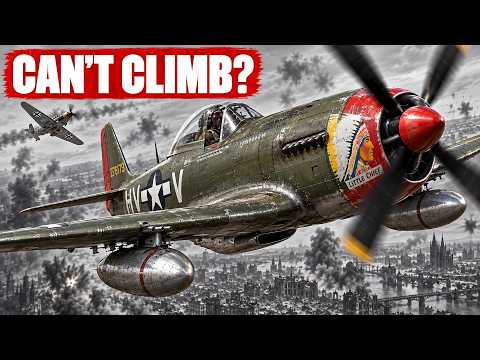
Within two years, the Thunderbolt with that ugly propeller would fly at 470 miles per hour. But first, the pilot in that shattered cockpit had to find a way home.
Robert S. Johnson was 23 years old in the summer of 1943. He came from Lawton, Oklahoma, a town next to the army base at Fort Sill. As a boy of eight, he watched army pilots fly low over the fields and decided in that moment, amid the dust, what the rest of his life would be. He grew up strong and stubborn. He boxed. He never gave up.
By spring 1943, he was a lieutenant in the 61st Fighter Squadron of the 56th Fighter Group, stationed in the flat, green, rainy countryside of eastern England. The morning of June 26 began like dozens of others. Pilots walked toward their planes through the damp air. Mechanics wiped oil from canopy glass and stepped back. Engines coughed, caught, and settled into a deep thunder that shook the ground underfoot.
Johnson climbed into his Thunderbolt and felt its familiar bulk close around him. Everything about the plane was huge. The cockpit was so roomy that pilots joked you could walk around inside it. The nose stretched ahead like the hood of a truck, and behind him sat an engine with the weight of a small car.
They climbed over the Channel, gaining altitude steadily. The formation spread across a pale sky. Somewhere over France, the Germans appeared. They came as they always did in those days—from above, from behind, from out of the sun.
Johnson never saw the first attack. But he heard it. A hammering, tearing sound, and then the cockpit exploded around him. Shells walked across the plane. Metal slammed against the steel armor behind his back. Hydraulic lines burst, and hot fluid sprayed into the cockpit, into his face and eyes. Smoke rose around his legs. Then came fire, small orange flames licking up from the floor.
He reached for the canopy to bail out. It moved a few inches, then stopped. The gunfire had twisted the frame. He heaved with all his strength. He braced his feet and pushed. He beat at it with his fists and shoulders until his arms burned with pain. It wouldn’t open.
Johnson was trapped inside a burning plane, half-blind, flying over enemy territory. Then, for reasons he could never fully explain, the fire suddenly went out. The engine kept running—rough and ragged, but running. He was still alive.
He turned the battered fighter northwest, toward the Channel and England, and began the long trip home alone. He hadn’t gone far when a shape appeared beside his wing: a Focke-Wulf 190, sleek and dark, painted in Luftwaffe camouflage. The German pilot closed slowly, close enough for Johnson to see him turn his head and inspect the ruined American fighter. Then the German dropped back and opened fire.
Johnson hunched behind his armor plate and waited to die. Bullets hammered the plane again and again. They tore through wings, fuselage, and tail. The Thunderbolt shuddered and wallowed, but it kept flying. The German pulled alongside again, looked him over, then dropped back and fired a second time. Still the massive fighter flew on.
Finally, the Focke-Wulf came alongside one last time. The German pilot waggled his wings, a kind of salute. Then he turned back toward France. He was out of ammunition. He had fired everything he had at one American plane, and it would not go down.
Johnson nursed the Thunderbolt over the gray water and landed at an emergency field on the English coast. When the ground crew walked around it, they found 21 cannon holes and more than a hundred bullet holes. The men who had worked on fighters for years stood and stared in silence. That plane had saved his life. No one argued about that.
But there was a question hanging over the wreck. A question the pilots of the 56th Fighter Group were asking more and more that summer. If this plane was so tough, why were the Germans always above them? Why did the enemy always choose the time to fight, attack out of the sun, and climb away before the Americans could answer?
To understand that question, you had to go back to a factory on Long Island and to a quiet man with a heavy accent who had built the largest single-engine fighter in the world. His name was Alexander Kartveli.
He was born in Tiflis, Georgia, in 1896, when that land was part of the Russian Empire. He grew up in a world torn by wars and revolutions. As a young man, he was sent to France to study aviation. When the Soviet Red Army swallowed his homeland, he did not go back. By the late 1920s, he was in the United States. In the 1930s, he became chief engineer of a company founded by another immigrant born in the same city—Alexander de Seversky. That company would become Republic Aviation, with its factory in Farmingdale, Long Island.
In the summer of 1940, Kartveli studied the reports coming out of Europe. The war there had changed everything. Fighters were fighting higher, faster, and more savagely than anyone had predicted. They needed armor to protect the pilot. They needed self-sealing fuel tanks. They needed heavy guns. And every one of those things added weight.
Kartveli’s answer was not to build a lighter fighter. His answer was to take the most powerful engine in America and build a plane around it. That engine was the Pratt & Whitney R-2800 Double Wasp, a massive 18-cylinder radial with two rows of cylinders, producing about 2,000 horsepower. Near the ground, it was a brute. But at high altitude, in the thin air where bombers flew and fighters fought, every engine struggled for oxygen. To keep the Double Wasp breathing up there, Kartveli added a turbosupercharger—a spinning turbine driven by the engine’s own exhaust. He put that turbo in the tail. Huge ducts ran from the engine in front, through the belly of the plane, back to the turbine, and then forward again. The airframe was, in a very real sense, designed around those pipes. It made the plane deep, round, and heavy. It also allowed the engine to keep making power at altitudes where other fighters were gasping.
Then came the propeller problem. An engine that powerful needed a big propeller to turn its power into thrust. The propeller chosen for the new fighter was a four-bladed Curtiss Electric nearly twelve feet across. A prop that size required ground clearance. Ground clearance meant long landing gear. But long gear needed long wheel wells, and the wings also had to carry eight heavy machine guns and all their ammunition. There simply wasn’t room. Kartveli’s team solved it with mechanical genius that still astonishes people today. The main landing gear was designed to telescope. As the wheels retracted, the legs shortened by about nine inches and folded neatly into the wing. When the gear came down, the legs extended to full length again.
The whole airplane was shaped around three things: its engine, its turbo, and its giant propeller. On May 6, 1941, the prototype XP-47B lifted off from Farmingdale for the first time. It was enormous for a fighter. Fully equipped for combat, production versions weighed nearly seven tons—roughly twice the weight of a Spitfire.
Across the Long Island Sound in Connecticut, at the Hamilton Standard propeller division, another engineer understood exactly what that meant. Frank Walker Caldwell was 51 that spring. He had worked on propellers since World War I, when he served as the Army’s chief propeller engineer at McCook Field in Dayton, Ohio. There, he had spun wooden and metal blades on test stands until they shattered. He had watched blades fly apart at full speed. He knew precisely how much violence was stored inside a spinning propeller.
In the early 1930s, Caldwell and his team at Hamilton Standard developed a propeller whose blades could change their angle, their pitch, in flight. It was like giving an airplane gears. In 1933, Caldwell received the Collier Trophy, one of the highest honors in American aviation, for that work. His propellers helped make modern airliners like the Boeing 247 and Douglas DC-2 possible. Caldwell was not a showman. He was an engineer who believed the propeller was the most misunderstood part of any airplane. Everyone looked at the engine. Everyone bragged about horsepower. But horsepower meant nothing unless the propeller turned it into thrust. An engine might roar with 2,000 horsepower, and the plane would still struggle if its blades couldn’t grip the air.
It was a lesson the Army Air Forces would learn the hard way. The Thunderbolt entered combat from England in the spring of 1943. The 56th Fighter Group was among the first to take it into battle, flying its first combat missions that month. British pilots walked around the new American fighter and shook their heads. Parked beside a Spitfire, it looked like a delivery truck next to a racehorse. The American pilots gave it a nickname. They called it the Jug. Some said it was because its fuselage looked like an old milk jug. Others said it was short for Juggernaut. Either way, it wasn’t entirely a compliment.
In combat, the plane’s personality showed quickly. Above 25,000 feet, the Thunderbolt was fast—faster than most German fighters thanks to the turbo. And in a dive, nothing in the sky could stay with it. Its weight pulled it down like a falling safe. But climbing was another story. When a Thunderbolt pilot pulled up his nose to chase an enemy, the heavy fighter lost speed and seemed to hang in the sky. The Focke-Wulfs and Messerschmitts climbed away, then turned and slashed down from above.
The German pilots learned fast. Stay above the Americans. Hit them out of the sun. Climb away. Never let a Thunderbolt drag you into a dive. That summer, the pilots of the 56th came back with planes full of holes, and some didn’t come back at all. Empty chairs appeared at the mess tables. The plane could take incredible punishment. Robert Johnson was living proof of that. But it couldn’t always give its pilots the most important thing in air combat: altitude.
The engineers had given the Thunderbolt a giant engine. They had given it a turbo. They had given it armor, guns, and a fuselage built like a bank vault. What no one had yet realized was that the weakest link in the whole machine was spinning right in front of the pilot’s eyes.
Hubert Zemke was 29 years old when he led the 56th Fighter Group to war. He was the son of German immigrants, raised in Missoula, Montana, a former boxing champion with a sharp mind and very little patience for foolishness. In 1941, before America entered the war, the Army sent him overseas—first to Britain, then to the Soviet Union to help the Russians learn to fly American fighters. He had seen air war up close. He had no illusions about it. And he had no illusions about the Thunderbolt, either.
Zemke knew his pilots were flying a plane whose secrets the Germans had already figured out. The enemy pilots were experienced, many of them veterans who had spent years fighting over Poland, France, Britain, and Russia. They knew the Jug was heavy. They knew it didn’t climb well at medium altitude. They knew that if they could catch it from above, they could control the fight.
So Zemke built his tactics around the plane’s strengths and tried to hide its weaknesses as much as possible. Stay high. Keep your speed. Never climb head-on against a Focke-Wulf. Never try to turn with a Messerschmitt at low speed. Attack from above, slash down fast, and use that tremendous speed to climb back up before the enemy could respond.
It worked sometimes. On good days, Thunderbolts fell on German formations like hawks and tore them apart. Eight heavy machine guns firing together could destroy an enemy fighter in a single burst. The pilots who survived those first months learned to trust the plane’s dive speed and its ability to get them home. A successful attack felt like falling off the edge of the world. The pilot rolled his heavy fighter upside down and let the nose drop toward the enemy formation far below. The airspeed indicator spun around the dial. The controls became heavy and stiff in his hands. The wind outside turned from a roar into a shriek, and the whole plane trembled as it gained speed. Then for a few seconds, a German fighter filled the gunsight, and the pilot squeezed the trigger, and the eight guns fired together, shaking the plane from nose to tail.
Then it was over, and he was pulling up, his weight pressing into the seat, blood draining from his head, gray creeping into the edges of his vision, as the Thunderbolt carried all that speed back up into the safety of altitude. When it worked, nothing could touch them. When it went wrong, there was no second chance.
But the tactic had a cost. It meant Thunderbolts had to be in the right place at the right altitude at the right moment. It meant they spent most of their time defending and reacting, trying to stay ahead of an enemy who could choose when and where to fight. And when the Germans bounced them first, from above, out of the sun, the Americans had only bad choices: dive away and leave the bombers exposed, or try to climb and fight an enemy who could always out-climb them.
Through the summer and fall of 1943, the heavy bombers of the Eighth Air Force bled over Germany. B-17s and B-24s flew deep into enemy territory, and many never came back. The fighters couldn’t escort them all the way to their targets. Range was part of the problem. Early Thunderbolts drank fuel at a terrifying rate, and it took months to supply enough drop tanks to reach deeper into Europe.
There was a moment on those missions that every fighter pilot hated. The fuel gauges wound down to the point of no return, and the fighters had to turn back for England. Below and ahead of them, the great bomber streams kept flying east toward the target alone. The fighter pilots could see them going. They knew what was waiting for them. They knew the German fighters often gathered behind the point where the escort turned back, and there was nothing they could do about it.
Back at the airfields, the evenings followed a rhythm of their own. Men counted the planes as they came over the trees. They counted again. They waited by the runway long after the last engine had died, listening for another. Sometimes one came. Sometimes one didn’t. And the next morning there was an empty bed in the barracks and a new face at the breakfast table within a week.
But range wasn’t the only problem. When the fighters were there, they had to be able to fight on equal terms. And in the vertical fight, in a hard climb against a German fighter on the other side of the sky, the Thunderbolt was still losing. The question was: why?
On paper, the numbers didn’t make sense. The Double Wasp was one of the most powerful fighter engines in the world. With the turbo, it held its power at altitudes where other engines choked. The plane was heavy, yes, but with all that power, it should have climbed far better than it did.
The answer was in a place most people never thought to look—right in front of the airplane. A propeller is a wing. Each blade is a long, thin, twisted airfoil that rotates through the air and pulls the plane forward, just as a wing lifts it up. And like any wing, a propeller blade can only grip so much air. It can only convert so much power into thrust before it begins to slip, to stall, to waste energy.
The original Thunderbolt propeller had long, thin blades. For decades, that was how good propellers were made. Thin blades were efficient. They sliced through the air smoothly in cruise. They offered little resistance to the air ahead of them. Engineers had spent years refining them, and a slender, narrow blade was the mark of good design.
But the Thunderbolt wasn’t flying in ordinary air. At 25,000 and 30,000 feet, the air is thin. Each breath of it holds far less air than at sea level. The turbo could cram that thin air into the engine and keep the power up, but the propeller had no turbo. It had to bite into that thin air with nothing but the shape and size of its blades. Thin blades spinning in thin air couldn’t grip enough of it. The engine’s power was there, but much of it was never converted into useful thrust up high. The plane climbed like a strong man trying to run on ice.
Think of a man rowing a boat. Give him a thin stick instead of an oar, and he can pull with all his strength. The stick will cut through the water, and the boat will barely move. His power is real. It’s simply being wasted. Now give him a proper oar with a broad, flat blade, and suddenly the same pull moves the boat. Nothing about the man has changed—only the tool in his hands. The Thunderbolt had a champion rower at the oars. It was just holding a thin stick.
The fix was almost insultingly simple: make the blade wider. Not longer—longer blades meant tips breaking the speed of sound and wasting energy in turbulence. Wider. Broader chord. More paddle, less knife. Engineers at Hamilton Standard and Curtiss reached the same conclusion independently, and the Army tested both. They worked.
In January 1944, the first broad-bladed props arrived at the 56th in Halesworth. Mechanics worked with frozen fingers in the Suffolk sleet, swapping the slim blades for what looked like riverboat paddles. Pilots squinted at them. Some laughed. Then they flew.
The difference was brutal and immediate. Where the old prop slipped and flailed in the thin air above 25,000 feet, the new one bit down and pulled. Climb rate jumped by roughly 400 feet per minute—the difference between watching a Focke-Wulf escape and running it down. Zemke’s old rule, never climb with a German, quietly died.
By spring, the 56th was hunting instead of hiding. In the Big Week battles of February 1944, Thunderbolts clawed up into fights they once fled. Robert Johnson ran his score to 27, passing Eddie Rickenbacker’s legendary mark. The Wolfpack ended the war with more aerial kills than any other group in the Eighth Air Force—and they did it in the Jug, ugly paddle prop and all.
What looked ridiculous on the ground turned out to be the missing half of the equation. The engine was the muscle. The turbo was the lungs. The broad blade was the hand that finally gripped the sky.
So here’s the question for you: in your own life, what “thin stick” are you pulling with all your strength—when the real answer might just be a wider blade?
Report this article
Select a reason for reporting:






