July 1944. The Narva River, the jagged border between Russia and Estonia, became the stage for one of World War II’s most ferocious and forgotten clashes. Here, on a series of strategic heights known as the Blue Hills, a desperate stand would soon unfold—a battle that would echo the ancient heroism of Thermopylae.
In the sweltering summer heat, the air crackled with tension. Soviet forces, having shattered the siege of Leningrad, were now poised to unleash their full might upon the retreating German Army Group North. The Blue Hills, with their steep slopes and commanding views, were the last natural barrier before the Baltic. Both sides knew the stakes: for the Soviets, a gateway to the Baltic states; for the Germans, a chance to avert annihilation.
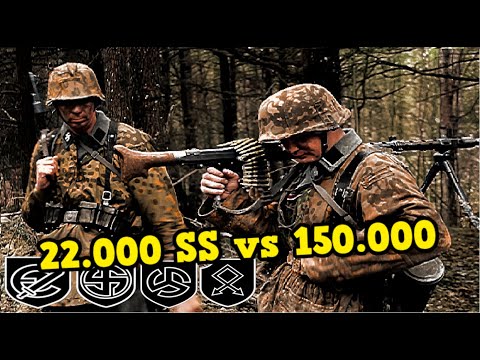
The defenders were an unlikely coalition—22,000 men of the Waffen SS, drawn from the far corners of Europe. Norwegians, Danes, Dutch, and Estonians, united under the banner of the Nordland and Netherland divisions. They were outnumbered nearly seven to one, facing 150,000 Soviet troops backed by thousands of tanks and guns. Yet, they dug in, determined to hold the line.
On July 26, the Soviet onslaught began. Artillery thundered, reducing the forests on the hills to splinters. The 21st and 256th Rifle Divisions, supported by tanks, surged forward, aiming to overwhelm the Nordland division. The Eastern Hill, known as Orphanage Hill, quickly became a cauldron of blood and fire. “Hold the hill! Not one step back!” echoed through the smoke, as men fought with bayonets and grenades.
Among the chaos, acts of incredible bravery emerged. Flemish volunteers of the Langemarck division, armed with Panzerfausts, knocked out fourteen Soviet tanks in a single engagement, repulsing the first wave. But the Soviets pressed on, their numbers inexorable. By afternoon, Orphanage Hill fell, and the defenders retreated to Grenadier Hill, leaving behind a trail of fallen comrades.
As the sun set on July 27, the new commander of Army Group North, Ferdinand Schörner, arrived and ordered immediate counterattacks. But the Soviet juggernaut was relentless. The next day, another hero arose: Remy Schrijnen, a Belgian sergeant in the Langemarck division, manned a 75mm anti-tank gun and destroyed ten Soviet tanks, earning the Knight’s Cross. Yet, the tide could not be turned.
By July 29, the battle reached its climax. Soviet artillery pulverized the hills, and six thousand infantrymen, backed by armor, surged toward Grenadier Hill. The Dutch defenders on the northern flank repulsed the attack, but to the south, the Soviets encircled the defenders and reached Love Hill. The situation grew desperate.
Steiner threw his last tanks into the fray, and Norwegian and Estonian soldiers launched a counterattack to retake Love Hill. The fighting was savage, often hand-to-hand, but slowly, the Soviet advance was checked. “We held them! We actually held them!” a young Estonian soldier gasped, his uniform torn and bloodied, as the enemy fell back.
For two more weeks, the Soviets launched attack after attack, but the men of the III SS Panzer Corps refused to break. By August 10, the exhausted Soviet commanders ordered a halt. The Blue Hills remained in German hands—a pyrrhic victory, but a victory nonetheless.
The cost was staggering: 10,000 German casualties, a dozen tanks lost. The Soviets suffered over 100,000 casualties and lost 160 tanks. Yet, as the smoke cleared, the survivors could not rest. The battle for the Blue Hills was over, but the war was far from finished. The hills would remain contested until mid-September, when Army Group North was forced to retreat, eventually facing encirclement in the Courland Pocket.
But for now, the defenders had achieved the impossible. They had held the line. And as they looked out over the scarred landscape, they knew that their stand would be remembered—not as a defeat, but as a testament to courage in the face of overwhelming odds.
The morning of July 30th broke grey and heavy, the smoke from a thousand shell craters hanging low over Grenadier Hill like a shroud. What remained of the III SS Panzer Corps clung to the scarred earth—foxholes collapsed, bunkers smashed, the dead lying where they had fallen. “Count the ammunition, not the men,” a grizzled Norwegian sergeant muttered to his loader, his voice flat with exhaustion. There was no time for mourning.
Steiner himself moved among the forward positions, his presence a quiet defiance against despair. He knew the arithmetic of the battle better than anyone: his divisions had been reduced to shadows of their former strength. The Netherland division now amounted to little more than a single regiment. Langemarck, once a proud formation of Flemish volunteers, could field only a handful of reinforced companies. The 2nd Estonian Regiment had effectively ceased to exist, its survivors absorbed into other units or buried on the slopes they had defended.
Yet the hills still flew the German colors. And that, Steiner understood, was precisely why the Soviets would not stop.
On the Soviet side, frustration was curdling into something darker. Marshal Govorov, who had staked his reputation on breaking the Tannenberg Line, summoned his corps commanders to a hastily assembled meeting. “Eight attacks on one hill,” he reportedly thundered, slamming his fist onto a map table. “Eight! And still the fascists hold it. I do not want excuses—I want that hill.” Fresh rifle divisions were pulled from reserve, and the artillery parks were replenished. The lull in early August was not a peace; it was a held breath.
For the men in the trenches, the pause was a strange gift. They used it to bury the dead, to patch wounds with whatever bandages remained, to sleep in shifts. A young Danish volunteer wrote a letter home by candlelight, his hands trembling not from fear but from fatigue. “We have done something here that no one will believe,” he wrote. “The hills are ours. But the price, Mother—the price is everything.” He would never send that letter.
Small patrols still clashed in no-man’s-land, and snipers kept both sides respectful of open ground. The Estonian soldiers, fighting for a homeland that seemed to be slipping through their fingers, grew quieter with each passing day. They had heard the rumors from the south—of the catastrophe at Bagration, of the Red Army’s relentless westward tide. Every man among them understood what the Blue Hills had bought: not victory, but time. And time was running out.
Then, on August 10th, the guns fell silent along the entire line. The Leningrad Front’s war council had ordered a halt to offensive operations against the Tannenberg Line. The order was met with disbelief in the Soviet trenches and grim satisfaction in the German ones. “They’ve stopped,” a Flemish soldier whispered, staring eastward at the empty hills. “God above—they’ve actually stopped.”
But as the defenders of the Blue Hills would soon learn, the quiet was only a prelude. Far to the south, the Red Army was already wheeling northward, its sights set on the Baltic coast and the encirclement of Army Group North. The battle for the hills was over—but the reckoning was yet to come.
Schörner wasted no time. Within hours of the Soviet halt, he was on the move, touring the shattered positions with a cold, appraising eye. He ordered every able-bodied man pulled from the line and reorganized into ad-hoc battle groups. “The hills bought us weeks,” he told his staff, “but the enemy will not repeat his mistakes. We must be ready to move before he does.”
The men of the Nordland and Netherland divisions, their ranks thinned to a fraction of their original strength, received orders to prepare for a fighting withdrawal. The Tannenberg Line, once the anchor of Army Group North’s defense, was now a liability—a salient that could be pinched off at any moment by the Soviet forces massing to the south.
Among the survivors, the news landed like a hammer blow. They had bled for these hills, buried their friends in them, and now they were being asked to give them up. “We held this ground with our bare hands,” a young Norwegian SS grenadier protested, his voice cracking. “And now we just walk away?” His sergeant, a veteran of the Narva fighting, placed a hand on his shoulder. “We walk away so we can fight another day. There is no shame in that.”
On the Soviet side, Govorov’s frustration had not abated. He understood that the halt order from the Leningrad Front war council was a strategic necessity—the Red Army’s focus was shifting toward the great encirclement of Army Group North—but it tasted bitter. The 2nd Shock Army had been bled white against the Blue Hills, and the marshal knew that the German defenders, however weakened, would slip away to fight again.
He ordered aggressive patrols to probe the German lines and, if possible, to seize the hills before the enemy could withdraw. On the night of August 12th, Soviet scouts crept toward Grenadier Hill and found the trenches eerily empty. The Germans were gone. “They’ve vanished,” the patrol leader reported, staring at the abandoned bunkers and the scattered debris of a hasty departure.
The withdrawal was a masterpiece of deception. Steiner had ordered campfires lit and dummy positions constructed from logs and helmets, while his men slipped away under cover of darkness. The rearguard, composed of the last remaining armored vehicles, mined the roads and set ambushes at every crossroads. The Soviets, advancing cautiously, found themselves delayed at every turn by hit-and-run attacks and booby-trapped bridges.
By mid-August, the remnants of the III SS Panzer Corps had reached the new defensive positions west of the Narva. They were exhausted, hollow-eyed, and reduced to a shadow of their former strength, but they were alive. And they had done what no one thought possible: they had held the Blue Hills for nearly three weeks against overwhelming odds, buying precious time for Army Group North to avoid immediate destruction.
But the reprieve was brief. The Red Army’s Baltic Offensive was already gathering momentum, and the men who had defended the hills would soon find themselves fighting for their very survival in the Courland Pocket. The battle for the Blue Hills was over—but for the soldiers of the Nordland and Netherland divisions, the war was far from finished.
By late September, the thunder of Soviet guns returned—not to the Blue Hills, but to the roads behind them. The Baltic Offensive had torn a gaping hole in the German front, and Army Group North was ordered to abandon the Narva line entirely. “So this is how it ends,” a Dutch SS veteran murmured, watching the hills recede in the autumn mist. “Not with a final charge—just a march into the fog.”
The retreat became a nightmare of mud, ambushes, and endless columns of weary men. By October, the survivors of the III SS Panzer Corps found themselves trapped in the Courland Pocket, their backs to the sea, surrounded by the same Red Army they had defied at the Blue Hills. There would be no more victories—only a grim, forgotten siege that would last until the war’s bitter end.
Yet the men who had stood on Orphanage, Grenadier, and Love Hills carried something the maps could never show. “We held them once,” a Norwegian sergeant told the new recruits, his voice steady. “Remember that. When everything else is gone, remember the hills.”
And so the Blue Hills passed into legend—a forgotten Thermopylae, fought by foreigners for a cause many would later curse, yet remembered by those who survived as the finest, most terrible days of their lives. The war moved on, but the hills remained.
What would you have done, standing on that scarred earth with the enemy closing in and no relief in sight?
Report this article
Select a reason for reporting:






