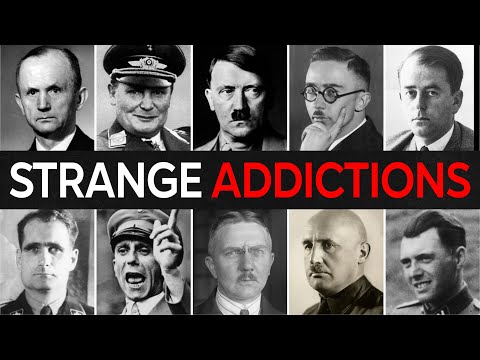
What happens when absolute power meets absolute delusion? Behind the uniforms, the salutes, and the horror, there were obsessions. Not just with war, but with rituals, syringes, poetry, gold, ghost energy, and tragic self-pity. These men weren’t just tyrants. They were addicts to strange things, dangerous things, things they tried to hide.
This isn’t just history. It’s a descent into 25 minds where evil didn’t march. It twitched, hoarded, injected, and whispered to itself in the dark. Welcome to the strangest addictions of the Nazi elite. You’ve heard how the Reich rose. Now see what rotted it from within.
Before we dive in, if you’re into dark history, hidden obsessions, and stories they never taught in school, hit subscribe so you don’t miss what’s coming next. While you’re here, drop a comment. Where are you watching from? And what time is it right now? Midnight in Berlin? 3:00 a.m. in Ohio? Let’s see who else is wandering through the weird corners of history with us tonight.
One, Adolf Hitler. Prescription drug cocktails. He wasn’t just the most feared man in Europe. He was also quite possibly the most overmedicated. By 1944, Adolf Hitler’s daily pharmaceutical intake would have put a rave crowd to shame. Methamphetamine for focus, barbiturates for sleep, cocaine for his sinuses, bull semen for vitality, and something derived from pig bile that his doctor swore helped with digestion.
The man who insisted Germans stay clean and strong was being pumped full of over 80 different concoctions by his private physician, Dr. Theodor Morell. A man once described as looking like a medicated walrus. Hitler believed these injections made him invincible. Morell would appear daily like a loyal chemist priest plunging syringes into the Führer’s pale trembling flesh.
Some say Hitler’s erratic behavior in the final years, the trembling hands, the sudden rages, the delusional speeches were less about ideology, more about pharmaceutical roulette. His war room became less a chamber of strategy, more a pop-up pharmacy with a dictator twitching through withdrawal. And when the miracle drug stopped working, he demanded more. The cure became the leash.
But where did this chemical obsession come from? For that, we follow the trail straight into the velvet-draped labyrinth of Hermann Göring. Two, Hermann Göring. Morphine and luxury excess. If Hitler was a junkie in denial, Göring was a maximalist in full bloom. Morphine, silk robes, golden pistols, pet lions, an obsession with uniforms. Hermann Göring didn’t just indulge. He curated his addictions.
Wounded in World War I and handed a morphine prescription to take the edge off, he never stopped. While the Third Reich rationed bread, Göring rationed truffles. While Berlin shivered, Göring sat in mink-lined chairs under oil paintings he looted from Jewish families. He once reportedly weighed over 300 pounds and still insisted his tailored military costumes be tight enough to show off medals he had awarded himself.
His estate, Carinhall, looked like Versailles got drunk and moved to the woods. His addiction wasn’t just chemical. It was symbolic. Göring hoarded beauty and decadence as a shield against the ugliness he helped orchestrate. When Allied bombs approached his mansion, he ordered it blown up rather than let anyone else walk its halls. But Göring’s cravings had limits. He sought the physical, things that glimmered and numbed. The next figure sought answers in smoke and symbols. Beyond wealth or war, he was consumed by myth. Step into the strange rites of Heinrich Himmler.
If you’re still here after that, you’re exactly the kind of curious mind we built this channel for. Go ahead and hit subscribe. It keeps the stories coming and the lights on. And tell us in the comments where are you tuning in from and what time is it right now. We’re betting some of you are deep in the night shift with headphones on.
Three, Heinrich Himmler. Occult mysticism. Heinrich Himmler didn’t just believe in ghosts. He tried to weaponize them. As head of the SS, Himmler was obsessed with Germanic paganism, astrology, and ancient runes. Convinced that Aryan destiny could be divine through arcane rituals, he commissioned astrologers. He sent archaeological teams hunting for the Holy Grail. He reimagined the SS as a kind of cult military order, complete with candlelit ceremonies and death’s head rings.
His headquarters, Wewelsburg Castle, was designed as a literal pagan temple, stone chambers, ritualistic floor mosaics, even plans for a black sun crypt beneath the earth. This wasn’t strategy. It was addiction disguised as ideology. Himmler saw himself as a mystic warrior restoring cosmic balance, even while orchestrating atrocities with bureaucratic calm. He believed reincarnation was real. He believed Atlantis was Aryan. He genuinely thought runes held power. While soldiers fought and died, he poured Reich resources into esoteric nonsense, trying to read the stars while the world burned.
But while Himmler whispered to spirits, another man whispered to himself obsessively, endlessly, and on paper. The Reich’s most dangerous propagandist wasn’t just addicted to lies. He was addicted to his own story. Four, Joseph Goebbels. Self-documentation. If narcissism were a fuel source, Joseph Goebbels could have powered Berlin for a decade. As Hitler’s propaganda minister, Goebbels mastered the art of controlling the narrative. But the narrative he cared about most wasn’t Germany’s. It was his own.
Over 30,000 pages of personal diaries written obsessively, compulsively at all hours of day and night. He didn’t just chronicle events, he rewrote them. He spun his fears into prose, his bitterness into poetry, his loyalty into tragic devotion. The war may have been lost on the battlefield, but in Goebbels’ mind, it was still winnable on paper. His addiction wasn’t just to writing. It was to reframing reality. When Berlin fell to ruin, he wrote about its sacred destiny. When his influence waned, he scribbled oaths to his own sacrifice. Each sentence was a mirror. Each entry a confession disguised as legacy.
Goebbels wasn’t trying to tell the truth. He was trying to be remembered on his own terms with his own punctuation. But behind the ink and the lies, there was something else. Paranoia, frailty, the desperate grasping for control through repetition. And speaking of repetition, meet the man who believed he could cure himself through enemas, star charts, and dietary ritual. Enter Rudolf Hess.
Five, Rudolf Hess. Pseudo-medical obsessions. If Goebbels journaled his way into delusion, Rudolf Hess attempted to detox his way into purity. And then he just kept going. Obsessed with health, astrology, and medical fads, Hess turned his body into a testing ground for every pseudoscientific therapy he could find. Raw food diets, bizarre fasts, essential oils before essential oils were even essential.
He distrusted processed food. He feared industrial medicine. He believed poisons were everywhere, hidden in pills, meals, even thoughts. The deeper he went, the more detached he became. Friends and aides described his compulsions as ritualistic: hours of sunbathing, enemas at dawn, herbal infusions prepared like holy sacraments. He consulted astrologers for major decisions and believed planetary alignments could predict betrayal.
His body was his fortress, and he guarded it obsessively. Yet for all his cleansing, his paranoia only grew. Eventually, his fixation on purity led him to his most irrational act: flying solo to Scotland in a misguided attempt at peace talks, guided more by horoscopes than strategy. Even Hitler was baffled. Hess had vanished into his own delusions, purified perhaps, but completely unhinged.
But while Hess sought purity through ritual, another man found satisfaction in violating it, one injection at a time. Meet Dr. Theodor Morell. Six, Theodor Morell. Injecting others. Theodor Morell didn’t crave power in the traditional sense. He craved control through injection. Known as the Reich’s most unusual doctor, Morell was a man of contradictions. Bloated, sweaty, and medically questionable, yet somehow indispensable to Hitler.
His obsession wasn’t medicine. It was penetration by syringe. Vitamins, hormones, stimulants, sedatives. If it could be injected, Morell had a vial for it. And if it couldn’t, he’d find a way. He didn’t just medicate his patients. He performed on them. Syringes became wands, needles blessings. His injections were constant, often daily, and delivered with priest-like solemnity.
Morell believed that pills were weak. Only injections, he claimed, reached the soul. His office became a theater of compulsive treatment, and Hitler was his most addicted audience. Even among the Nazi elite, Morell was mocked as a quack. But they still lined up when they needed something extra. Behind the curtain of legitimacy, his methods were murky, using animal extracts, industrial chemicals, whatever the moment required. The injections weren’t just therapy. They were theater, ritual, power.
And while Morell filled bodies with chemicals, one man did the opposite, removing nourishment in the name of science. His obsession was starvation. His name was Ernst Günther Schenck. Seven, Ernst Günther Schenck. Human starvation experiments. Ernst Günther Schenck didn’t see hunger as suffering. He saw it as data. Trained as a physician and later embedded within the SS medical apparatus, Schenck developed a cold fixation on starvation, not as a tragic byproduct of war, but as a controllable variable.
He obsessed over calorie counts, nutrient deprivation, and the slow mechanical breakdown of the human body when food was withheld. To him, starvation wasn’t cruelty. It was a process, a system, a puzzle that could be measured, charted, refined. Colleagues later recalled how Schenck spoke of hunger with disturbing neutrality, as if discussing faulty machinery. He convinced himself that by understanding the limits of the human body, he was serving science, perhaps even progress. This was the lie that made his obsession possible.
He wasn’t just following orders. He was intellectually invested. Starvation became his specialty, his niche. The thing that made him useful and therefore untouchable. What made Schenck particularly unsettling wasn’t sadism. It was enthusiasm. He leaned into his role with academic pride, insulating himself from moral consequence by burying everything under terminology and charts. In his world, empathy was inefficient. Distance was professional.
But obsession takes many forms. Some bury themselves in numbers and denial. Others craft themselves into legends so large they can’t be questioned. And few men inflated their own myth quite like the scar-faced commando who turned war into personal branding. Otto Skorzeny was waiting in the wings, polishing his reflection.
Eight, Otto Skorzeny. Personal myth-building. Otto Skorzeny didn’t just fight wars. He staged them. Tall, scarred, theatrical, he cultivated the image of the Reich’s most daring commando with the precision of a film director. His most famous operation, the rescue of Mussolini, was real enough. But what followed was something else entirely. A lifelong addiction to his own legend.
Interviews, memoirs, carefully exaggerated accounts. Skorzeny turned selective truth into a personal franchise. He understood something crucial: history favors confidence, so he supplied it in excess. Stories grew more heroic with every retelling. Risks became calculated genius. Coincidences became destiny. Even defeats were reframed as misunderstood brilliance. Skorzeny wasn’t lying outright. He was curating, editing himself into the center of every frame.
After the war, this addiction didn’t fade. It intensified. He sold his image to journalists, intelligence agencies, and anyone willing to listen. The war may have ended, but his performance never did. He lived as if the spotlight were permanent, convinced that survival itself proved his exceptionalism. But where Skorzeny inflated himself into myth, another man wallowed in something darker. Obsession not with heroism, but degradation. He didn’t want to be admired. He wanted to provoke. Julius Streicher didn’t build legends. He collected filth.
Julius Streicher. Pornographic anti-Semitism. Streicher wasn’t satisfied with hatred. He needed it exaggerated, sexualized, obsessively repeated. As publisher of Der Stürmer, he pushed propaganda beyond politics into obsession, producing material so lurid that even other Nazis found it excessive. Streicher fixated on grotesque caricatures and explicit fantasies, recycling the same imagery again and again, as if repetition might make it real.
This wasn’t just ideological zeal. It was compulsion. Streicher surrounded himself with his own publications, reread them constantly, and personally micromanaged content to ensure it remained shocking. Hatred for him wasn’t a tool. It was a fixation that consumed his identity. Where others used propaganda strategically, Streicher indulged in it, marinating in degradation until it became indistinguishable from desire.
Even Hitler, no stranger to extremism, kept Streicher at arm’s length. There was something unseemly about his obsession. Something too raw, too revealing. Streicher didn’t mask his fixations behind philosophy or science. He reveled in them, unchecked and unapologetic. But obsession doesn’t always announce itself so loudly. Sometimes it hides behind white coats and moral logic. The next figure believed he was acting out of mercy, convinced that killing could be reframed as care. And that belief, more than any addiction, proved lethal.
Ten, Karl Brandt. Euthanasia ideology. Karl Brandt liked to describe himself as a healer. He wore the title comfortably, almost proudly, even as he quietly redefined what healing meant. As Hitler’s personal physician and a key architect of the so-called mercy death programs, Brandt became addicted to an idea more than a substance. The belief that killing could be reframed as care if the language was clean enough.
His obsession wasn’t violence. It was logic. A cold, polished logic that reduced human lives to categories, efficiencies, and diagnoses. Brandt spoke in clinical terms, wrapping irreversible decisions in medical calm. He convinced himself that compassion could be engineered, that eliminating burdens was not cruelty, but progress. This wasn’t a lapse or a momentary rationalization. It became his intellectual comfort zone. The more resistance he encountered, the deeper he leaned into theory, papers, committees, procedures. Bureaucracy became anesthesia.
What made Brandt dangerous was how sincerely he believed himself. There was no theatrical cruelty, no rage, just a serene certainty that he was right. He treated ideology like medicine and medicine like math. Somewhere along the way, the patient disappeared entirely. But not everyone hid behind clinical detachment. Some obsessions were grander, louder, and built to last a thousand years. At least in stone. To understand that kind of fixation, you have to look up, way up. Albert Speer was already drawing the skyline.
Eleven, Albert Speer. Architectural gigantism. Albert Speer didn’t just want to build buildings. He wanted to build eternity. Hitler’s favorite architect was obsessed with scale, permanence, and how power should look long after its creators were gone. Speer designed structures so massive they bordered on absurd: domes meant to dwarf cathedrals, avenues designed for endless parades, monuments engineered to crumble beautifully into romantic ruins centuries later. He even planned how decay should appear, ensuring the empire would look noble even in collapse.
This wasn’t ambition, it was fixation. Speer believed architecture could outlive guilt. If the buildings were big enough, solid enough, beautiful enough, they would drown out the screams beneath them. He lost himself in blueprints and models, convincing himself that art and efficiency could exist separate from consequence. While cities burned, Speer obsessed over stone quality and sightlines. After the war, he reframed himself as the apolitical technocrat. Another act of architectural illusion, this time built from words instead of concrete. But the obsession never really faded. He always spoke of structures, never of people. Walls were safer. They didn’t argue back.
Yet even Speer’s monumental dreams required emotional insulation. Others coped differently by turning inward, by retreating into self-pity and performance. One man oversaw terror by day and played piano by night. Convinced he was the real victim in the room. Hans Frank was already warming up the keys.
Twelve, Hans Frank. Music and self-pity. Hans Frank fancied himself a misunderstood artist trapped in a brutal world. As Governor-General of occupied Poland, he presided over devastation while privately indulging in addiction to classical music and his own sorrow. Frank spent evenings playing piano, losing himself in Beethoven and Chopin, framing his life as tragic rather than monstrous. In his mind, he wasn’t a perpetrator. He was a sensitive soul burdened by responsibility.
Music became his refuge and his excuse. After long days of issuing orders, he would sit at the piano and weep, convinced that his suffering balanced the scales. He wrote about himself constantly, casting his role as that of a fallen intellectual, forced into moral compromise by fate. Self-pity wasn’t a side effect. It was the addiction. It allowed him to feel profound without feeling accountable. Frank’s fixation on his inner turmoil insulated him from the external consequences of his authority. If he could feel deeply enough, mourn loudly enough, then surely he must still be human. That was the lie he clung to, note by note.
But while Frank hid behind music, another mind drifted even further from reality toward invisible forces, cosmic energies, and a belief that science itself had missed something fundamental. The obsession wasn’t power or beauty. It was an energy no one else could see. Wilhelm Reich was already building the box.
Thirteen, Wilhelm Reich. Orgone energy. Wilhelm Reich didn’t fit the usual Nazi mold. Not a uniformed ideologue, but a fringe scientist dancing dangerously between genius and delusion. Before being expelled from the Reich and later exiled entirely, Reich had become consumed by a theory so abstract it sounded like parody. Orgone energy, a mystical, all-pervasive life force he claimed could be harvested, stored, and even weaponized.
His obsession wasn’t just with proving it existed. It was with building the machines that could contain it. Orgone accumulators, he called them: coffin-sized boxes where believers would sit for hours absorbing invisible energy waves. Reich wasn’t content being an eccentric theorist. He became a prophet. He believed orgone explained everything. Love, weather, disease, fascism. Skepticism only fueled his conviction. Critics weren’t just wrong. They were enemies of truth. He treated ridicule as proof of righteousness, paranoia as enlightenment. Even after being cast out by the very regime that once flirted with his ideas, Reich never let go. And so he vanished into his theories, conducting experiments alone, chasing energy no one else could feel.
But where Reich saw power in the air, the next man found it in paperwork, contracts, clauses, and the twisted comfort of legality. Arthur Seyss-Inquart didn’t need energy. He had footnotes.
Fourteen, Arthur Seyss-Inquart. Legal rationalization. Arthur Seyss-Inquart was less a fanatic than a functionary. Soft-spoken, educated, and disturbingly polite. He embodied the bureaucrat’s dream: obedience wrapped in justification. His addiction: legality. The compulsion to find a law, clause, or precedent to excuse almost anything. As Austria’s Nazi-appointed chancellor and later governor of occupied Holland, Seyss-Inquart didn’t argue morality. He argued paperwork. He restructured repression into memos. His crimes arrived in typed paragraphs, double-spaced, formatted like policy proposals.
This wasn’t apathy. It was fixation. He believed deeply in systems, in the comforting illusion that legality could neutralize horror. He wasn’t the type to shout orders. He signed them, and he expected the ink to sanitize what followed. When confronted with the aftermath, he often seemed confused, as if surprised that anyone would find fault in procedures so carefully filed. His addiction to legal language gave him plausible deniability until it didn’t. At his trial, he spoke in the same measured tones, invoking duty, structure, and necessity. But beneath the calm surface was a mind that had long abandoned conscience for clause.
And while Seyss-Inquart buried morality in legal ease, the next figure buried it in something colder: precision-driven obsession with the human form. Twins, symmetry, and surgical fate awaited under the scalpel of Joseph Mengele.
Fifteen, Joseph Mengele. Twin obsession. Joseph Mengele wasn’t searching for answers. He was chasing perfection. As the Angel of Death at Auschwitz, his true fixation wasn’t experimentation in general. It was twins. Identical, fraternal, conjoined. Any kind would do. He wasn’t motivated by curiosity so much as a warped quest for symmetry, an aesthetic and ideological obsession rolled into one. He believed twins were nature’s cheat code to genetic purity. Mirror images to be compared, controlled, broken apart.
But what made Mengele terrifying wasn’t just the nature of his work. It was the ritual of it. He personally selected his subjects with an almost theatrical interest, meticulously logging every detail in notebooks as if cataloging fine art. He often appeared strangely gentle at first, smiling, asking questions before transforming that familiarity into something clinical and cold. His addiction to twins became his identity. He was less a doctor than a curator of bodies, rearranging nature in pursuit of something that only existed in ideology and imagination. Precision, purity, symmetry. These weren’t scientific goals. They were compulsions disguised as research.
But while Mengele sought perfection in duplicate, another man worshiped a different idol. Gold melted, hoarded, and polished until it gleamed like absolution. Walther Funk never saw wealth the same way again.
Sixteen, Walther Funk. Gold fetishism. Walther Funk was no battlefield general. He wielded no rifle, issued no dramatic orders. His war was waged from behind desks, vault doors, and balance sheets. As Reich Minister of Economics and Head of the Reichsbank, Funk’s addiction was gold, not as currency, but as symbol. He became fixated on the idea that wealth equaled purity, and that hoarded gold represented not just power, but permanence.
Under his watch, the Reichsbank accepted and stored vast reserves of looted valuables: wedding rings, watches, eyeglass frames, and yes, dental gold, systematically cataloged, melted down, and reforged into usable bullion. Funk wasn’t just complicit. He was enchanted. Reports suggest he spent excessive time in the bank’s vaults, moving among the stacks, inspecting ingots, treating the piles not as evidence of atrocity, but as testaments to financial genius. His speeches reflected this obsession, painting gold as the stabilizing force of civilization. In truth, he saw it as the only thing immune to decay. He believed in gold’s immortality, even as everything else crumbled.
But while Funk measured power in weight and luster, another man measured it in movement. Fast, precise, obsessively managed. Heinz Guderian didn’t collect wealth. He collected control.
Seventeen, Heinz Guderian. Operational micromanagement. Heinz Guderian was a tactician, a perfectionist, and above all a micromanager in uniform. As a leading architect of Blitzkrieg strategy, Guderian treated war like a chessboard he couldn’t stop rearranging. His addiction wasn’t fame or ideology. It was command in real time. He demanded updates by the hour, interfered with field reports, rerouted divisions mid-battle, and even bypassed political protocol if he thought an order was wrong.
He wasn’t content with being right. He needed to be everywhere, constantly adjusting the machine he helped build. This obsession made him formidable but also insufferable. Guderian’s colleagues frequently clashed with him, not because he lacked competence, but because he insisted on inserting himself into every detail. He believed disaster could be avoided if only he were involved in each decision. Delegation was weakness. Autonomy was risk. By the end, his addiction to control made him politically radioactive. But to Guderian, that was irrelevant. If tanks moved smoother and timelines stayed tight, that was enough. It wasn’t about ego. It was about precision delivered through command.
But if Guderian was a man of metal and maps, the next figure was something else entirely. A poet in jackboots, addicted not to war, but to romantic illusions. Enter Baldur von Schirach, the Reich’s lyrical narcissist.
Eighteen, Baldur von Schirach. Poetic narcissism. Baldur von Schirach wanted to be remembered not as a Nazi but as a tragic poet who happened to govern. As the head of the Hitler Youth and later Gauleiter of Vienna, Schirach cloaked himself in cultural sophistication, quoting Goethe while signing off on deportations. But underneath the cultured veneer was a profound addiction to aestheticized self-pity.
He wrote poetry obsessively, often about loyalty, destiny, and his own misunderstood soul. His verse framed Hitler as a mythic hero and himself as a romantic disciple swept along by fate. This wasn’t irony. It was survival. Schirach buried his complicity in meter and metaphor, crafting a narrative in which he wasn’t an architect of suffering, but its victim. He treated political power like performance art, casting himself as a sensitive intellectual trapped in a brutal system, doomed to be judged for the crimes of others. It was narcissism in rhyming couplets. Even at his trial, he quoted poetry. Not law, not defense, poetry. Because for Schirach, image was everything. If he could just rewrite the story beautifully enough, the ending might change.
But while he floated on verses, another man sank deep into myth. One obsessed not with beauty, but with rewriting the origin of humanity itself. Alfred Rosenberg wasn’t composing poems. He was building a racial religion.
Nineteen, Alfred Rosenberg. Mythological racial theory. Alfred Rosenberg wasn’t content with rewriting history. He wanted to rewrite creation itself. As the chief racial theorist of the Nazi regime, Rosenberg’s addiction was to mythology disguised as scholarship. He constructed vast pseudo-historical frameworks that blended Nordic legends, racial pseudoscience, and borrowed bits of ancient philosophy into a sprawling ideological tapestry.
His central text, The Myth of the 20th Century, read like a fever dream of borrowed grandeur, claiming that Aryans were the sacred engine of civilization, spiritually descended from Atlantis, and fated to dominate history. Rosenberg wasn’t stupid, just hopelessly enthralled by his own inventions. He scoured ancient texts and esoteric sources, not for knowledge, but for confirmation of his mythos. Every ruin, every rune, every symbol was twisted into validation. He didn’t need truth. He needed narrative. A grand, holy one. To him, this wasn’t policy. It was prophecy. Other Nazis used Rosenberg’s ideas when convenient. He treated them as gospel. His mind wasn’t political. It was theological, obsessed with purity, not just of blood, but of meaning.
But while Rosenberg chanted myths in the shadows of dead empires, one man ruled his occupied territory like a theater of cruelty where power wasn’t spiritual but sadistic. Erich Koch didn’t theorize darkness. He performed it.
Twenty, Erich Koch. Sadistic domination. Erich Koch ruled occupied Ukraine like a medieval tyrant with a modern budget. Unlike others who cloaked their actions in policy or ideology, Koch’s obsession was brutally straightforward: domination for its own sake. He wasn’t merely authoritarian. He was compulsively cruel, often exceeding even Nazi directives in his treatment of the local population. His addiction wasn’t to doctrine. It was to feeling powerful. Visibly, viscerally, absolutely.
Reports from the era described Koch as erratic, vengeful, and performatively brutal, delivering public punishments and issuing contradictory commands just to assert dominance. He seemed less interested in outcomes than in spectacle. Governance became theater, and his audience, whether terrified subordinates or terrified civilians, was always captive. He wasn’t driven by belief. He was driven by the thrill of subjugation. Koch once said that Ukrainians were no better than animals, but it wasn’t ideology. It was justification. He needed the permission to indulge in domination without shame. The Reich gave him that mask. He wore it too well.
But while Koch flaunted his tyranny, another man turned his power inward, convinced he was more than a politician, more than a writer, more than a man. Dietrich Eckart believed he was chosen.
Twenty-one, Dietrich Eckart. Prophetic self-image. Dietrich Eckart didn’t just think he understood Hitler. He believed he had created him. As an early Nazi mentor, poet, and cult dabbler, Eckart styled himself as a prophet-kingmaker, a spiritual father figure to the Führer. His addiction wasn’t to substance or status. It was to cosmic self-importance.
He wrote verses that dripped with grandiosity, framing himself as a vessel of ancient truths destined to awaken the German soul through a boy named Adolf. Eckart mixed nationalism with mysticism, convinced that the rise of Nazism wasn’t politics, it was prophecy fulfilled. He saw cabals everywhere, secret forces working against the chosen people, and himself as the only one able to decode the signs. His notebooks weren’t political manifestos. They were revelations. He claimed to understand esoteric symbols, ancient bloodlines, spiritual vibrations. In his mind, Hitler wasn’t a man. He was his message made flesh. Even after his death, the myth he built endured. His name was whispered like a sacred prelude. His writings treated like scripture by early party faithful. He didn’t seek influence. He sought immortality.
But while Eckart reached for eternity, another man raced against time, driven by sleepless ambition, tireless work, and an addiction to productivity as salvation. Fritz Todt never slowed down. Not once.
Twenty-two, Fritz Todt. Hyperproductivity. Fritz Todt didn’t believe in rest. He believed in output. Raw, ceaseless, glorified labor. As Hitler’s chief engineer and founder of the Organisation Todt, he built autobahns, fortifications, bunkers, and mythologies of progress. His obsession wasn’t just with building. It was with never stopping. Todt reportedly worked 18-hour days, often surviving on minimal sleep and stimulants, not out of obligation, but because he felt compelled. The war was a canvas, and his blueprints were its gospel.
But hyperproductivity for Todt wasn’t just engineering. It was identity. The moment he stopped working, he ceased to matter. He pushed impossible deadlines, overrode expert warnings, and demanded results at a pace that defied logic. He treated construction like combat. Each project became a monument to willpower. Each delay a personal insult. When he died in a plane crash in 1942, even Hitler remarked that no one could replace him. Not because of brilliance, but because no one else was so willingly enslaved to the work. Todt didn’t believe in limits. He believed in building his way past them.
And while Todt built toward exhaustion, another man spiraled in the opposite direction, addicted not to creation, but to destruction, served raw, violent, and street-level. Christian Weber never saw a brawl he didn’t like.
Twenty-three, Christian Weber. Street-level violence. Christian Weber never truly left the street. A horse trader turned early Nazi enforcer, Weber’s addiction was primitive and unfiltered: raw physical dominance. Even as he climbed the party ranks and became a high-ranking SS officer, his taste for direct violence never dulled. He was addicted not to strategy or ideology, but to the act of intimidation itself. Fist fights, beatings, threats. Not just power, but tactile power, the kind you could throw across a barroom.
Unlike others who polished their image for high society, Weber remained proudly crude, a gangster in uniform. His enemies feared him, but so did his allies. He operated with impunity, his thuggishness protected by proximity to Hitler. There were whispers, complaints, reports of brutality, but Weber thrived on them. The more chaos he caused, the more essential he seemed. He didn’t need medals or metaphors. He needed to feel feared. He needed confrontation. Politics was just the arena that let him keep swinging.
But while Weber’s power came from his fists, the next figure wielded it from behind ledgers and illusions. His weapon wasn’t muscle. It was money conjured from thin air. Hjalmar Schacht didn’t break things. He made mirages.
Twenty-four, Hjalmar Schacht. Financial manipulation. Hjalmar Schacht was the magician of Nazi economics, an economist so brilliant and so morally disengaged that he could make entire budgets appear where no money existed. His addiction was elegant and invisible: financial sleight of hand. As the Reich’s Minister of Economics and President of the Reichsbank, Schacht engineered a parallel economy of fake currency, barter deals, and opaque banking tricks that allowed Germany to rearm before the world realized what was happening.
He wasn’t a loyal ideologue. He was a technician. A man addicted to the thrill of outsmarting the system. He created shell companies, moved gold like chess pieces, and played international markets with the calm of a poker champion bluffing with nothing in his hand. Schacht didn’t just manipulate numbers. He relished the manipulation itself. And yet, for all his skill, he walked a tightrope, too smart for the thugs around him, too useful to discard until he wasn’t. Eventually, even his illusions couldn’t shield him from the regime’s chaos.
But where Schacht dealt in invisible games, the last man in our list was obsessed with rituals visible to everyone. Uniforms perfect to the centimeter, daily habits followed with military zeal. Karl Dönitz didn’t imagine order. He lived it.
Twenty-five, Karl Dönitz. Total discipline ritual. Karl Dönitz didn’t crave pageantry or mysticism. He wasn’t a mythmaker, a cultist, or a sadist. He was something in many ways more unnerving: a man of absolute routine. As commander of the U-boat fleet and later Hitler’s appointed successor, Dönitz structured his life and those around him like a machine calibrated to military perfection.
His addiction was discipline. Not just in action, but in thought, posture, diet, speech, shaving times, walking pace. Every detail logged, repeated, enforced. He believed rituals weren’t just habits. They were moral anchors. Deviate, even slightly, and you risked collapse. Officers under his command were expected to uphold this same obsessive order: daily inspections, unbroken chain of command, polished boots, perfect charts, no excuses. While others in the Reich dissolved into superstition or chaos, Dönitz doubled down on control. Not because it made sense, but because it was predictable. Predictability to him was sanity.
Even as Germany crumbled, Dönitz kept routines intact. He issued naval orders when there were no ships left to sail. He addressed subordinates with full titles when the state they served no longer existed. The world ended and he shaved anyway. And maybe that’s the strangest addiction of all. The fantasy that order can outlast collapse. That in the face of moral ruin, one more checklist will make it all clean again.
So here we are, at the end of our descent into the 25 minds where evil didn’t just march—it twitched, hoarded, injected, and whispered to itself in the dark. These were not just tyrants, but addicts, each consumed by a private obsession that ultimately helped rot the Reich from within. Their stories are a chilling reminder that absolute power doesn’t just corrupt—it distorts, until the men who wield it become prisoners of their own delusions.
But the question remains: which of these obsessions do you find most disturbing? Was it Hitler’s pharmaceutical haze, Himmler’s occult fantasies, or perhaps Dönitz’s hollow discipline? Share your thoughts in the comments below—we read every one. And if you’ve made it this far, you’re clearly one of us. Hit subscribe for more deep dives into the dark corners of history. Until next time, stay curious, and stay skeptical. Because the past is never as distant as it seems.
Report this article
Select a reason for reporting:






