Temperate rainforest once covered a significant portion of the British Isles, but centuries of clearance for timber, agriculture, and development have reduced it to less than one percent of its former extent. For decades, this habitat loss received little formal attention. A private restoration project on a farm in Cornwall, begun in 2019, provided a working demonstration of how the ecosystem could recover, and in 2023 the British government published its first national strategy for restoring England’s temperate rainforests.
The temperate rainforest of the British Isles requires high rainfall, high humidity, and low annual temperature variation. These conditions allow mosses, liverworts, lichens, and ferns to grow on trees, rocks, and other surfaces. The western coastline of Britain, from Cornwall to the Scottish Highlands, provides this climate. Maps of what remains show small, disconnected fragments, many of which are slowly declining.
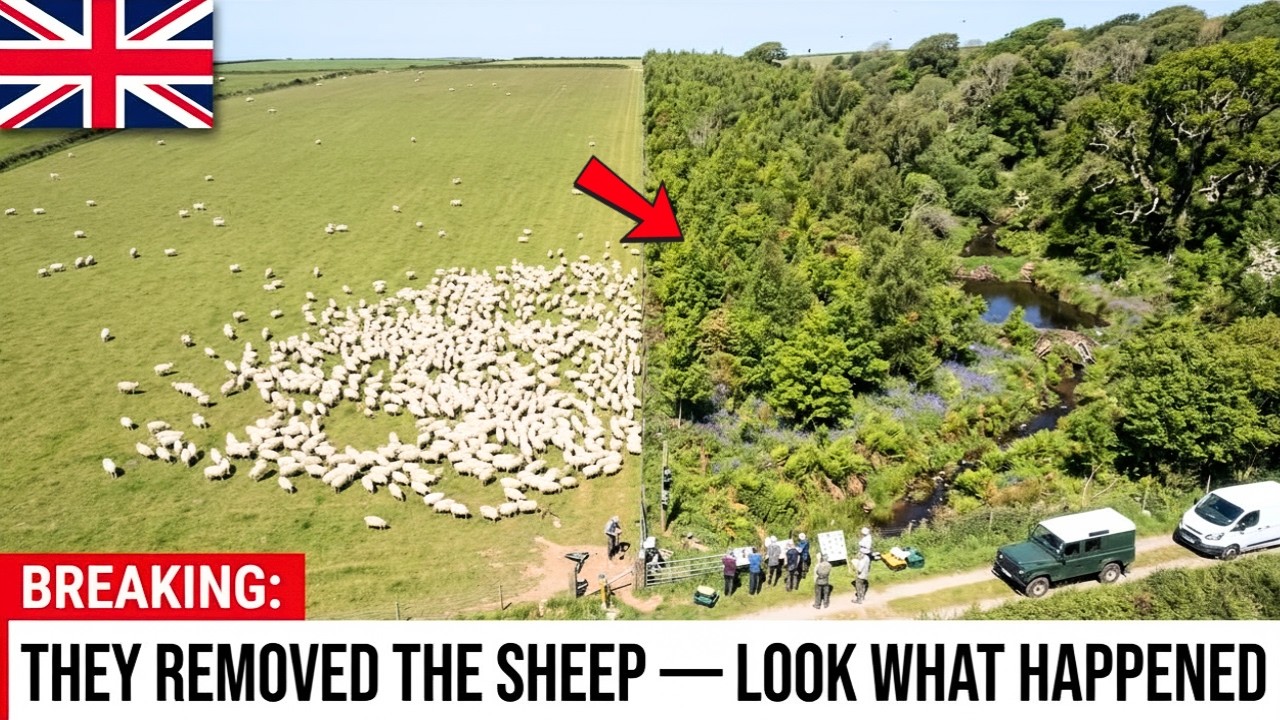
Several pressures have prevented regeneration. Sheep, introduced and subsidized into large numbers, eat young plants that grow under the canopy. Deer populations, without natural predators, consume saplings before they reach maturity. Gray squirrels strip bark and harvest acorns. An invasive ornamental plant, Rhododendron ponticum, chokes the understory. In many places, the ancient oaks that remain are the last generation, as new trees have been unable to grow.
Cabilla, a valley on the southern edge of Bodmin Moor in Cornwall, has a long history. The Domesday Book of 1086 lists a farm there called Carbulia, and research suggests the site has had continuous tree cover for more than 3,500 years. The Hanbury-Tenison family has farmed the area since 1960. For most of that period, the operation was conventional: sheep, cattle, and some deer and wild boar. The forest survived because it was difficult to clear, but it declined because no one was actively managing it for regeneration.
In 2018, Robin Hanbury-Tenison’s son, Merlin, took over the farm after a career as a British Army officer and a period in the corporate world. He found a forest that was not regenerating. The following year, he and his wife, Lizzie, launched what they called the Thousand Year Project. The goal was to plant 100,000 trees, restore the existing ancient woodland, and reintroduce species that had been locally extinct for centuries. In 2022, they established a charity called the Thousand Year Trust, whose mission expanded to tripling the amount of temperate rainforest across the United Kingdom.
The first intervention at Cabilla was straightforward: the sheep were removed, deer numbers were managed, and gray squirrels and rabbits were controlled. With the herbivore pressure reduced, native oak, hazel, birch, rowan, and willow saplings began regenerating naturally on the forest edges. The seed sources had been present all along; the seedlings had been eaten as soon as they appeared. Once that pressure was removed, the forest began to recover on its own.
Researchers from the University of Plymouth, the University of Exeter, and the Eden Project began studying the site. The wider Cabilla and Red Rice Woods Reserve supports six species of bat, including the greater horseshoe bat. The findings suggested that the British temperate rainforest contains species assemblages not found in the same combination elsewhere, making it a habitat of international significance.
In November 2023, the British government published its first formal plan to recover England’s temperate rainforests. The plan acknowledged that approximately 18,000 hectares of temperate rainforest remained in England, that they were of international biodiversity significance, and that government policy would support their restoration. Critics noted that the plan lacked an overarching target, but the plan existed. Five years earlier, the government had not formally recognized the habitat as a distinct category.
Several factors contributed to this shift, including public attention from a book by Guy Shrubsole and a BBC series presented by David Attenborough, as well as decades of work by botanists and lichenologists. The demonstration site at Cabilla provided a proof of concept.
By 2024, the Thousand Year Trust had expanded its scope to the wider Cornwall Rainforest Project, aiming to triple temperate rainforest cover across the county. The approach is sometimes called rewilding, or process-based restoration. The idea is to restore natural processes, such as reducing herbivore pressure and allowing natural regeneration, then let the ecosystem develop on its own. In 2023, the insurance company Aviva announced a 38 million pounds, 100-year partnership with the Wildlife Trusts to restore temperate rainforest across the British Isles. Several major conservation organizations now have active temperate rainforest restoration programs.
The transition has not been without tension. Hill farming in the British uplands has relied on public subsidies for generations, and the sheep that have damaged rainforest regeneration were part of a system the public was funding. The shift to nature-positive land use has real consequences for farming communities. The Hanbury-Tenison family owns the land at Cabilla, a position most tenant farmers are not in. The Thousand Year Trust has stated that its preferred model is partnership with existing farmers rather than displacement, and the Cornwall Rainforest Project is structured around supporting agroforestry, low-impact grazing, and farmer-led restoration.
The forest at Cabilla will not become a mature rainforest within the lifetime of anyone working on the project today. The 100,000 trees will take decades to grow, and reintroductions of species such as beaver and red squirrel will take time. The model will not save the existing one percent of British temperate rainforest unless broader land-use policies change. But within the first growing seasons of reduced herbivore pressure, the forest began regenerating naturally. By the second year, native saplings were rising on land that had been pasture for generations. By the fifth year, the British government had published a national strategy for a habitat it had not formally named for most of the previous century. The recovery did not require the most expensive interventions. It required the removal of what had been preventing the forest from growing, and the forest has been doing the rest.






