In 2002, the Monterey Bay Aquarium released an orphaned sea otter pup into Elkhorn Slough, a degraded California estuary north of Monterey Bay. The pup had been raised by a non-releasable female otter named Toola, who had adopted it inside the aquarium’s exhibit tank. Over the next 14 years, 36 more orphaned pups followed the same path. Stranded on California beaches, rescued within days of birth, raised by surrogate mothers, and released into the slough’s brackish waters, the animals became part of an experiment that researchers did not expect to succeed.
By 2019, when the full 15-year data set was published in the journal Oryx, the results had exceeded all projections. The eelgrass beds, which had collapsed to just two hectares by the early 1980s under heavy agricultural runoff, had expanded sixfold. The otter population had more than doubled. Surrogate-reared animals and their descendants accounted for more than half of all population growth in the estuary. Beneath the surface, an entire food web was reorganizing around a top predator that had been absent from California estuaries for over a century.
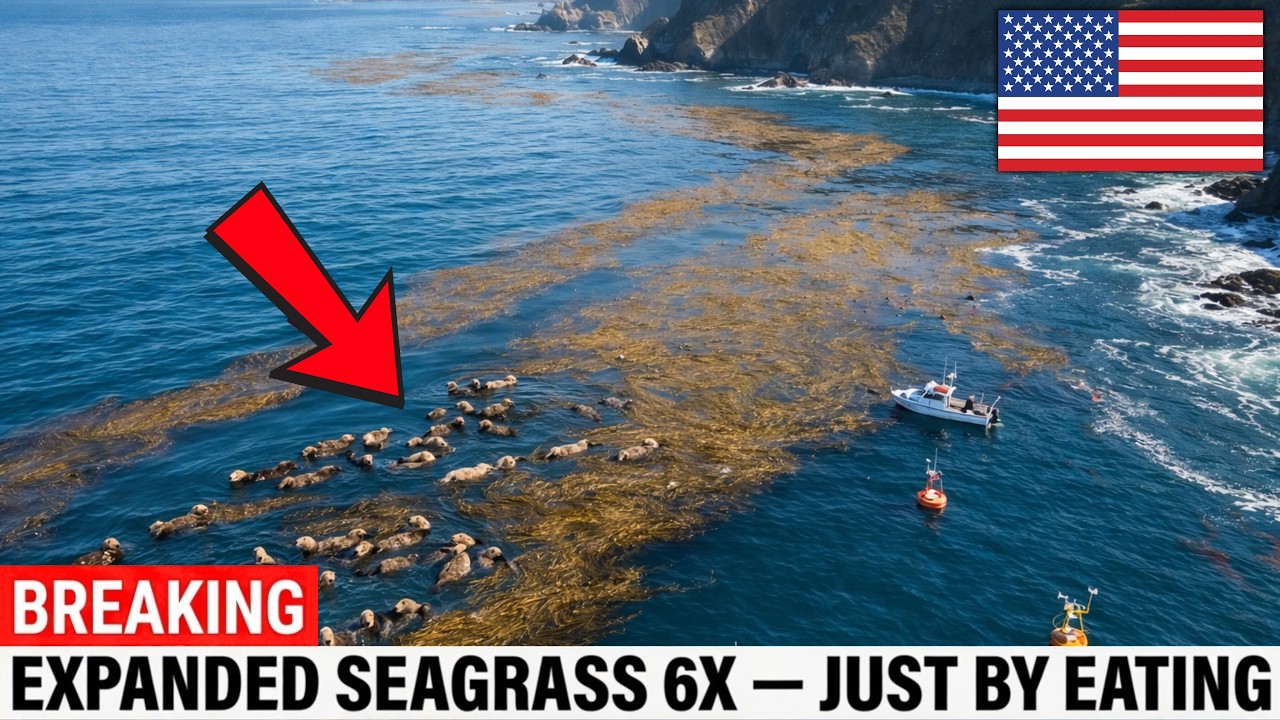
Most accounts of sea otter recovery focus on the animals’ appeal. This story follows the data: the stranded pups, the caretakers who wore cloaks to prevent imprinting, one otter orphaned at three days old who is now raising wild pups of her own, and the peer-reviewed evidence showing what happens when a keystone species returns to an ecosystem long written off as lost.
The southern sea otter is the smallest marine mammal in North America, weighing between 30 and 70 pounds. It has the densest fur of any animal on Earth, about one million hairs per square inch. That fur is the only thing keeping it alive in cold coastal waters, because sea otters have no blubber. An otter with wet skin in cold water will die, so they spend hours each day grooming to trap a layer of air next to their skin. To fuel that metabolism, a sea otter eats roughly 25 percent of its body weight daily, diving up to 250 feet for crabs, clams, urchins, abalone, and snails. They are among the few non-primate mammals known to use tools routinely, smashing shellfish against rocks balanced on their chests.
Sea otters are also a formally designated keystone species. When present, they regulate the food web beneath them. When absent, the entire structure collapses as every species below reorganizes around the loss.
Before European contact, an estimated 150,000 to 300,000 sea otters ranged from northern Japan through Alaska and down the California coast to Baja California. Beginning in 1741, the maritime fur trade changed that. Sea otter pelts were among the most valuable furs in the world, and the commercial hunt ran for 170 years. By 1911, when the International Fur Seal Treaty outlawed the hunting of sea otters, the species was considered functionally extinct across its range. The surviving California population was estimated at about 50 animals on a remote stretch of the Big Sur coast.
The consequences were ecological as well as biological. Without otters preying on urchins, urchin populations exploded across the coast. Urchins grazed kelp forests down to barren rock expanses known as urchin barrens. Fish that depended on kelp for spawning and shelter collapsed, as did invertebrate diversity and nearshore productivity. The coast that had teemed with life in the 1700s looked like an underwater desert by 1950.
In California’s estuaries, the damage was compounded by agricultural runoff. Fertilizer sales in the Elkhorn Slough watershed rose from 200 tons per year in the 1930s to 30,000 tons per year by 2005. The nutrients fed algal blooms that grew on eelgrass leaves, blocking sunlight. By the early 1980s, eelgrass cover in Elkhorn Slough had collapsed to just two hectares. The system had no top predator and too many nutrients. Scientists assumed it was a lost cause.
The first attempt at active intervention came in the late 1980s. Between 1987 and 1990, the US Fish and Wildlife Service moved 140 wild sea otters from the central California coast to San Nicolas Island, off the coast of Los Angeles, to establish an insurance population against oil spills. The translocation failed. Most of the moved otters died, disappeared, or swam hundreds of miles back to their original ranges. Only a handful remained. The project was declared over, and the lesson was that wild adult otters with an established home range will try to return to it.
At the Monterey Bay Aquarium, a different approach was emerging. The aquarium had been rescuing stranded sea otter pups since the 1980s, orphaned by storms, disease, or shark attacks. Hand-raising the pups with human caretakers did not work. The pups imprinted on humans and did not survive in the wild. In 2001, a non-releasable female otter named Toola, who could not return to the wild herself, did something unexpected. When a stranded pup was placed in her exhibit, she adopted it. She groomed it, let it sleep on her chest, and taught it to open shellfish, dive, and behave like an otter.
The program that grew from that first adoption was built on careful protocols. Orphaned pups, sometimes rescued within hours of separation from their mothers, were brought to the aquarium. Human caretakers who fed the youngest pups wore dark cloaks and face shields so the infants never learned what a human face looked like. At around eight weeks of age, once a pup had shed its fluffy natal coat, it was transferred to the exhibit tank, where a non-releasable female was allowed to adopt it. Over the next four to six months, the surrogate mother taught the pup to groom, dive, identify food, and open shells. At approximately seven months, the juvenile was ready for release.
Elkhorn Slough was chosen deliberately. It had a small existing population of male otters, abundant prey, accessible waterways for monitoring, and degraded ecological conditions that researchers hoped otters might help repair. The first surrogate-raised juvenile was released there in 2002. Between 2002 and 2016, 36 more followed. Each released pup carried a surgically implanted radio transmitter, and the first two weeks after each release were treated as a conditioning period, with field teams monitoring the animal daily. If a pup was not foraging successfully, it was recaptured.
The biggest surprise was where the otters stayed. The San Nicolas translocation had failed because wild adults tried to return home. The surrogate-reared pups had no home to return to. Most had been orphaned at birth and had no ecological memory of anywhere else. When released into Elkhorn Slough, they stayed. Ninety percent of released females and 80 percent of males remained in the slough, a retention rate no prior translocation program had approached.
The emblematic case was sea otter 327. Rescued in 2005 after stranding at Morro Strand State Beach when she was three days old, she was brought to the aquarium, raised through the surrogacy protocol, and released into Elkhorn Slough as a juvenile. She stayed, reached breeding age, mated with a wild male, and began producing wild-born pups of her own in the same slough where she had been released. An animal orphaned three days into her life became, through a chain of human and otter caregivers, a mother of wild California sea otters.
By 2016, the arithmetic was clear. Thirty-seven surrogate-reared pups had been released. At least eight females had survived and reproduced in the slough. Median age-specific survival rates for surrogate-reared otters were virtually indistinguishable from those of wild-born otters along the Monterey Peninsula.
What researchers documented next was a full ecosystem response. When Dr. M. Tim Tinker, a sea otter population biologist, ran the numbers, the surrogate-reared otters and their descendants accounted for more than half of all observed population growth in Elkhorn Slough during the study period. The slough had been limping along with a small, male-dominated population that could not reproduce on its own. The surrogate-reared females changed that by establishing breeding in an estuary that had been ecologically incomplete for generations.
In 2013, a team led by Dr. Brent Hughes at the University of California, Santa Cruz published a paper in the Proceedings of the National Academy of Sciences documenting a trophic cascade. Sea otters do not eat eelgrass, but they eat large quantities of crabs, favoring the two cancer crab species that dominate Elkhorn Slough. The crabs eat small grazing invertebrates, sea slugs, and isopods that clean algae off eelgrass blades. Without otters, crab populations were abundant, the grazers were suppressed, algae grew unchecked, and eelgrass suffocated. When otters returned, crab populations crashed, grazers rebounded, eelgrass was scoured clean, and the meadows expanded sixfold.
This recovery occurred in an estuary where nutrient pollution had been rising for decades. The eelgrass recovered not because the pollution was fixed, but because the predator at the top of the food chain had returned and was regulating the system again from above. Divers documented eelgrass meadows where there had been bare mud a decade earlier, and juvenile fish, halibut, herring, and salmon using the recovered meadows as nursery habitat. Shorebird activity increased on banks where restored vegetation had returned.
A 2023 follow-up study in Biological Conservation documented two decades of refinements to the surrogacy technique and confirmed that it remains one of the most effective tools for restoring sea otter populations. The Monterey Bay Aquarium is now evaluating Morro Bay as the next release site, another California estuary where otter numbers are low and eelgrass is in decline.
Sea otters have also become an economic presence. Kayakers on Elkhorn Slough routinely encounter rafts of dozens of otters, many descended from the surrogacy program. The aquarium’s live sea otter exhibit is among the most visited attractions of any aquarium in the world. Tourists come to Monterey specifically to see the animals.
Before the fur trade, California’s sea otters ranged from just north of San Francisco Bay south into Baja California. The historical record of that range survives in old ship logs, indigenous oral tradition, and place names like Otter Rock and Otter Cove describing a coast that had not seen a wild otter in generations. Now the animal is back in at least one slough, in the descendants of 37 orphaned pups raised by surrogate mothers and released into an estuary that nobody expected to recover.
The current California range still extends only about 480 kilometers of the central coast, from around Santa Cruz down to Santa Barbara. The species remains listed as threatened under the United States Endangered Species Act, and the historical range has not been fully recovered. But the proof of concept is now in the water. Surrogate-reared otters can restore a population, and that population can restore an ecosystem. Over 15 years, recovery in Elkhorn Slough accelerated in ways the models did not predict.






