In the Arctic, two predators occupy the top of the food chain in separate domains. On the ice, the polar bear relies on strength and endurance. In the water, the killer whale uses speed and coordinated hunting strategies. For thousands of years, their territories rarely overlapped, but the shrinking of sea ice is bringing them into closer contact and changing the dynamics of Arctic predation.
Research in Svalbard, a Norwegian archipelago, provided an unexpected illustration of how the Arctic food web can be disrupted. Scientists investigating an unusual number of harbor seal deaths performed a necropsy on a Greenland shark, a slow-moving scavenger sometimes called a living fossil. Inside the shark’s stomach, they found the jawbone of a polar bear. The discovery was notable because it showed that even a dominant land predator can end up as prey.
Researchers do not believe the shark actively hunted the bear. Greenland sharks are slow and typically feed on carrion, making them incapable of taking down a healthy adult polar bear. The more likely explanation is that the bear died, possibly from injury or exhaustion, and sank into waters where the shark fed on its remains. The find underscored how thin the margin for survival can be in the Arctic, where an accident can turn a top predator into food for another species.
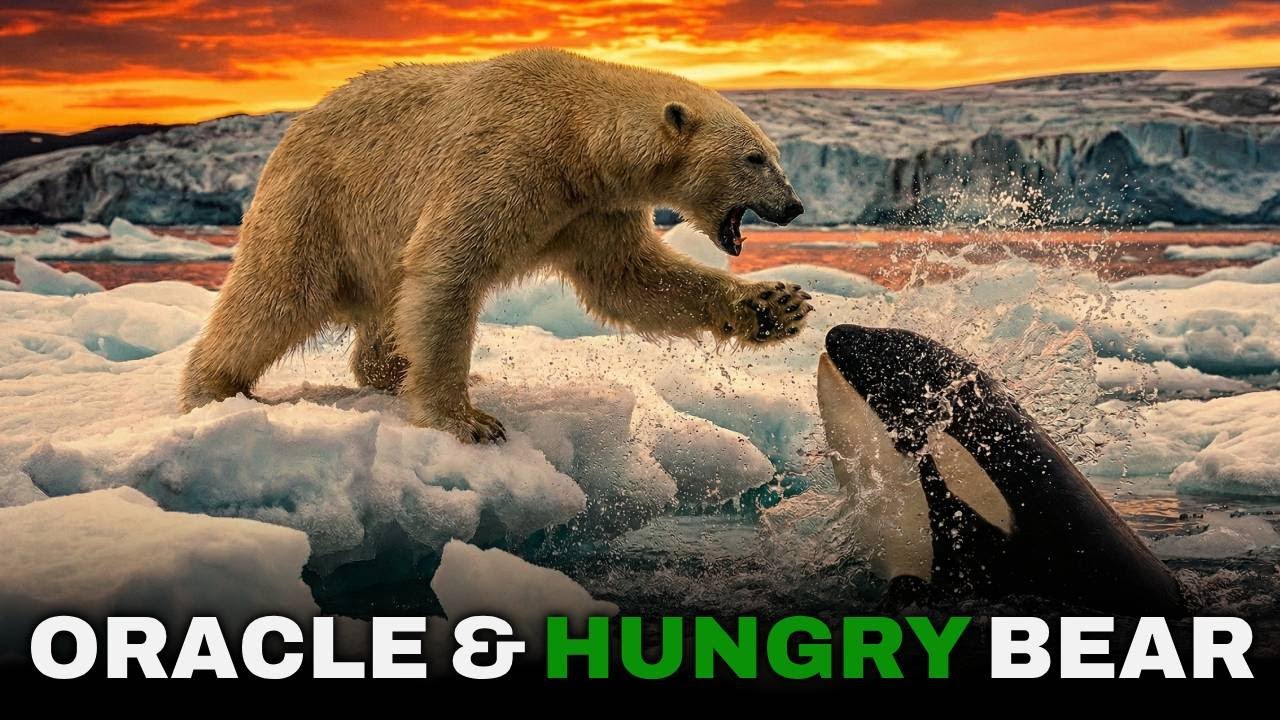
Interactions between polar bears and killer whales are rare and usually driven by food. Neither species actively hunts the other under normal conditions. A live killer whale in open water is beyond a polar bear’s reach, and a healthy polar bear on land or ice is not accessible to a whale. Their paths cross most often when a carcass washes ashore. A dead whale can provide enough fat and protein to feed many polar bears for weeks, and such finds draw bears from a wide area.
This separation of territory has historically prevented direct conflict. But climate change is altering that balance. As sea ice declines, polar bears lose access to their main prey, seals, and must range farther or seek alternative food sources. At the same time, killer whales are moving into Arctic waters that were once blocked by ice, opening new hunting grounds. The two species are now appearing in the same areas more frequently than before.
One documented example of polar bears gathering in large numbers occurred on Wrangel Island in 2017, when a whale carcass washed ashore. More than 200 bears converged on the site. The gathering was driven by necessity rather than cooperation, as each bear competed for a share of the food.
Killer whales have long been regarded as highly effective marine hunters. Their name in Latin carries associations with death, and early sailors observed them coordinating attacks on prey much larger than themselves. They use teamwork, speed, and vocal communication to isolate and capture seals, fish, and other whales. In the open ocean, they have few natural threats.
Polar bears hunt alone. Their strategy depends on stealth, patience, and a powerful sense of smell. They are adapted for life on sea ice, where they wait near breathing holes for seals to surface. Their physical strength allows them to break through ice and overpower prey that most other land predators could not handle.
As the Arctic warms at roughly twice the global average, the pressures on both species are increasing. Polar bears face longer periods without ice, forcing them to swim greater distances or move onto land where seals are harder to catch. Some bears have been observed fishing for salmon in rivers, a behavior not previously documented in the species. Others have preyed on reindeer when seal hunting became impractical.
Killer whales, meanwhile, are expanding their range into waters that were previously inaccessible. This brings them into contact with new prey and new risks. In Hudson Bay, for example, the bay freezes over in winter, which historically kept killer whales out. In summer, when the ice retreats, they enter to feed. But the ice can return quickly, and whales that misjudge the timing can become trapped in shrinking openings.
In 2013, a group of killer whales in Hudson Bay became trapped in just such a situation, confined to a small area of open water surrounded by ice. Polar bears gathered at the edge of the ice, waiting for an opportunity. A trapped whale, weakened by stress and exhaustion, could become vulnerable.
Similar events have been documented elsewhere. In 2015, white-beaked dolphins in Norwegian waters became trapped in a small gap in the sea ice, and polar bears took advantage of the situation to pull the dolphins onto the ice.
Polar bears have also hunted beluga whales, particularly young ones, around Somerset Island. The bears position themselves at spots where the whales surface to breathe and strike when the whales come within reach. A single successful hunt can provide enough food to sustain a bear for weeks.
The changing conditions are creating new risks and new strategies. A killer whale that is injured, stranded, or separated from its group may become a target for a hungry polar bear, although such encounters remain uncommon. A healthy killer whale in open water would be effectively impossible for a polar bear to catch.
Polar bears also demonstrate a capacity for planning that extends beyond hunting. After making a large kill, a bear may hide the carcass under snow and ice, creating a natural cache that preserves the meat and conceals it from scavengers and competing bears. This behavior has been documented on a limited number of occasions, but it shows an ability to manage resources over time.
The species has shown adaptability over long periods. Polar bears evolved from brown bears and have survived multiple shifts between ice ages and warmer intervals over roughly fifty-two thousand years. But the current rate of change is faster than anything in that history, and the question is whether they can adjust quickly enough.
There are some signs of resilience. A study from the Chukchi Sea region, home to roughly three thousand polar bears, found that the population there has remained stable. These bears have continued to find sufficient seals and maintain good physical condition. Their situation is better than that of bears in other parts of the Arctic, where ice loss has been more severe.
Tracking individual polar bears presents practical challenges, particularly in group settings such as zoos. Researchers have developed unusual methods to address this, including adding small amounts of non-toxic glitter to each bear’s food. The glitter passes through the digestive system and can be identified in droppings, allowing researchers to determine which bear produced which sample.
When comparing the two predators, environment determines the outcome. In the water, the killer whale is faster, more agile, and equipped with sophisticated group hunting tactics. A polar bear in the water is at a clear disadvantage. On land or ice, the polar bear has the strength and endurance to dominate, and a killer whale cannot leave the water to challenge it.
Neither species is invulnerable in the new Arctic. A polar bear’s strength is of little use in deep water, and a killer whale’s speed does not help it on ice. The retreat of the ice is erasing the boundaries that once kept these predators apart. As their ranges overlap more frequently, both must adapt to conditions for which neither is fully prepared.
The Arctic is changing faster than its wildlife can fully adjust. The old rules that kept these predators in separate worlds are breaking down, and the long-term outcome is uncertain. The question is no longer simply which predator is stronger, but which will be able to survive as the rules of the Arctic continue to shift.






