In southern Florida, python hunters keep mental records of their catches. Last season, those numbers took an unexpected turn. Hunters captured fewer live pythons than the year before, which initially seemed like positive news. Fewer invasive snakes would suggest the ecosystem was recovering. But population models indicated the opposite. Radio transmitters attached to more than sixty monitored pythons were sending signals from the same locations for weeks. In the field, that means one thing: the snake carrying the transmitter had died. When biologists went to investigate, they found not isolated deaths but clusters of deceased pythons gathered in the same shaded areas of the swamp. There were no visible claw marks, bite wounds, or signs of external attack. The bodies were not scattered randomly. They were grouped together, as if something had swept through entire areas of the snake population rather than targeting individual animals. Whatever was killing the Everglades’ top invasive predator was not hunting them from outside. It was already inside them.
To understand why this discovery concerned researchers, it helps to know how established Burmese pythons have become. The snakes first appeared in the Everglades in the late 1970s and early 1980s, likely from escaped or released pets. By the 2000s, they had turned southern Florida into an unrestricted feeding ground. Surveys tracking mammal populations along park roads found that rabbit and fox sightings had dropped to near zero. Raccoon numbers fell by about 99 percent, while opossum and bobcat populations declined by more than 80 percent in the main hunting range. The reason was straightforward: no native predator here had evolved to handle a snake of this size. Florida panthers, alligators, and bobcats sometimes attacked smaller individuals, but there was no coordinated pressure, no inherited instinct across generations. Four decades is nothing in evolutionary terms. The python entered a system that was, biologically, unaware of its existence.
Human effort became the main resistance. Contracted hunters were paid per foot of snake length. Public hunting competitions turned removal into an organized event, with one recent season yielding more than five hundred animals. Researchers implanted tracking devices in what they called scout snakes, mostly males, and followed them to breeding aggregations during mating season. Sometimes a dozen animals were caught gathered around a single female. This worked in the sense that thousands of snakes were removed from the ecosystem over the years. But it did not work in the way that mattered most. Total population estimates still ranged from tens of thousands to hundreds of thousands, spread across a wetland the size of a small state. Much of it is impossible for humans to walk through, let alone search. So when the die-off began, no one expected good news. They expected something worse. They were right.
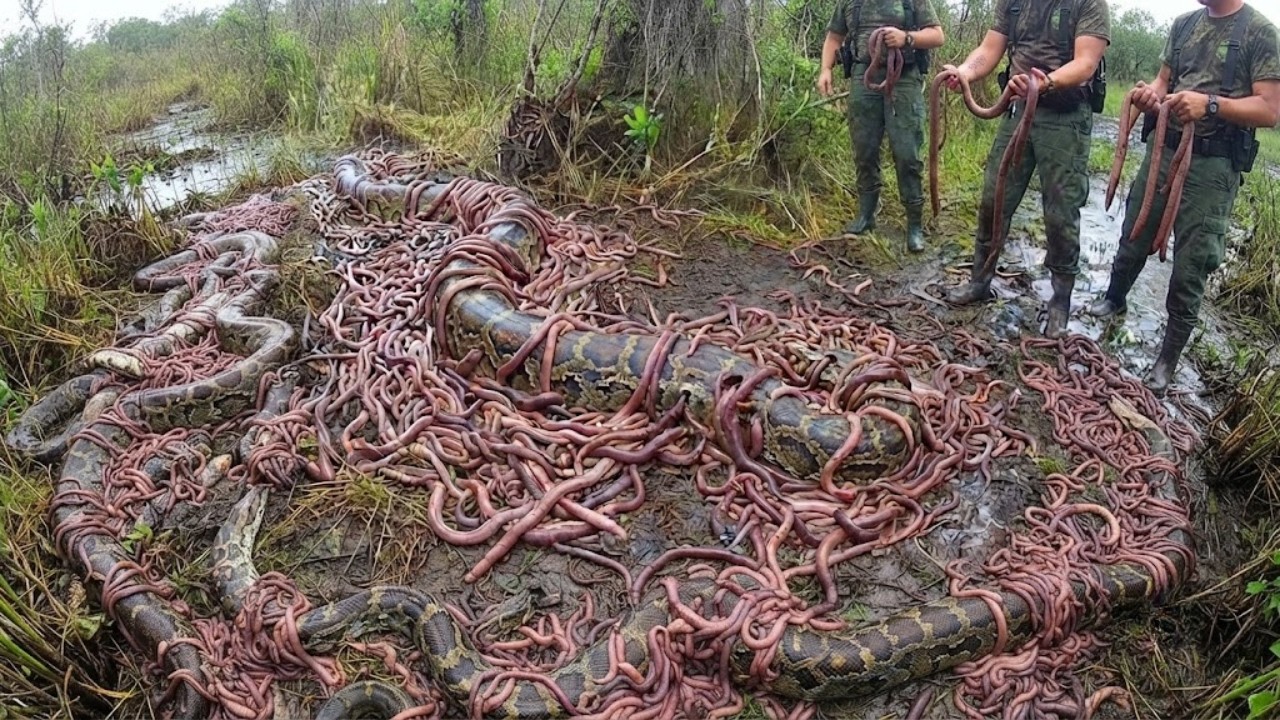
The team investigating the clustered deaths ruled out the obvious suspects almost immediately. An alligator attack leaves torn flesh and deep wounds. A panther or wildcat leaves claw marks and dragged carcasses. Poison, if someone were using it illegally, tends to leave detectable traces in tissue and organs. None of that appeared. What researchers found when they opened the pythons’ chest cavities was unusual. The lungs were not collapsed or scarred. They were packed with pale, thread-like organisms tangled into dense masses. In samples examined soon after death, some of these organisms were still moving weakly. This was not external injury. It was something living, feeding, and reproducing inside the snake’s respiratory tract until there was no physical room left to breathe. The animal had effectively suffocated from the inside over weeks without showing a single external sign. In snakes examined shortly after death, the tissue lining the lungs was thickened and scarred around the parasite masses, evidence that the body had been fighting a losing battle for some time. There was no single crisis moment. It was a slow, patient siege the animal had no way to resist because its evolutionary history had not prepared it for an enemy this small operating from deep within its own body.
The organism responsible is a parasitic lungworm, a species that evolved alongside Burmese pythons in their native range in Southeast Asia long enough for the snake’s immune system to learn to tolerate it. In that original relationship, the worm is a tenant, not an executioner. Wild pythons in Myanmar or Thailand carry moderate numbers of these parasites throughout their lives without fatal consequences because host and parasite negotiated their terms over an evolutionary timescale. The python was never the target. It was the carrier. The moment this carrier was smuggled into a swamp on the other side of the planet, that balance meant nothing, because the worm found new hosts.
The transmission chain does not require one python to touch another. Adult worms living in an infected python’s lungs release eggs that pass out with waste. Flies, ubiquitous in a wetland this size, land on that waste and pick up the eggs. Native frogs do what frogs have always done: they eat flies. Native snakes do what they have always done: they eat frogs. Every link in that chain is completely ordinary swamp behavior, the same food web that has operated in the Everglades for thousands of years. The only thing that changed is what rides inside it. Once larvae reach a new host, they burrow through the stomach wall, migrate to the lungs, and settle there permanently, feeding and reproducing while the host’s airway slowly narrows. Researchers studying infected native snakes describe animals found gasping with open mouths, moving slowly, starving for air they could no longer inhale. Unlike pythons, which had millions of generations of tolerance built into their biology, Florida’s native snake species had no prior exposure at all. Cottonmouths, rat snakes, and several species of rattlesnakes have been found with severe, often fatal infections. Surveys tracking the parasite’s spread have found infected animals hundreds of miles north of the main python range, meaning the worm has stopped relying entirely on its original host. Even if every python in Florida disappeared tomorrow, the parasite would continue circulating through flies, frogs, and native snakes indefinitely because it no longer needs the species that brought it here.
This is what concerns invasive-species researchers most. Most invasions end when you remove the invader. This one has already outgrown its original mode of transport. Field surveys have confirmed infections in more than a dozen native snake species across a range much larger than anyone initially expected. Each new survey season pushes that boundary further north. Some of the hardest-hit species are already under separate pressure from habitat loss and road mortality. A slow respiratory parasite arriving on top of that does not land on a healthy population. It lands on populations already declining, with less genetic depth to draw on and less capacity to absorb another source of decline. While that happens below the surface, the remaining python population is not standing still either. Genetic sequencing of hundreds of captured snakes revealed a small but real number of individuals carrying DNA from the Indian python, a closely related species that also entered Florida through the pet trade over the decades. The two lineages met somewhere in the wetland and produced hybrid offspring.
That finding matters because of the environments each species adapted to. Burmese pythons are creatures of still water, dense marsh, and mud, which is exactly why the Everglades acted as a kind of natural enclosure, keeping the population within the wetland habitat they actually need. Indian pythons prefer drier ground, forest edges, and woodland, places a pure Burmese python might struggle to survive. A hybrid that inherits tolerance for both environments is no longer restricted to the same geography. Add to that the discovery that a single female python can be fertilized by multiple males in one breeding cycle, mixing genetic material from several fathers in a single clutch of eggs, and you get a population generating new genetic combinations faster than any model built around traditional invasive species can predict.
There is another detail rarely discussed outside the research community. Pythons that swallow fruit-eating animals pass viable seeds through their digestive systems and deposit them miles from where the meal was eaten. They are not only consuming the animals of these ecosystems. They are quietly reshaping where plants grow, seed by seed, with each digestive cycle. Even in a hypothetical future where every python vanished, the vegetation patterns they have already started would continue to appear for decades. None of these mechanisms were part of the original threat assessment when the first escaped pets were spotted decades ago. At the time, the concern was direct and simple: a large constrictor loose in a wetland, eating whatever fits in its mouth. No one was modeling parasites jumping between species and becoming self-sustaining, or a hybrid strain that could leave the wetlands entirely, or a digestive system silently reshaping the landscape with every excretion. Each of these threads alone would be a manageable research project. Stacked together, they describe an invasion that has stopped behaving like the typical case anyone trained for.
Amid all this, one native animal is moving in the opposite direction, and its story offers a counterpoint. The eastern indigo snake is the longest native snake species in North America. Solid black with a faint iridescent sheen in direct light, it is immune to the venom of all the pit vipers it shares its habitat with, meaning it can hunt and swallow rattlesnakes and cottonmouths without risk. For most of the twentieth century, this snake thrived in the longleaf pine forests of the Southeast, largely because it depended on gopher tortoise burrows for shelter. But those forests and the tortoises inside them were cleared for development at an unrelenting pace. By the late 1970s, the indigo snake had virtually disappeared from most of northern Florida, absent for decades from places it once dominated without challenge.
Conservation groups began a captive breeding and release program about a decade ago. The real work was not just releasing snakes into the wild. It meant rebuilding entire habitats, restoring the fire regimes that keep pine forests healthy, and growing tortoise populations dense enough to provide the burrow network an indigo snake needs to survive the winter. After years of rebuilding efforts, a trail camera pointed at a tortoise burrow entrance captured something researchers had stopped expecting to see: two young indigo snakes born in the wild with no human intervention in their birth at all. That was the first confirmed wild reproduction for the species in that area in more than half a century. Since then, releases across Florida and neighboring Alabama have exceeded hundreds of individuals, and follow-up surveys have confirmed that many previously released animals are not just surviving but joining breeding populations, including one adult male recorded at roughly two meters long.
Getting to this point required more patience than most restoration projects are willing to invest. Years of planned burns to keep the understory open. Years of monitoring tortoise burrow density before releasing a single snake. Years of waiting with no guarantee any of it would work. It is the kind of recovery that does not make headlines as it happens because there is nothing dramatic to film. Just slow, unglamorous habitat work paying off on a timescale measured in generations rather than news cycles. The open question is whether this recovery will arrive in time to face the ongoing problem affecting native snakes. No one studying this currently claims to know the answer with real confidence. A small indigo snake under five feet long falls easily within the range of what an adult python can overpower and swallow. A fully grown female python approaching fifteen feet and weighing close to two hundred pounds is a different physical matter entirely. There is no documented encounter between the two from which to draw conclusions. On top of that uncertainty, the lungworm is spreading north in the same general direction the indigo snake is expanding. The indigo snake’s immunity to pit viper venom is a specific molecular adaptation, and there is no reason it would provide any protection against an unrelated parasite. If the lungworm becomes established in indigo snake habitat before the population reaches a stable, self-sustaining size, this species’ recovery could stall before it fully begins.
So what is actually killing the snakes in these marsh populations? Not a larger predator, not poison, not coordinated human effort finally paying off. It is a parasite the snakes brought with them from the other side of the planet. A parasite that spent millions of years learning to coexist peacefully with its original host, and only became lethal once it found a new one. The deeper reality behind this discovery is something invasive-species researchers keep returning to: large-scale biological invasions cannot be completely erased by human intervention. What actually happens is a new balance, a different ecosystem with different rules and different species occupying roles no one assigned to them. The Everglades as it existed forty years ago will not return, regardless of what happens to the snakes from now on. The only real question left is what the swamp will become instead, and whether the animals capable of shifting that balance, the lungworm spreading north and the indigo snake spreading south, will arrive in an order that leaves room for anything resembling recovery. Researchers continue pulling memory cards from trail cameras every few weeks. They are still counting, but they recognize increasingly that they are no longer just counting snakes. They are watching an ecosystem decide in real time what it will become next, at a pace that outstrips anyone’s ability to fully understand it while it is happening.






