The Great Pyramid of Giza and the surrounding plateau continue to be a source of archaeological and geological debate. Recent research and new scanning technologies have prompted renewed discussion about hidden structures beneath the sands and the methods used to build these ancient monuments.
Much of the recent attention stems from a study by Italian and Scottish researchers who employed synthetic aperture radar (SAR) to examine the Pyramid of Khafre, the second-largest pyramid on the Giza Plateau. The team, led by Corrado Malanga from the University of Pisa and Filippo Biondi from the University of Strathclyde, reported detecting large vertical shafts, spiral pathways, and two massive cube-shaped chambers over a mile beneath the pyramid’s base. They have also suggested that similar access points may exist under all three of the main Giza pyramids, potentially linking them via a network of tunnels.
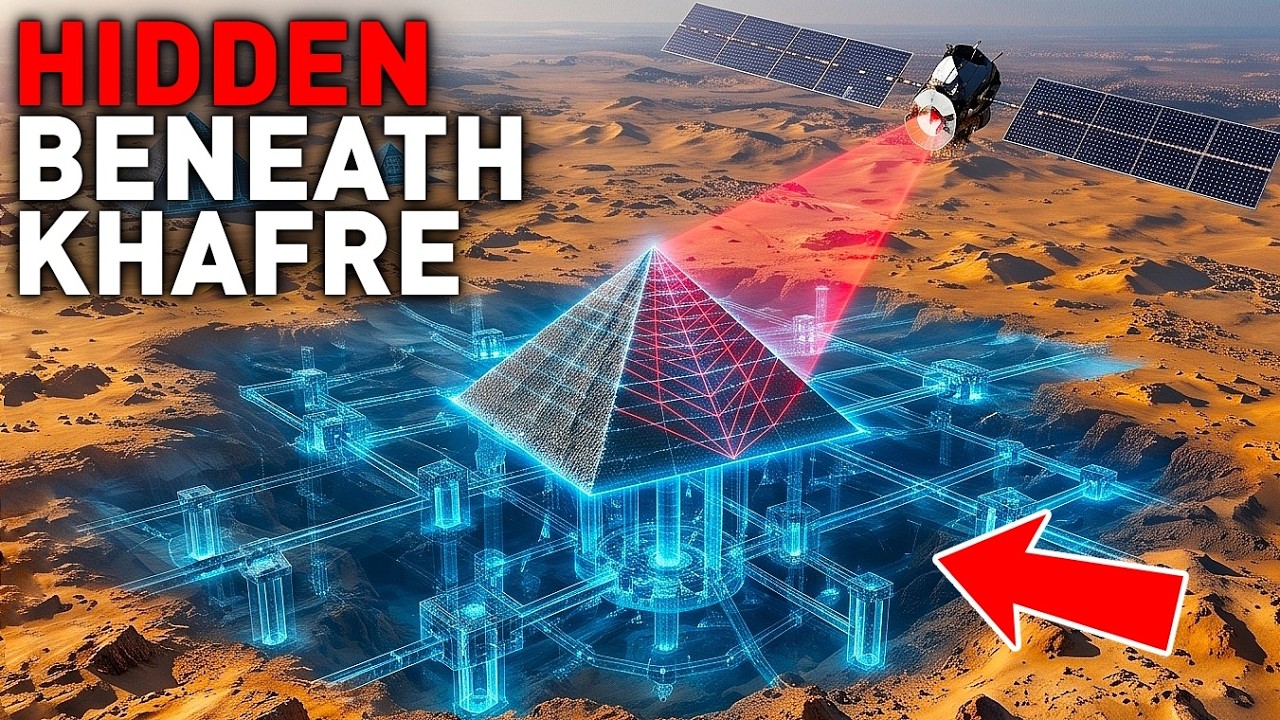
These claims were widely reported but have met with significant skepticism from many archaeologists and radar experts. Critics have pointed out that the findings have not yet been peer-reviewed or independently verified. Some experts have also questioned whether SAR technology is capable of producing such detailed images at those depths, noting that some of the detected structures near the surface could have natural explanations. The team responsible for the scans has acknowledged that excavation is needed to confirm their findings, though obtaining permission from Egyptian authorities is a difficult and lengthy process.
Other research has focused on anomalies closer to the surface. Between 2021 and 2023, a team from Japan and Egypt used ground-penetrating radar and electrical resistivity tomography to survey an unexplored area in the western cemetery of Giza. They discovered an L-shaped structure made of sand and gravel that appears to have been deliberately backfilled. The structure measures at least 33 feet in length and sits just over six feet below the surface. Below this, the scans detected a larger, deeper anomaly that could be a chamber or another structure, but its nature remains unknown. Excavations are currently underway at the site to determine what these structures are and why they were built.
Another notable underground structure in the area is the Osiris Shaft, located beneath the causeway connecting the Sphinx and the Pyramid of Khafre. The shaft was initially explored in 1933 but was fully excavated in 1999 by a team led by Zahi Hawass. The excavation revealed a multi-level structure with several chambers. The deepest level contains a flooded hall with a large granite sarcophagus. The site contains no inscriptions, which is highly unusual for an Egyptian burial site, making its purpose unclear. Two small tunnels branch off from a vault near the burial chamber, pointing toward the Great Pyramid and the Sphinx, but they are too small for an adult to enter and have never been explored. Scholars generally agree that the shaft was likely a symbolic tomb or a ritual space associated with the god Osiris, rather than a standard royal burial.
There has also been ongoing discussion about the age of the pyramid complex and the methods used to build it. One researcher, Alberto De Martini, has proposed that the Great Pyramid may be much older than the Egyptological consensus of roughly 4,500 years. His theory is based on a relative erosion method that compares weathering on different parts of the limestone pavement surrounding the pyramid. He averaged data from 12 different locations and suggested the pyramid could be around 25,000 years old. This idea has been strongly disputed by most Egyptologists, who rely on inscriptions, radiocarbon dating, and other archaeological evidence to support the established timeline. De Martini himself has said the estimate is not a guarantee.
Despite the uncertainty about its age, the construction of the pyramids is generally understood as a massive logistical project. The Great Pyramid of Khufu was built using an estimated 2.3 million stone blocks, many weighing several tons. Workers likely used sleds, ramps, and the Nile River to transport materials to the site. Evidence from the workers’ village indicates that the builders were skilled laborers who were well-fed and housed, rather than slaves. Records, including a diary by an official named Merer, document the daily transport of limestone blocks by boat to the construction site.
Several mysteries about the pyramids remain unresolved. The Great Pyramid has an eight-sided appearance when viewed from above, with faces that dip slightly inward. It was originally covered in polished white limestone casing stones, and likely had a gold-covered capstone, known as a pyramidion, both of which are now missing. The pyramid’s internal temperature remains constant, and its alignment with the cardinal points is precise. While no mummy has ever been found in the Great Pyramid, it has been proven to be remarkably resistant to earthquakes, spreading vibrations through its structure rather than concentrating them.
Research into the construction of the Step Pyramid of Djoser, the first of its kind, suggests that water may have played a key role. A study proposed that a hydraulic lift system could have been used to raise heavy stone blocks through vertical shafts. The method would have involved placing stones on floating platforms and using controlled water flow to lift them into place. Evidence for this theory includes ancient rainfall patterns, a nearby lake, and internal shafts within the pyramid, though not all archaeologists are convinced.
The Giza complex extends beyond the pyramids themselves. A long-lost branch of the Nile has been identified running alongside the pyramid fields, which likely served as a transport route for materials. The desert fortress of Tell Abu Shafi, located in the Sinai Peninsula, offers another example of ancient engineering. Archaeologists there found a paved, tree-lined avenue leading to a military fortress, complete with defensive trenches, barracks, and lime kilns. The presence of over 500 clay planting pits suggests the Egyptians built irrigation systems capable of supporting hundreds of trees in a desert environment.
The Sphinx itself remains a subject of study and debate. It was carved directly from bedrock, measures about 240 feet long and 66 feet high, and was likely painted in bright colors originally. Its nose is missing, and while the face is commonly attributed to Pharaoh Khafre, there is no inscription directly confirming this. The monument’s appearance has also changed over time due to erosion and repeated restoration efforts.
The Giza site continues to yield new information. Recent discoveries in Egypt include the first known mummy of a pregnant woman, which was found in a coffin belonging to a male priest due to 19th-century museum trading practices. Archaeologists have also uncovered mummification workshops in Saqqara, a 2,000-year-old marble head near Alexandria, and an L-shaped astronomical observatory that dates to the 6th century BCE. The observatory, located at the Temple of Thoth, contained a shadow clock used for timekeeping and calculations related to religious rites and agriculture.
The pyramids are part of a broader tradition of monumental construction found in many parts of the world, including Sudan, Mexico, and Iraq. While these structures share a similar shape, they were built independently by different cultures using different materials and techniques. The ziggurats of Mesopotamia, for example, are stepped temple towers made of mud brick, while the Egyptian pyramids were constructed from stone with smooth, angled sides. The Egyptian pyramids are generally believed to have been built by skilled Egyptian workers, a conclusion supported by surviving documents and archaeological evidence.
While theories about lost technology or ancient energy systems circulate online, there is no documented evidence to support them. The consensus among historians remains that the pyramids were constructed by Egyptian engineers and laborers using a combination of ramps, sleds, water transport, and precise mathematical knowledge. The ongoing use of non-invasive scanning technologies may continue to provide new information about the plateau in the years ahead.






