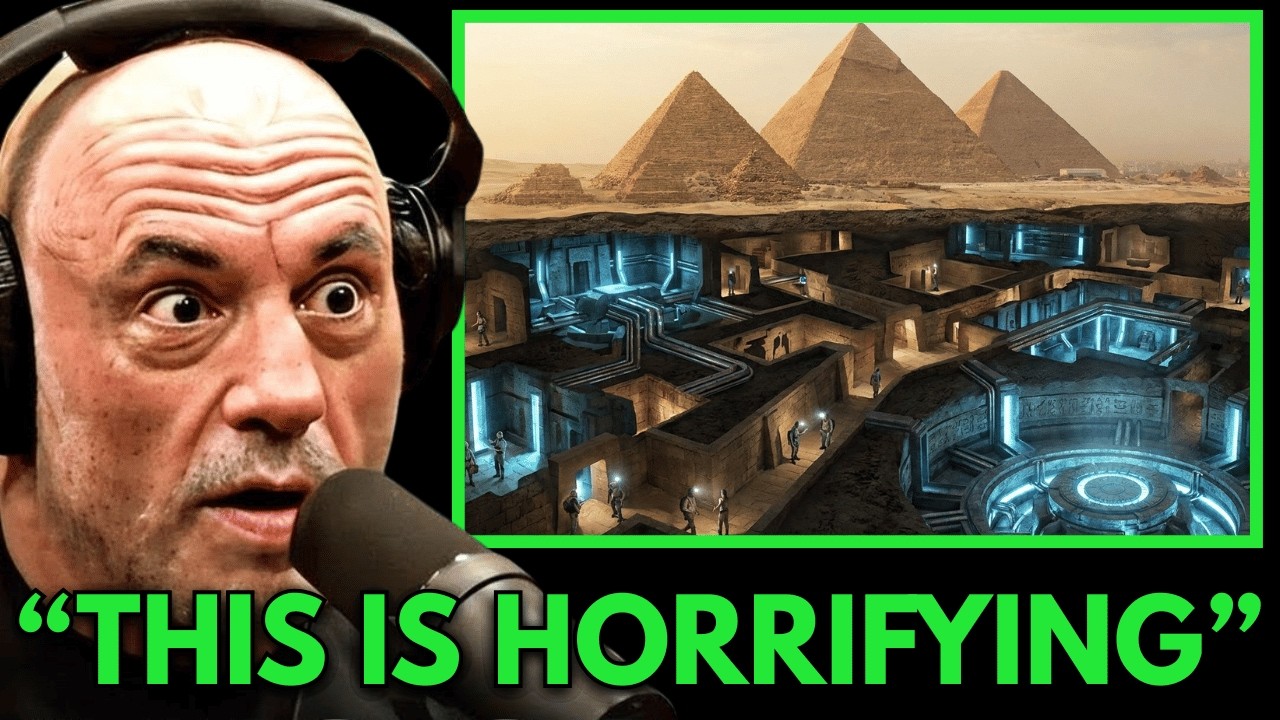
In March 2025, three researchers held a press conference and announced that they had identified large structures beneath the Pyramid of Khafre at Giza using a technique called synthetic aperture radar. They described eight vertical shafts descending more than 600 meters into the ground, spiral staircases, and an underground city extending roughly two kilometers beneath the plateau. The story spread quickly across social media and reached major news outlets and popular podcasts in a matter of days.
The announcement was not a peer-reviewed scientific finding. The team had not published their work in an academic journal, and the researchers had no formal background in Egyptology or archaeology. One of the main figures involved, Corrado Malanga, has been associated with UFO research. The dramatic images circulated online were not scans of anything underground. They were computer reconstructions based on data that the team interpreted themselves and never made available for independent review.
Scientists and archaeologists who examined the claims found significant problems. Milo Rossi, an archaeologist and science educator, published a detailed video explaining that the raw data appeared denser than expected and had been inflated into what he called an exaggerated simulation. Lawrence Conners, a radar specialist at the University of Denver who uses this technique in archaeology, noted that radar waves weaken as they pass through the ground and that no radar can penetrate hundreds of meters of solid rock. Sarah Parcak, a satellite archaeologist, said flatly that the radar data could not see through solid stone.
Zahi Hawass, the former Egyptian minister of antiquities, called the claim baseless and stated that the ministry never granted the team permission to work at the pyramid. Fact-checking by AFP and Snopes reached the same conclusion, classifying the claim as unverified and heavily overstated. By the time corrections and expert assessments appeared, many millions of people had already seen the original story.
The underlying geology at Giza is one reason such claims cannot hold. According to a 2019 study, the Giza plateau sits above a groundwater table located only a few dozen meters below the surface. Digging deep into the site means encountering water relatively quickly. This is not speculation. The Osiris Shaft, a vertical tomb complex near the pyramid, was excavated in stages throughout the twentieth century by archaeologist Selim Hassan and later reexamined by Zahi Hawass. The shaft descends more than 30 meters through three levels, and its lowest chamber has been permanently flooded by groundwater for a very long time.
That reality conflicts directly with the 2025 claim of eight shafts extending hundreds of meters downward. Any shaft at that depth would sit far below the water table, within saturated limestone. It would not contain a dry, habitable hidden city. The stone itself, a dense marine limestone formed tens of millions of years ago, is also a poor candidate for large hollow chambers. A structure of that size would likely collapse or fill with water long before anyone could use it.
There is a documented, accessible space beneath the Great Pyramid known as the subterranean chamber, located about 30 meters below the base. It has been known and documented for nearly two centuries. Its purpose remains unclear, but it is not a dramatic secret.
The pyramid complex also faces ongoing conservation problems. The Great Pyramid can attract thousands of visitors per day when open. Each visitor exhales moisture, which settles on the limestone walls. Salts accumulate, crystallize, and force cracks to appear in the stone. Hawass has described finding salt deposits up to two centimeters thick on chamber walls. He has used the word “cancer” to describe the deteriorating condition of the Sphinx, whose mother rock has been degrading for centuries. Previous restoration efforts that sealed limestone with cement trapped moisture and worsened the damage.
UNESCO has warned that at current levels of mass tourism, some monuments could degrade significantly within the next two centuries. This conservation concern is one reason authorities are hesitant to authorize invasive excavation based on unverified radar anomalies. As Hawass has said, cracks and natural features also produce anomalies, and a reading that looks like a chamber may simply be a fissure in the rock.
The claim of a hidden underground city was not new in its overall shape. In the 1930s and 1940s, an American psychic named Edgar Cayce, sometimes called the “Sleeping Prophet,” gave thousands of readings while in a self-induced sleep state. Among his claims were descriptions of a “Hall of Records,” a hidden chamber near the Sphinx said to contain the written history of the lost civilization of Atlantis, buried there around 10,500 BCE by refugees from a sunken continent. Cayce placed the chamber near the Sphinx’s paw.
None of this comes from ancient Egyptian tradition. No Egyptian text mentions such a chamber. The Atlantis story itself originated with the Greek philosopher Plato, centuries later. The Hall of Records is a twentieth-century addition to Giza mythology. Followers of Cayce helped fund real geological surveys at the Sphinx in the hope of proving his claims. In the 1990s, ground-penetrating radar detected anomalies beneath the Sphinx’s paws, briefly suggesting the legend might have some basis. When examined, those anomalies turned out to be natural cavities and fissures in the limestone. Archaeologist Mark Lehner, who has spent much of his career at Giza, concluded there was no man-made chamber there.
Actual work beneath and inside the pyramids has proceeded through non-invasive methods. In 2017, the ScanPyramids project published a finding in the journal Nature using muon imaging, a technique that tracks subatomic particles as they pass through stone. Three independent teams detected a large void above the Grand Gallery, at least 30 meters long, previously unknown. In 2023, the same approach confirmed a hidden corridor above the pyramid’s original entrance, and a camera was inserted to view the space directly.
Legitimate discoveries, in other words, have been made recently without any destructive excavation. The method is slow and unglamorous, but it produces published, verifiable results. In 1993, a small robot crawled into one of the narrow shafts leading from the Queen’s Chamber and found a limestone door with metal handles blocking the passage. The robot’s camera showed copper fittings and smooth limestone, then returned. What lies beyond that door has not been fully explored in the decades since.
The 2025 underground city claim collapsed for straightforward reasons. The radar technology was used beyond its physical limits, the data was never shared for independent review, and the announcement appeared at a press conference rather than in a scientific journal. The geology of Giza, with its shallow water table and deteriorating stone, makes the existence of vast deep chambers highly unlikely.
The real obstacles to digging beneath the pyramids are practical ones: groundwater at shallow depth, fragile limestone, the ongoing effects of tourism, and a conservation priority that respects the monuments’ long-term survival. The search beneath Giza has continued for years through muon detectors, robots, and careful survey work, and it has produced real findings. The hidden-city story, by contrast, traces back to a psychic’s vision from the 1930s, repeatedly revived by new technology and repeated claims, and repeatedly failing to survive scrutiny.






