In November 2020, two Tasmanian devils named Lisa and Lenny were released into the Barrington Wildlife Sanctuary in New South Wales, marking the beginning of a project to reintroduce the species to mainland Australia after an absence of roughly 3,000 years. The release was part of a larger effort involving 26 devils, all bred through a program run by the conservation group Aussie Ark. The goal was to address two problems at once: preserving a species threatened by disease in Tasmania and restoring an ecological balance on the mainland, where feral cats and foxes have harmed native wildlife for more than two centuries.
Tasmanian devils once lived across the entire Australian continent, but they disappeared from the mainland between roughly 3,200 and 3,000 years ago. Research published in 2018 placed the extinction window at around 3,200 years before the present, a period close to when the thylacine also vanished from the mainland. The most likely cause was competition from dingoes, which arrived in Australia about 4,000 years ago. Dingoes never reached Tasmania, which allowed devils to survive there.
In Tasmania, a separate problem emerged. Devil facial tumor disease, a contagious cancer spread through biting, began reducing the wild population. The disease causes tumors around the face and mouth and is fatal. By the time Aussie Ark started its breeding program in 2011, the disease had cut the wild Tasmanian population by more than 80 percent in under 20 years, leaving an estimated 25,000 devils in the wild.
Aussie Ark began with 44 devils and eventually built a captive population of more than 200 animals, with over 390 devils born over the decade. The program was designed as an insurance policy, preserving a genetically diverse population free of the disease. But the long-term aim was always to return the animals to the wild.
The mainland presented a different challenge. Feral cats, introduced with European settlement, now occupy the entire continent and are estimated to kill up to two billion native animals each year. Foxes, also introduced, compound the problem. Both predators target small native species in a weight range between 35 grams and 5.5 kilograms. Australia has the world’s worst mammal extinction rate, and introduced predators are a central factor.
Reintroducing dingoes was considered, but dingoes kill livestock and also prey on small native species, making them politically difficult to manage. Devils offered a different option. They do not prey on livestock, and they coexisted with small native marsupials for tens of thousands of years before dingoes arrived. In Tasmania, where devil populations remained healthy, feral cats tended to retreat from those areas.
The Barrington Wildlife Sanctuary, a 400-hectare fenced area in the Barrington Tops, was prepared over several years. The perimeter was predator-proof, and foxes and cats were removed before the devils were released. The fence also served to keep the devils from wandering, allowing them to establish territory and avoid learning to associate people or vehicles with food.
Aussie Ark selected the 26 released devils specifically to avoid inbreeding. Each pairing in the program had been tracked, and the release group was chosen for the broadest possible genetic spread. Seven of the 26 were reproductive females, setting a theoretical maximum of around 20 first-year joeys, though survival was uncertain.
After the release, the team monitored the animals through camera traps and radio collars but did not manage them directly. The point was to observe whether the devils could establish themselves without intervention. By May 2021, rangers confirmed seven joeys in the pouches of monitored females, all healthy and developing normally. The joeys confirmed that the released females had bred successfully in the wild.
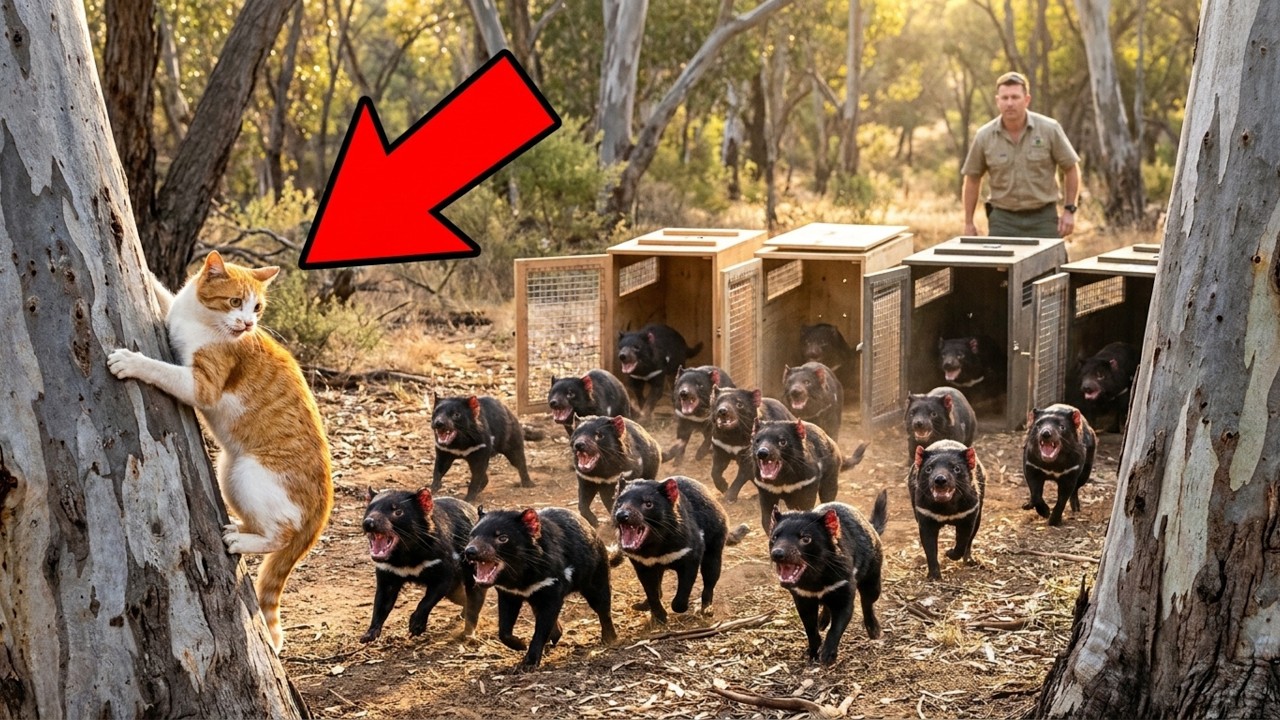
The effect on feral cats in the sanctuary has been gradual. Devils do not chase down prey the way cats do. Instead, they are efficient scavengers that consume carcasses completely, leaving little behind for other scavengers. This removes a food source that supports cat populations between hunts. Devils also actively harass smaller carnivores near food sources. In Tasmania, studies showed that when devil numbers declined due to disease, feral cats moved into the affected areas. The reverse also held true: where devils remained, cat activity was lower.
Fossil evidence from the Willandra Lakes region in New South Wales shows that devils and small native marsupials coexisted in the same ecosystems for tens of thousands of years. The current project is designed to restore a functional predator hierarchy rather than a pre-European baseline.
The release of the 26 devils in 2020 did not solve the broader problem on its own, but it demonstrated that the approach works. The animals established territory, bred, and began exerting ecological pressure in an environment they had not occupied for three millennia. Aussie Ark continues to monitor the population and is considering further mainland releases.