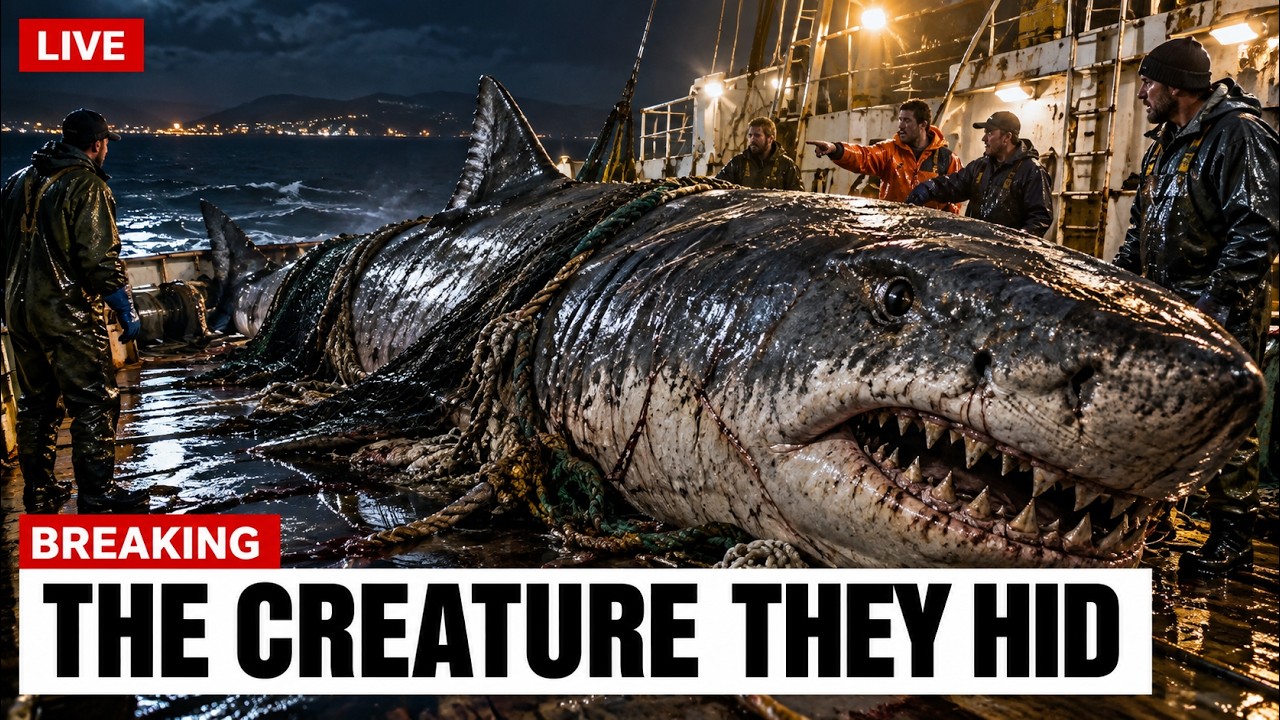
In early 2014, five commercial fishermen working off the coast of Western Australia reported an encounter with a large unidentified animal. The crew was operating roughly 70 nautical miles from Steep
In early 2014, five commercial fishermen working off the coast of Western Australia reported an encounter with a large unidentified animal. The crew was operating roughly 70 nautical miles from Steep Point, the westernmost tip of mainland Australia, in waters ranging from 300 to over 2,000 meters deep. Conditions were calm and visibility was good.The crew estimated the object at between 90 and 120…
In 1875, the crew of the British research vessel HMS Challenger dredged the seafloor near Tahiti in the South Pacific. Among the sediment and fossil material brought up from a depth of about 4,360
In 1875, the crew of the British research vessel HMS Challenger dredged the seafloor near Tahiti in the South Pacific. Among the sediment and fossil material brought up from a depth of about 4,360 meters were two teeth from Otodus megalodon, the extinct giant shark. Each tooth measured roughly four inches long, a size consistent with megalodon specimens already recovered on land across multiple co…
The Pacific Ocean looks calm from space, but scientists are currently studying a region where entire tectonic plates disappear into the Earth. Earthquakes can shift the ocean floor. Volcanoes rise
The Pacific Ocean looks calm from space, but scientists are currently studying a region where entire tectonic plates disappear into the Earth. Earthquakes can shift the ocean floor. Volcanoes rise from the darkness, and organisms live under pressures that would crush most living things. In 2026, researchers are still finding things they did not expect.NOAA missions are mapping parts of the Pacific…
Scientists are currently mapping and studying parts of the Pacific Ocean floor that have never been examined in detail, and recent expeditions have produced a wide range of findings, from deep-sea
Scientists are currently mapping and studying parts of the Pacific Ocean floor that have never been examined in detail, and recent expeditions have produced a wide range of findings, from deep-sea ecosystems to fossilized shark teeth. Researchers from the National Oceanic and Atmospheric Administration (NOAA) are using sonar to create more complete maps of the seafloor between Hawaii, Guam, and th…
“`text The Mariana Trench was thought to be a lifeless desert—until a submersible’s camera caught something far larger than a Megalodon gliding through the abyss. Scientists initially dismissed the shadow as a malfunction, but the sonar data told a different story.
Megalodon is widely regarded as the largest predator ever to inhabit the oceans. It appeared in the fossil record roughly 20 to 23 million years ago and remained present for nearly 20 million years. Based on a major 2025 study involving nearly 30 shark experts, the species could reach approximately 24 meters in length and weigh as much as 94 tons, making it several times larger than the largest re…
A divers’ crew filming in the Mariana Trench reportedly captured a Megalodon tooth at 36,000 feet, a depth where the prehistoric giant shouldn’t exist. The discovery echoes an 1875 oceanographic find, when the HMS Challenger dredged fossilized teeth from the Pacific floor.
In 1875, the research vessel HMS Challenger dredged two fossilized Megalodon teeth from the South Pacific seafloor near Tahiti. The teeth were recovered from a depth of about 4,360 meters at a location cataloged as Station 281. They were coated with manganese dioxide, a mineral crust that forms slowly on objects resting on the ocean floor.In 1959, Vladimir Chernesky, a zoologist at Queen Mary Coll…
More humans have stood on the Moon than reached the bottom of the Mariana Trench, where crushing pressure equals 50 jumbo jets on a chest. Yet when cameras finally descended nearly 36,000 feet, they didn’t just find pale snailfish and armored isopods thriving in permanent darkness.
The ocean covers roughly 70 percent of the planet, yet about 80 percent of it has never been directly observed. More of the surface of Mars has been mapped than the floor beneath the waves. The deepest point in the ocean, the Mariana Trench, sits nearly 36,000 feet below the surface. In all of human history, three people have reached its bottom: two in 1960 and one in 2012.For comparison, more tha…
A plastic bag filmed at 10,898 meters in the Mariana Trench sat in a Japanese archive for two decades before anyone spotted it. Researcher Sanae Shiba reviewed 5,010 overlooked dives and found more than 3,000 pieces of human waste, with single-use plastic dominating below 6,000 meters.
The water pressure at the bottom of the Mariana Trench reaches roughly 8 tons per square inch, and sunlight never reaches that depth. The first crewed vessel to arrive there did so in 1960, and the first robotic vehicles capable of returning video footage followed decades later. In 2018, researcher Sanae Shiba avoided the ocean entirely and searched an archive of video instead. She reviewed 5,010…