
Armored catfish are vanishing from Florida’s rivers, and scientists have finally identified what’s preying on them. These invasive fish, protected by tough bony plates, seemed nearly untouchable in the state’s waterways.
For four years, Dr. Ryan Allisson had been conducting population density surveys in Florida’s Peace and Hillsborough rivers. He knew what the numbers should look like, having established the monitoring protocol himself, with fixed stations and consistent survey lines walked the same way each field season so that real changes would appear as trends rather than noise.In the winter of 2022, three sur…
California found just 15 foxes left on one island, teetering on the brink of total extinction. Wildlife rescuers scrambled to save the species from disappearing forever, launching an urgent breeding program in the remote wilderness.
In 1994, approximately 450 island foxes lived on San Miguel Island off the California coast. Five years later, only 15 remained. Graduate student Gary Roemer began finding fox carcasses on neighboring Santa Cruz Island during his research there. Over two years, he found 21 dead foxes, 19 of them with similar wounds indicating predation from above.The island fox, about the size of a house cat, live…

A new predator is swallowing Florida pythons whole, and the footage is changing what biologists thought they knew. For years, the invasive Burmese python was considered the undisputed apex predator of the Everglades, with no natural enemies capable of stopping its spread.
In the Florida Everglades, Burmese pythons have become a major ecological problem, but there are growing signs that native wildlife is beginning to prey on the invasive snakes. Footage has documented alligators, bobcats, wading birds, hawks, and black bears killing and eating pythons, a development that has drawn attention from researchers and wildlife managers.Burmese pythons are not native to Fl…
Florida’s invasive giant python population has been under attack—and scientists say a surprising hunter is responsible. Officials have tracked something killing massive pythons, leaving their bodies in ways no predator was expected to manage.
The population of Burmese pythons in the Florida Everglades has declined significantly in recent years. Governor Ron DeSantis attributed this reduction to a partnership with a Miami-based company that manufactures clothing and accessories from python skin. The pythons, an invasive species native to Southeast Asia, have caused extensive damage to the ecosystem of South Florida over the past four de…
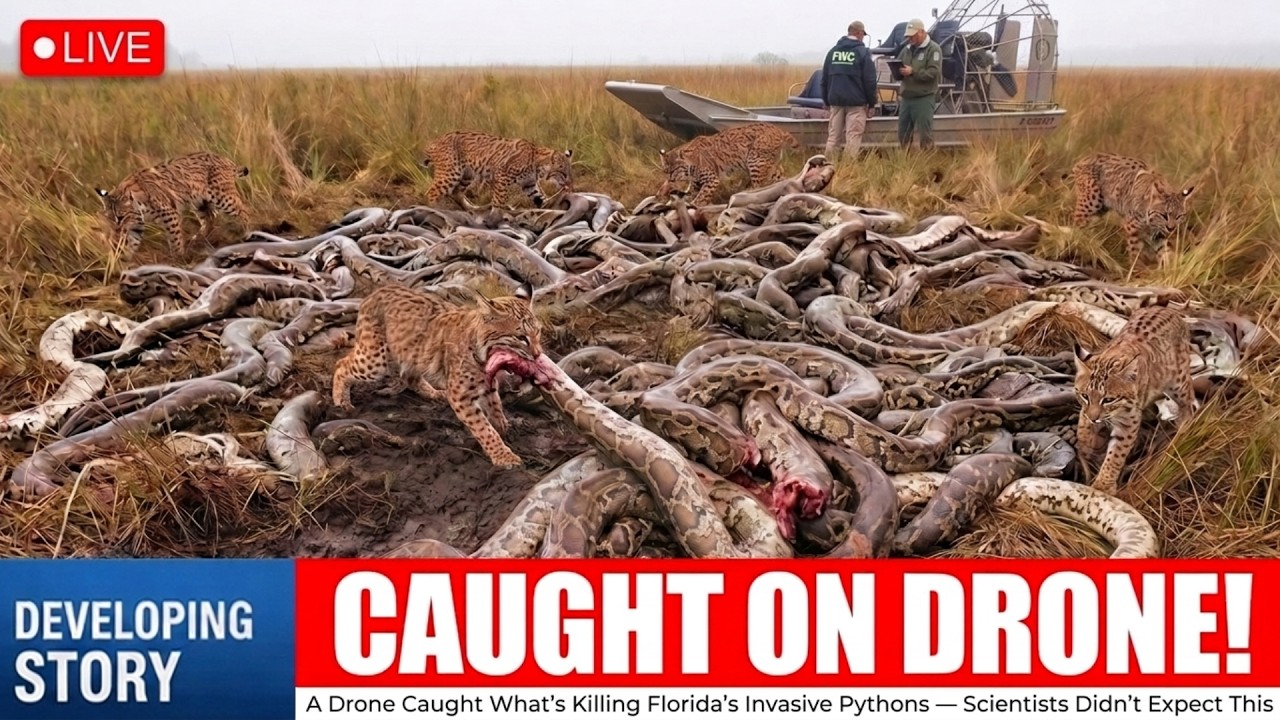
A drone has finally caught what’s killing Florida’s invasive pythons, and scientists didn’t expect this. For years, researchers watched the giant snakes vanish from certain areas without explanation.
In December 2022, biologists with the Conservancy of Southwest Florida found the body of a radio-tagged Burmese python in pinewoods near Naples. The male snake, known as Loki, had been part of their research program for more than six years. The team had checked on him days earlier and found him in good condition. When they followed his signal after a cold front moved through, the head and neck of…
Florida’s new snake killer swapped guns for a far more personal method with pythons, and wildlife officials are already alarmed. The hunter began abandoning lethal tactics entirely, instead tracking massive invasive snakes deep into the Everglades to handle them live.
Florida’s Everglades are home to an estimated 300,000 Burmese pythons, an invasive species that has significantly reduced populations of native mammals such as raccoons, opossums, and marsh rabbits. However, in Big Cypress National Preserve, some young pythons are being killed by native predators, including alligators, cottonmouths, and other mammals.One notable case involved a juvenile python tha…

Nine lynx were released into a Spanish valley as a last-chance experiment—and within months, something strange appeared in the camera footage. The foxes were vanishing.
In 2009, nine Iberian lynx were released into a shrubland valley in Spain’s Córdoba province. The animals had been bred in captivity, and roughly half of similar releases had ended in death within a year. With fewer than 100 lynx left in the wild, the margin for error was minimal. Spain had already invested more than 70 million euros in recovery efforts, and the population remained in the hundreds…