In August 2011, Hurricane Irene delivered 12 inches of rain onto an active wildfire in Virginia’s Great Dismal Swamp. The fire, already burning for weeks, continued for a total of 111 days, smoldering beneath the floodwater. The rain could not reach the fire because the fire was not burning on the surface. It was burning inside the peat soil itself.
The Great Dismal Swamp is a peatland on the Virginia–North Carolina border. For most of its 9,000-year history, the ground was saturated and the peat was fireproof. That changed after humans drained the swamp for 260 years, exposing ancient carbon to air.
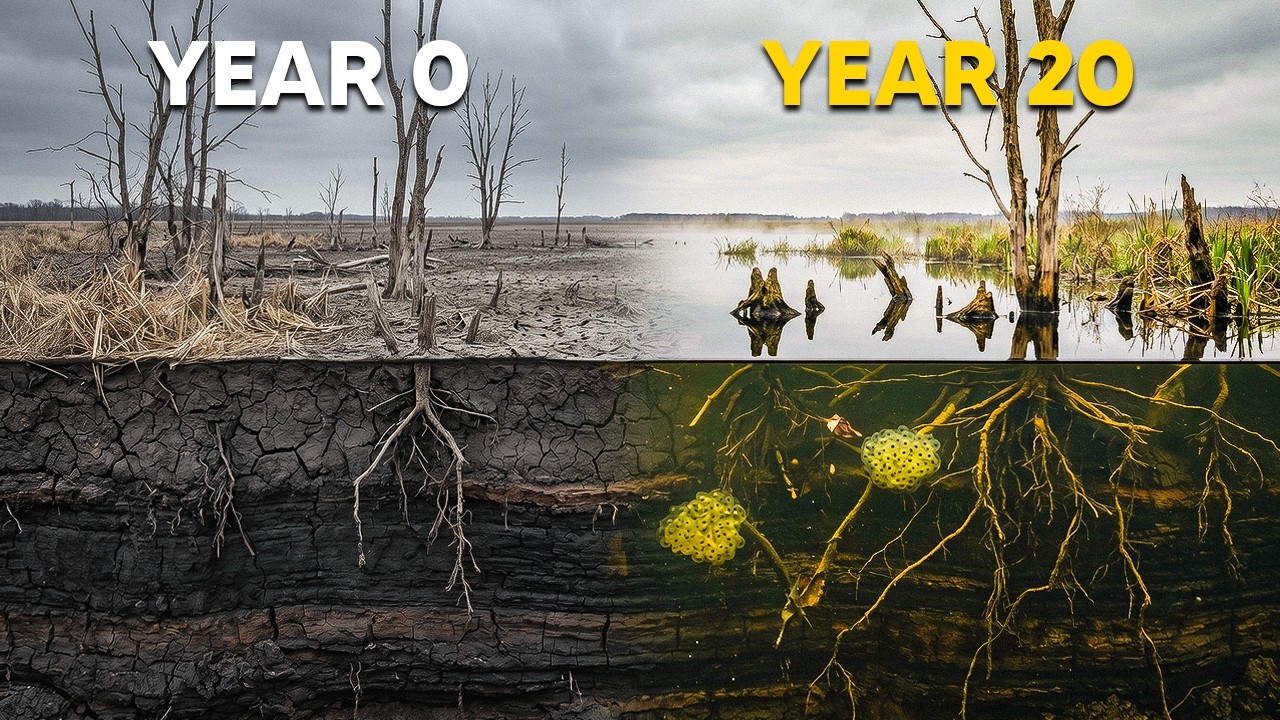
A healthy peatland depends on permanently waterlogged ground. The swamp sits on a low hillside with a layer of dense clay beneath the soil. That clay trapped rainwater at the surface, and the flat terrain gave the water nowhere to drain. The soil was more than 85% water by volume. In those oxygen-free, acidic conditions, dead vegetation did not decompose. Leaves and roots accumulated century after century, compressing into peat up to 14 feet thick.
The trees themselves supported this system. Atlantic white cedar and bald cypress roots created elevated mounds that shaped the swamp floor into wet hollows and dry ridges. The trees held the terrain, the terrain held the water, the water preserved the soil, and the soil fed the trees. That loop ran uninterrupted for 9,000 years.
Drainage began in 1763, when a land speculation company that included George Washington cut a 22-mile canal through the peat for timber extraction and agriculture. That canal eventually expanded into more than 150 miles of drainage ditches and logging roads. The ditches lowered the water table by several feet across large sections of the swamp. When the water left, oxygen entered the peat for the first time in millennia.
Bacteria that require oxygen began consuming the organic carbon. The process released an estimated 50 million metric tons of carbon dioxide since colonial drainage began. It also caused the ground to physically collapse as organic matter was consumed. That subsidence made it harder for water to pool back into damaged areas, exposing deeper peat to drying.
Dried peat develops a permanent chemical shift. It becomes water-repellent, shedding water off its surface rather than absorbing it. This property is why Hurricane Irene could not extinguish the 2011 fire and why conventional firefighting methods failed.
The tree population also shifted. Water-dependent cedar and cypress died off and were replaced by red maples, a dry-adapted hardwood that pulls moisture from the soil and releases it into the atmosphere. The new species accelerated the drying that had replaced the old ones.
In 2008, a spark from logging equipment ignited the South One fire. Crews used bulldozed fire lines, aircraft water drops, and surface hoses. The fire dropped below ground, burned through the peat itself, and smoldered for 121 days. It cost $11 million to suppress and became the longest continuous wildfire in Virginia’s recorded history.
Three years later, lightning struck the 2008 burn scar on August 4, 2011. The Lateral West fire ignited and entrenched itself underground. When Hurricane Irene arrived weeks later with 12 inches of rain, surface flames went out, but the underground fire continued. Mature trees whose roots had been consumed from underneath toppled into the smoldering ground.
The problem was that water from above could not reach a fire burning below a sealed, water-repellent barrier. The standard assumption that water falling from above meets fire and extinguishes it did not apply. The fire was underneath the barrier and the water sat on top of it.
During the Lateral West fire, engineers changed the approach. They brought in industrial agricultural pumps capable of moving about 18,000 liters per minute and ran them in reverse. Because the fire burned at a higher elevation than available water, the pumps forced water backward upstream against the natural gradient of the canals. Temporary dams were built across ditches every one to two kilometers. The backed-up water pushed sideways through the porous ditch walls into the surrounding soil, raising the water table directly underneath the fire. The smoldering peat was submerged from below and the fire drowned.
That emergency tactic became the basis for a permanent system. Since 2012, hydrologists from the U.S. Fish and Wildlife Service and the U.S. Geological Survey have installed 75 adjustable water control structures across the swamp’s 150-mile ditch network. Each structure is deliberately low-tech, costing between $50,000 and $100,000. A corrugated aluminum culvert sits in the bed of a drainage ditch beneath a spoil pile road. At the upstream end, hydrologists stack removable 6-inch boards to raise or lower the water level. When the boards go in, the ditch backs up and water forces laterally into the surrounding peat, resaturating the soil.
The system is adjustable for weather. Ahead of hurricanes, staff pull the boards to drain the canals rapidly, turning the empty ditches and adjacent peat into a sponge that absorbs incoming rainfall, protecting downstream cities like Chesapeake and Suffolk. On coastal-facing canals, one-way flex valves drain fresh water but close against salt water during storm surges.
Reflooding the swamp also addresses carbon storage. The two major fires vaporized peat so thoroughly that the ground dropped by up to four and a half feet in places. Rebuilding that carbon will take roughly 1,740 years at natural deposition rates. The restored sections now sequester about 200,000 metric tons of carbon per year, comparable to removing 42,000 cars from the road annually.
A 2022 storm at Pocosin Lakes National Wildlife Refuge in North Carolina provided a natural test. The refuge, a sister peatland using the same water control structures, received four direct lightning strikes on rewetted land. The saturated peat absorbed the strikes without igniting. A fifth bolt struck privately owned farmland a mile and a half away, where peat was still drained for agriculture. That dry peat ignited immediately, and the uncontrolled underground fire burned nearly 2,000 acres over ten days.
Across managed zones of the Great Dismal Swamp, water tables have risen by half a foot to a full foot. In 2019, two wildfires ignited within the refuge and were both rapidly contained with minimal damage. Over 73,000 Atlantic white cedar seedlings have been planted across 123 acres of burn scar, and natural cedar regeneration has reached densities exceeding 14,000 stems per hectare in zones with sustained soil moisture.
The cost comparison is direct. The entire 75-structure network cost between $3.75 million and $7.5 million to install. Suppressing the 2008 fire alone, one event, cost $11 million. Economic modeling projects the current management approach generates $326 million in net societal benefits through avoided emissions, prevented fires, and reduced health care costs. Preventing a single catastrophic peat fire saves an estimated $3.69 million in emergency room visits from smoke inhalation in surrounding cities.
The swamp is being managed but not fully restored. The current network is insufficient for complete hydrological recovery. Subsidence has been arrested, but new peat accumulation has not yet restarted. In the worst areas, a full meter of peat burned away, and degraded peat permanently loses some capacity to hold water.
Full restoration to pre-1763 conditions would require backfilling the entire ditch network and demolishing the miles of elevated spoil pile roads. Those same roads are what staff use to reach the water control structures and adjust the stop logs. The infrastructure that caused the damage is also the infrastructure needed to administer the ongoing treatment.
The system depends on a small team of hydrologists manually adjusting aluminum boards season by season, guided by groundwater models and weather forecasts. The swamp’s original destruction came from a network of hand-dug ditches that introduced oxygen and triggered soil consumption. The current fix reverses that direction, using water pressure from below to keep the peat wet. No advanced technology was required in either case. The physics is the same. Only the direction of the water flow has changed.






