The teeth of Otodus megalodon sit in museum cases around the world, and the first thing visitors notice is their unnatural scale. Some are seven inches long, wider than a grown man’s open hand, with serrations so regular they appear manufactured. They came from the rock, buried in sediment that predates human history, but the animal they belonged to was real. Estimates place the largest megalodons between 50 and 80 feet long, with a bite powerful enough to crush a whale’s rib cage. For roughly 20 million years, it was the dominant predator in the world’s oceans. Then, around 3.5 million years ago, its teeth disappear from the fossil record.
Before that extinction, however, a story emerged off the coast of Australia that has refused to fade for more than a century. In 1918, off Port Stephens in New South Wales, a group of professional crayfishermen reported an encounter with something they could not explain. The sighting was recorded by a naturalist named David Stead, and because he took the men seriously, the account has been passed down ever since.
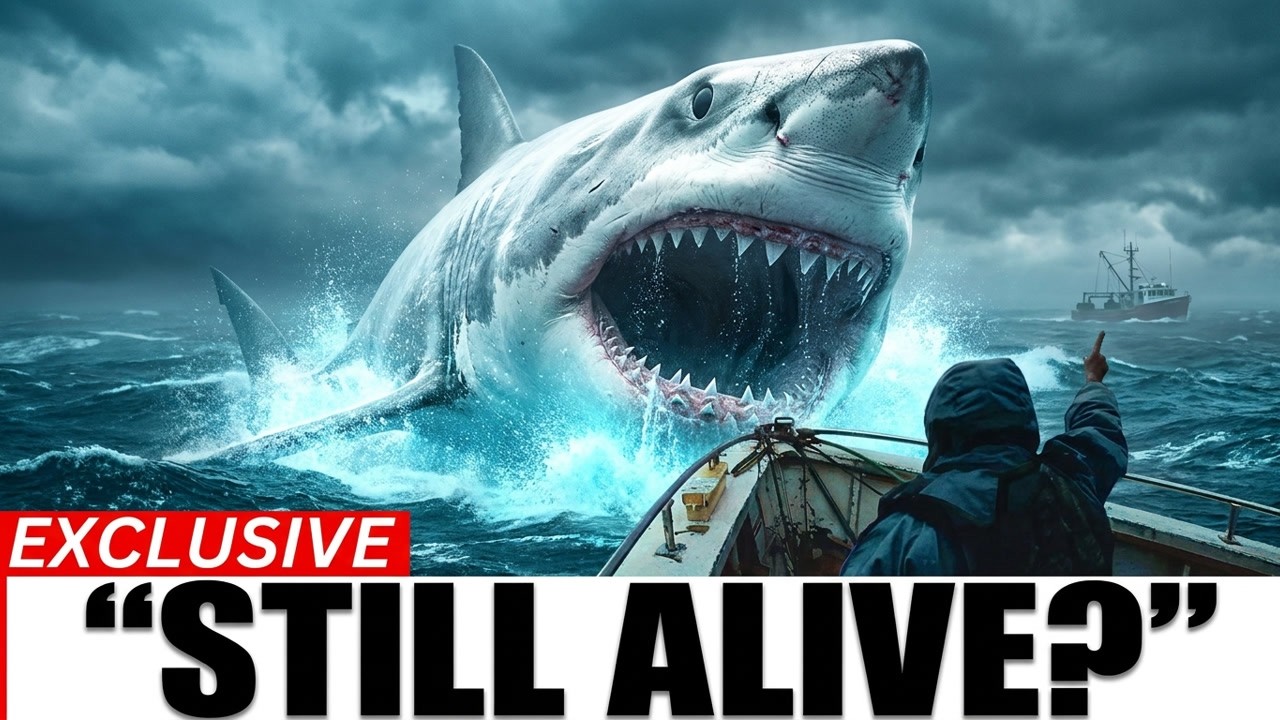
The men involved were not amateur sailors. They were experienced watermen who had worked those grounds for generations, men who routinely dealt with sharks and rough weather as ordinary parts of the job. They did not frighten easily. On a routine morning in 1918, however, something beneath their boats caused them to head for shore and refuse to return to sea for several days.
The accounts that survive describe a creature that was pale or ghostly white, moving slowly beneath their boats. Witnesses said it was enormous, with claims ranging from roughly 115 feet to, in the most extreme retellings, 300 feet. They said it lingered near the vessels, that it circled and appeared to study them rather than attack. They also reported that their crayfish pots came up crushed or went missing entirely, their lines severed. After the encounter, the fleet stayed tied to the wharf for nearly a week, with the men choosing to forgo income rather than return to that stretch of water.
Stead, a serious observer of Australian marine life, documented the account. He did not necessarily endorse every detail, but he considered the men credible. He noted that their fear appeared genuine rather than theatrical, and his decision to record the sighting is the primary reason it has survived.
The size estimates are the most difficult part of the story to assess. There is little to measure against on open water, and fear is known to distort a witness’s perception of scale. A creature could easily appear larger than it was. Even so, for it to be mistaken for 100 feet or more, it would have still needed to be genuinely massive. The color detail is also notable. Great white sharks are not naturally white all over; they are countershaded, dark on top and pale below. A shark that appeared entirely white would be unusual, though a pigment condition or unusual lighting could explain the appearance. The reported behavior, lingering and circling, is also consistent with how large sharks sometimes investigate unfamiliar objects in their environment.
The evidence does not prove a surviving megalodon, nor does it provide a clear alternative explanation. No body was recovered, and no photograph exists. The account remains an unresolved historical record, preserved by a credible observer but impossible to verify.
The scientific case for megalodon’s extinction is straightforward. Its teeth appear consistently in the fossil record for 20 million years, then stop. The cooling of the oceans, the shrinking of its warm coastal nursery grounds, and competition from newer predators likely contributed to its decline. A warm-water hunter that depended on abundant giant prey would not have been able to survive undetected in the cold depths for 3.5 million years. A breeding population large enough to persist would have left fresh teeth, bite marks on living whales, and far more frequent sightings.
Megalodon is extinct. But that does not diminish what it was. It was a real predator of extraordinary size and power, the apex of its era, and much about it remains unknown because its skeleton was cartilage that dissolved into the seafloor. What survives are its teeth and scattered vertebrae, leaving genuine questions for paleontologists about its exact size and appearance.
The Port Stephens account remains a curious historical footnote. It cannot be confirmed, and it may have been a misidentification of a large but ordinary shark under fear-filled conditions. Still, the fact that seasoned fishermen were willing to lose a week’s income rather than return to the water suggests they believed something extraordinary was there. The story has endured not because it is proof, but because it is a well-documented moment of genuine uncertainty on the ocean.






