In 1940, 630 beavers lived in the Kawuneeche Valley in Colorado. By 2023, only six remained. Willow trees had thinned, wetlands had disappeared, and roughly 90 percent of the valley’s surface water was gone. The valley sits at the headwaters of the Colorado River, which supplies drinking water to about 40 million Americans along its 1,450-mile path through the western United States. Ecologists had begun referring to the area as a willow graveyard.
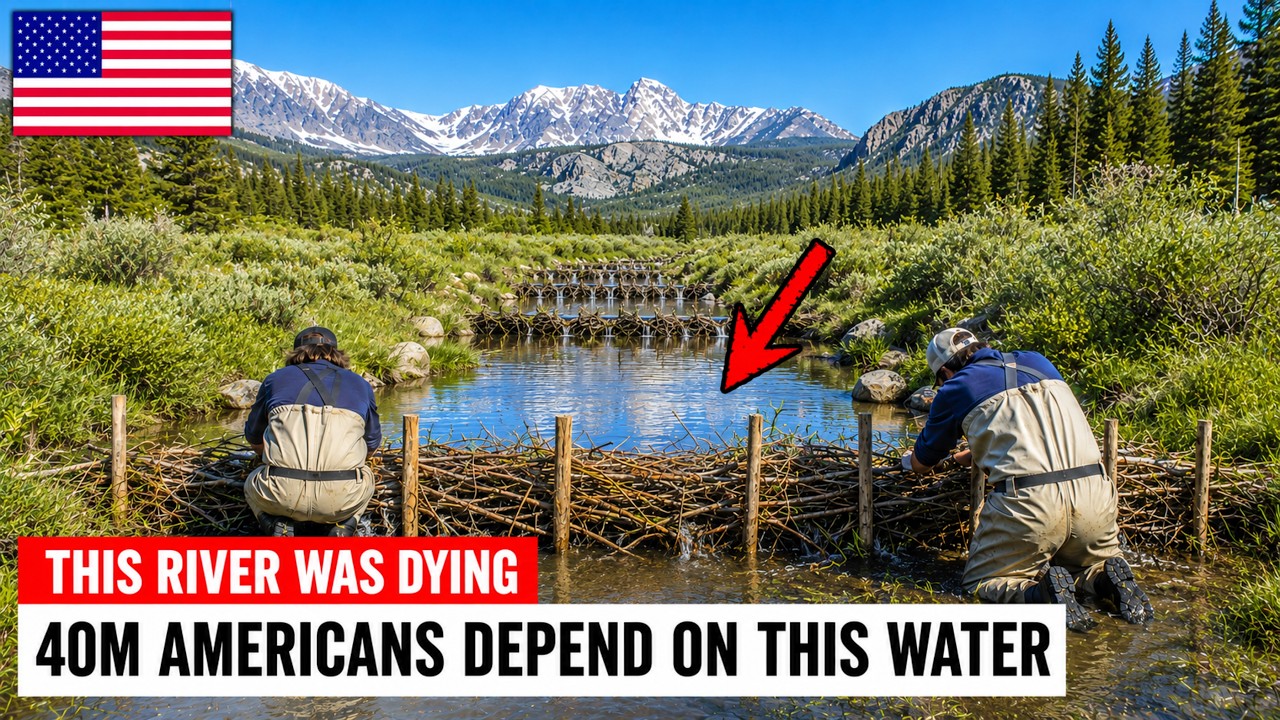
In 2024, a small team of scientists entered the valley, located about two hours northwest of Denver in Colorado’s northern Rocky Mountains. They carried wooden posts, willow branches, and buckets of river stones. By hand, they built 29 low structures resembling beaver dams. No concrete or steel was used.
For much of the past century, the American West treated beavers as a nuisance. Within this valley, a homestead established by the Holzwarth family in 1917 still stands as a national historic site. The son who inherited the family’s trapline once boasted of catching 28 beavers in 31 days. Trapping was a normal livelihood at the time. Between 1941 and 1949, the National Park Service hired trappers who killed more than 200 beavers in the valley, describing them as pests.
Researchers initially expected recovery to take a decade or more. A few ponds, some regrowth, and a modest, gradual change. But when hydrologists returned in the summer of 2025, they found changes their computer models had not predicted. Groundwater levels rose within a single growing season. Life forms absent from the valley for a generation began to reappear. By spring, the stream was flooding a meadow that had been dry for 80 years. A decline that took eight decades had been reversed in 18 months.
The Kawuneeche Valley sits on the western side of Rocky Mountain National Park. Its 15 miles of alpine meadows lie between the Never Summer and Front Range mountains. For most of the past 10,000 years, the area was not a meadow at all but one continuous wetland, shaped by beaver dams and dense willow thickets.
In 1913, naturalist Enos Mills, whose advocacy helped persuade Congress to create the park, described the beaver as one of the first conservationists. He was not speaking poetically. Beavers had built the valley.
Its decline resulted from three decisions made over a century by separate groups, none of whom intended to destroy the landscape.
The first was a ditch. Between 1890 and 1936, a private irrigation company called the Water Supply and Storage Company hand-dug a 14.3-mile channel along the mountainside. The Grand Ditch still operates today, diverting water from the western side of the Continental Divide to farms on the eastern side, averaging 20,000 acre-feet per year and sometimes carrying up to 40 percent of the water melting from the Never Summer Mountains. Under Colorado water law, the earliest claims hold the strongest rights, and those rights are protected similarly to property deeds. The park cannot close or reduce the ditch. The water irrigates roughly 40,000 acres of farmland in Weld and Larimer Counties.
The second decision came from the park itself. In the 1940s, the National Park Service determined that beavers were also pests. They were felling trees and flooding roads. Blood tests conducted years later found no disease among surviving beavers, but trapping continued for a decade.
The third decision was the introduction of 12 moose in 1978. Colorado wildlife managers, seeking to expand hunting and roadside tourism, relocated moose from Utah and Wyoming to the mountains just west of the park. Moose feed on willow, which makes up about 90 percent of their summer diet. A single adult moose can consume up to 50 pounds of willow per day. The park has no wolves, no grizzly bears, and no hunting. By 2025, an estimated 240 moose lived inside the park.
The moose were not behaving unusually. They were acting on natural instincts in an environment lacking predators to keep their numbers in check.
The willow, already stressed by a century of water diversion, could not withstand the pressure. As it declined, the ecosystem unraveled. Beavers starved and stopped building dams. The stream cut a deeper channel and lowered the groundwater table beneath the meadow. More willow died. Ecologists call this state hysteresis: a system so far altered that fixing the original cause is no longer enough. Something must push it back onto its former path.
David Cooper, an ecologist involved in the project, first saw the valley’s decline in the 1980s. He began photographing the same scene in 1994 and has continued returning to that spot ever since.
The conventional approach to restoring a beaver ecosystem would be to bring beavers back and let them rebuild. Cooper did not believe that would work here. The math was simple: beavers need willow for food and building materials. In a valley where more than three-quarters of the tall willow had been lost, relocated beavers would likely either starve by winter or move down the mountain in search of food. The remaining willow was heavily browsed by moose, year after year, leaving it only a few inches tall. The habitat had failed before the beavers had. As Jeremy Shaw, Cooper’s colleague at Colorado State University, put it: the situation had deteriorated to the point where beavers could not do the work themselves. The idea was to give the process an initial push.
The team worked in reverse, building the dams beavers would have built, using the materials beavers use: posts, branches, and stones. Then they waited, allowing water to pool, sediment to settle, and protected willow to grow tall enough to support a beaver colony. Only then, if beavers returned on their own, would the valley be able to sustain them.
The approach, called low-tech process-based restoration, or LTPBR, was developed by hydrologists at Utah State University. Teams of about eight people work in the streambed with hand tools, driving wooden posts into the gravel, weaving willow branches between them, and stacking river stones at the base. The finished structures span about 15 feet across the stream. They are designed to leak, to move, and to allow animals to rebuild them later. The official term is beaver dam analog, or BDA. There are now 29 of them in one section of Beaver Creek, surrounded by a fence enclosing about 35 acres, tall enough to keep moose out. Without the fence, Cooper said, the rebuilt habitat would disappear in a single season.
One obvious question is why not remove the moose instead. Most of the herd lives inside a national park where hunting is prohibited. A 2026 study led by William Taylor at the University of Colorado Boulder found evidence that moose may have lived in Colorado for thousands of years before European settlers arrived, suggesting the 1970s transplants may have been an unintentional reintroduction of an animal whose historical predators were absent.
Funding for the restoration has come in steadily. Colorado Parks and Wildlife contributed $216,700 in 2023. The National Park Foundation provided $300,000 in 2025 for 6,000 feet of new fencing at Onahu Creek. The total project budget is about $20 million across four sites: Beaver Creek, upper Baker Creek, lower Baker Creek, and Onahu Creek.
No one is planning to truck beavers into the Kawuneeche Valley, not now, not in five years, and possibly never. The team is betting that beavers will find the valley on their own once enough willow grows inside the fences. Four acres of mature willow, by Cooper’s general rule, is enough to feed a colony indefinitely. But only about six beavers remain in the entire Colorado River basin within the park.
The researchers expected recovery to take a decade or more. They were wrong. Within one growing season, groundwater levels under Beaver Creek began to rise. Within 18 months, aquatic invertebrates that require clean, cold, well-oxygenated water appeared in downstream samples. Canada thistle, one of the most invasive weeds in the American West, began yielding to native sedges. In spring 2025, water backed up behind the BDAs to flood an area the size of one and a half football fields, similar to conditions in 1940.
Isabel de Silva, the ecologist leading monitoring efforts, said the vegetation recovery was nearly immediate after that first season. She described the first year of the project as about 90 percent successful.
What has not yet returned is vertebrate life. No fish yet, as the stream remains too small. If beavers do not arrive on their own, the collaboration could eventually consider the approach used at Birch Creek in Idaho, relocating a small colony into prepared habitat. But Cooper’s stated preference has always been patience.
Standing on the streambank, two possible futures are visible at once. Inside the 35-acre protected area, willow height has increased by up to 500 percent since the fence was installed. Outside the fence, along the same stream, willow remains less than a quarter of its height from the 1990s. Same soil, same water, same climate. The only variable is what is allowed to eat.
Cooper has 37 photographs of the same scene, spanning 1994 to 2021. In the first, willow thick enough to form a wall of green hides the water. In the last, the water is visible because little remains to hide it. The willow collapsed into a low gray carpet of browsed stumps. The stream cut a raw channel through what had been a natural sponge. Cooper published the series in the journal Conservation Biology in 2025, along with decades of collected data: 94 percent of beaver pond surface area lost since 1953, and 77 percent of tall willow lost since 1999. Asked what he sees in his own photographs, Cooper told the National Parks Conservation Association that the series is a horror film for an ecologist.
The collaboration’s website shows two aerial photos of the same section of Beaver Creek. The 2023 image shows a single sharp line of water. The 2025 image shows a tangled silver sheet spreading sideways into the meadow. In two years, the water pattern changed more than it had in the previous 40.
The next site is Onahu Creek, with another 6,000 feet of fencing and 35 additional enclosed acres. But two factors remain beyond the project’s reach.
The Grand Ditch is still owned by the same private company and still holds a legal right to 20,000 acre-feet of water per year. Even if every restoration site succeeds, this valley will not be as wet as it was in 1889.
The moose population also remains. One wolf arrived in Rocky Mountain National Park on its own in 2023, but a single wolf cannot control a herd of 240 moose. The fences will likely remain for the foreseeable future.
The third limitation is the river itself. The project is rebuilding 35 acres. The Colorado River runs 1,450 miles and is expected to carry more water than the sky provides. Since 2000, the American Southwest has been in a megadrought worse than any in the past 1,200 years by tree-ring records. A 2022 study in Nature Climate Change estimated that about 42 percent of the soil moisture deficit is attributable to human-caused warming. Brad Udall, a water climate scientist at Colorado State University, put it plainly: the river’s legal framework was written for a river that no longer exists.
What is happening at Beaver Creek is a proof of concept, not a rescue. The beavers did not disappear on their own. Their food, tools, and the predators of the animals that outcompeted them were all removed over 80 years. Reversing that requires more than reintroducing wolves.
Sometimes the most effective restoration tool is not a wolf or a dam. It is a fence, a willow branch, and a commitment to stay for another 40 years. In 2025, Cooper published the photo series documenting the valley’s long decline. By that spring, the stream was flooding a meadow that had been dry for 80 years.






