The temple complex at Baalbek in Lebanon contains the largest stone blocks ever quarried in human history. Three stones known as the trilithon form part of the foundation platform, each roughly 19 meters long, 4 meters high, and 3.5 meters thick, weighing between 750 and 800 tons. They are fitted together with gaps so narrow that a sheet of paper cannot pass between them.
For comparison, the heaviest stones in the Great Pyramid of Giza weigh about 80 tons. The trilithon stones are roughly ten times heavier. In a quarry about a kilometer from the temple platform, three additional stones were cut but never moved. The largest, discovered in 2014 by the German Archaeological Institute, weighs an estimated 1,650 tons and remains partially attached to the bedrock where the cutting stopped.
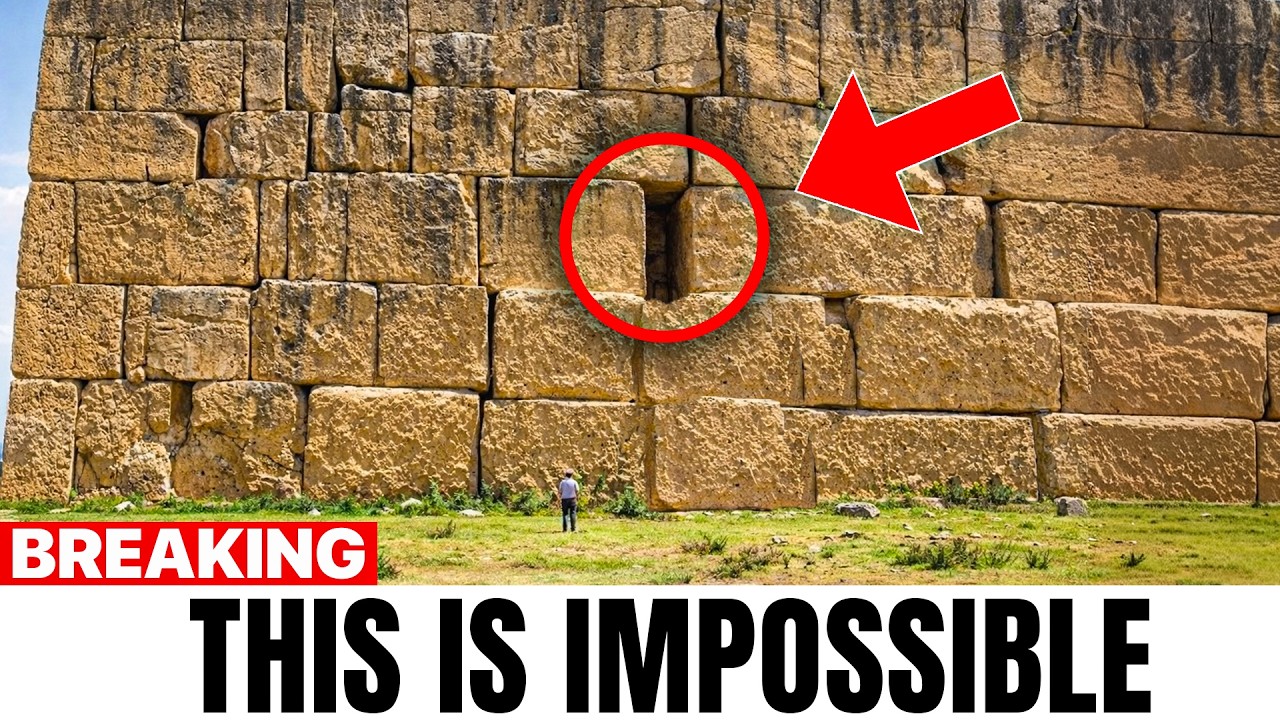
The mainstream archaeological position dates the trilithon and the megalithic foundation to the Roman period. This is supported by architectural style consistent with Roman methods, stratigraphic context, and an inscription indicating the major construction phase was nearing completion around 60 AD during the reign of Nero. The Romans knew the site as Heliopolis, the city of the sun, and it was one of the most significant pilgrimage destinations in the Eastern Empire.
Margaret Van S, an archaeologist, has argued that the cutting method visible at the quarry matches the technique used for stone blocks at the Pont du Gard, the Roman aqueduct in southern France. The large scale of the stones may be explained by the site’s geology. Baalbek sits on karst terrain, a limestone landscape with underground voids, and the massive stones would have been needed to bridge those irregularities and create a stable foundation.
The case for who built the stones and why is stronger than the case for how they were moved. No surviving Roman document describes the transportation of the trilithon stones. The largest stones Rome moved elsewhere, Egyptian obelisks weighing around 53 tons, were far lighter. No current consensus exists among archaeologists explaining the precise mechanism used to transport and place blocks of this weight.
Some researchers argue the megalithic foundation predates Rome by a significant margin. The visual difference between the weathered lower courses and the Roman construction above them has been noted. Human settlement at Baalbek goes back approximately 10,000 years, with Bronze Age settlements dated to around 2900 BCE. Graham Hancock has suggested the platform may be contemporaneous with Göbekli Tepe in southern Turkey, which is dated to approximately 12,000 years ago, though no direct physical evidence has established a pre-Roman construction date for the trilithon.
The 2014 quarry mapping project revealed that the stones were cut at specific orientations chosen to follow the internal grain structure of the limestone, minimizing the risk of fracturing. This suggests sophisticated geological knowledge on the part of whoever did the cutting. The survey also confirmed pre-Roman occupational layers beneath the complex, indicating a genuinely multi-layered construction history.
The name Baalbek itself reflects the site’s long religious significance. Baal was a Canaanite deity, and the name connects the location to sources of water. Permanent fresh water in a difficult landscape was understood as evidence of divine favor across ancient Middle Eastern cultures. The Romans, rather than replacing local traditions, created a hybrid deity called Baal Jupiter, incorporating both religious traditions. The Temple of Jupiter was built on ground that had been sacred for thousands of years before Rome arrived.
Experimental archaeology has demonstrated that timber rollers, ropes, earthen ramps, and organized labor can move large stones, but the physics do not scale linearly. Friction, structural integrity, and coordination demands all become harder as weight increases, and no experimental demonstration has come close to moving stones of the trilithon’s weight. The largest stone moved in any such demonstration sits well below the weight of the trilithon blocks.
The three stones left in the quarry show no structural flaws that would explain why they were abandoned. The cutting simply stopped. Possible explanations include the stone being surplus to the final design, the project being interrupted by conflict or plague, or a more ambitious original plan being scaled back. None of these can be proven from current evidence. The quarry appears not as a ruin but as an interrupted construction site where work stopped for reasons no surviving record explains.
The layered answer to who built Baalbek is that the Romans built the temples, which is well supported by evidence. A pre-Roman civilization, possibly Hellenistic, Phoenician, or significantly older, likely shaped the platform those temples rest on. Beneath all of this, people had been returning to this valley for 10,000 years, recognizing it as a place of importance.
In November 2024, UNESCO granted Baalbek provisional enhanced protection under the second protocol to the Hague Convention due to the ongoing conflict in Lebanon and the threat it poses to the site. A UNESCO evaluation mission in March 2025 assessed the impact of the conflict on the complex.
The research at Baalbek is ongoing. The foundation has not been fully excavated, and the questions that remain open are open because the evidence needed to close them has not yet been recovered. The 1,650-ton stone is still in the quarry, still attached to the bedrock at one end. The people who cut it understood the stone’s internal structure well enough to cut at that scale with apparent regularity. What stopped their work left no explanation. The stone remains where they left it, offering what evidence it can through its size and precision.






