Around 3,000 years ago, the body of an Egyptian woman named Lady Chenet Ah was placed inside a sealed coffin. For decades, researchers could not determine how she got in, as the coffin appeared to have no openings. Modern CT scans eventually revealed the method used by the embalmers.
Lady Chenet Ah lived during Egypt’s Third Intermediate Period, a time between major dynasties. She was in her late 30s or early 40s, which was considered old age at the time. Like most Egyptians, her diet consisted of bread, lentils, and fish, and her teeth showed significant wear from sand in the food. Her burial was elaborate, with expensive linen wrappings and artificial eyes meant to help her see in the afterlife. Her coffin was made of cartonnage, a material similar to paper mache, which was used for elite burials.
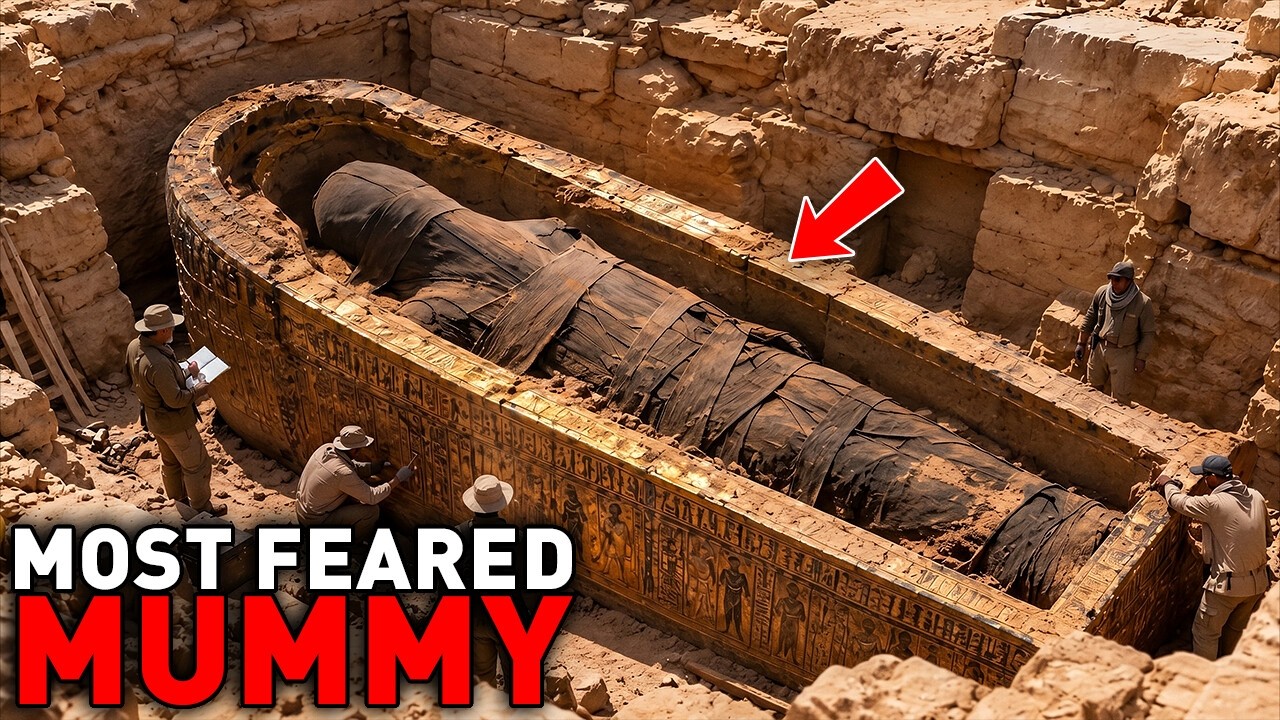
The mystery of how she entered the coffin was solved when researchers at the Field Museum in Chicago used CT scans to examine her and other mummies. The scans showed that the coffin was made first and then softened with moisture. After being molded around her wrapped body, a slit cut along the back was laced up like a corset. A wooden panel at the feet was secured to hold everything in place, leaving only a small gap.
The scans also provided information about other mummies, including a man named Harwa, who lived around the same time. His teeth were well-kept and showed no signs of hard labor, indicating he had a high social status and access to better quality food.
Another notable mummy is Xin Zhui, also known as Lady Dai, a noblewoman from China’s Western Han Dynasty. She was married to Li Cang, a high-ranking official in the Changsha Kingdom. She lived a life of luxury, with private musicians, fine food, and expensive silk clothing. However, her health declined with age, and she developed a heart condition, diabetes, high blood pressure, and other ailments. She died of a heart attack around age 50, shortly after eating melons, seeds of which were found in her system.
Lady Dai was buried in a series of four nested pine coffins wrapped in 20 layers of silk and sealed with charcoal and white clay. When her tomb was opened in 1972, her body was remarkably well preserved, with soft skin and flexible joints. The preservation is attributed to a mysterious acidic liquid that prevented bacterial growth. Her tomb contained over 1,400 artifacts, including silk clothes, cosmetics, musical instruments, food, and carved wooden figurines.
The location of King Philip II of Macedon’s tomb has been a subject of debate among archaeologists. In 1977, four royal tombs were discovered in Aigai, now Vergina, Greece. Experts have long debated whether Philip II was buried in tomb one or tomb two. New analysis using x-rays, CT scans, and radiocarbon dating suggests he was most likely buried in tomb one, which also held the remains of a woman and a child, believed to be his wife and son. The tomb was smaller and less impressive than others, possibly because his son, Alexander the Great, was low on funds while preparing for his campaign in Asia.
In early 2025, archaeologists working in Abydos, Egypt, uncovered a 3,600-year-old royal tomb. The tomb, located about 23 feet below the surface, had mud-brick walls over 16 feet tall. Golden hieroglyphs of the deities Isis and Nephthys adorned the entrance, but the pharaoh’s name was missing. This is significant because, in ancient Egyptian belief, a person’s name was essential for their survival in the afterlife.
The tomb dates to the Second Intermediate Period, a time when Egypt was divided among rival kingdoms. It shares similarities with the tomb of Senebkay, a king from the Abydos Dynasty whose remains showed wounds indicating he died in battle. The discovery of the new tomb suggests an even earlier, more powerful ruler of Abydos may be buried there.
The area around Abydos also yielded a Roman-era pottery workshop and a medieval cemetery, indicating the site remained significant for centuries.
Two other discoveries in Egypt highlight the cultural transitions of the time. On the Mediterranean coast, archaeologists opened 18 tombs dating back over 2,000 years. Among the burial goods were gold tongues placed in the mouths of the deceased. This practice was based on the belief that gold, being an immortal material, would allow the dead to speak when they stood before the gods for judgment. A stone altar carved to resemble a false door was also found, which was thought to be a passage only the dead could use.
The second discovery was a planned city in an oasis about 1,600 to 1,700 years old. It featured a grid layout, a central church, watchtowers, and a fort. The city contained numerous written notes on broken pottery, recording everyday transactions and letters. One house belonged to a man named Tabithos, and archaeologists believe it was used for worship before the church was built. Together, these finds show a society in transition, with old beliefs coexisting alongside a new religion.
The Step Pyramid of Djoser in Saqqara is considered the starting point of pyramid construction in Egypt. Built about 4,700 years ago for Pharaoh Djoser, it stands about 200 feet tall. Below it, a network of tunnels stretches about 3.5 miles. Surrounding the complex is a large dry moat, and some researchers have proposed it was part of a hydraulic system used to lift heavy stones during construction. The theory suggests water from the trench could have powered a lift to raise blocks, though not all experts agree, citing concerns about water availability and the effort required to build such a device.
The exact methods used to build the pyramids remain uncertain. Theories include the use of ramps, which could have wrapped around the structure or been built internally. Ancient records and recent discoveries, such as a steep ramp system at a quarry, provide some clues. The workforce is generally estimated at around 20,000 to 30,000 workers, many of whom were farmers who labored during the Nile’s flood season.
A recent discovery near Alexandria has added a new layer to the understanding of ancient Egypt. Archaeologists excavating at Kom el-Nogous found mud-brick walls beneath Greek ruins, indicating an Egyptian settlement existed there long before the Greeks arrived. The site includes a temple built by Ramses the Great and evidence of a military base. A pottery fragment bearing a royal seal with the name of Princess Meritaten, the eldest daughter of Queen Nefertiti and sister of King Tutankhamun, was also found. This suggests the city was active during the Amarna period, a time of religious upheaval under Pharaoh Akhenaten.
More recent work has focused on the tomb of Tutankhamun. Scans have detected anomalies behind the walls of his tomb, leading to theories that a hidden chamber may exist, possibly belonging to Queen Nefertiti. Results have been mixed and remain debated. Researchers are also studying a 2,000-year-old pleasure boat found off the coast of Alexandria and a valley temple southwest of Cairo, which included blocks carved with a calendar of religious feasts.
New x-rays of Tutankhamun’s famous golden mask have revealed details about its construction. The mask is made of 23-carat gold mixed with copper, likely to make it more flexible. In 2015, a scan found a gold tube inside the beard, likely used to attach it to the mask. Some researchers have proposed that the mask was originally made for Nefertiti, noting that King Tut’s name appears to have been altered on an inscription and that the mask’s pierced ears suggest a different owner.
Recent excavations near Luxor uncovered a dozen wooden coffins and other artifacts, including a necklace with amethyst beads, copper mirrors, and toys. Fragments of Queen Hatshepsut’s Valley Temple were also found, along with over 1,000 decorated stone blocks.
The idea of a curse associated with Tutankhamun’s tomb has been attributed to a number of factors, including the deaths of several people connected to its discovery. Some researchers have suggested that radiation or toxic waste in the tomb may have contributed to these deaths, while others point to natural causes. The excavator Howard Carter, who was present at the opening, died at age 64, which was a common life expectancy at the time.
Kathleen Martinez, a criminal lawyer turned archaeologist, has spent years searching for the tomb of Cleopatra VII. She believes the queen is buried at Taposiris Magna, a temple dedicated to Osiris, rather than in Alexandria. Her team has found coins bearing Cleopatra’s name, a tunnel leading from the temple to the sea, and a foundation plate confirming the temple was dedicated to Isis, Cleopatra’s patron deity. Underwater searches have also revealed large stone structures that may be the remains of a submerged city. Cleopatra’s tomb has not yet been found.






