In 1964, a contractor cutting a drainage ditch through a marshy field in Kenosha County, Wisconsin, struck a large bone buried in the mud. The bone was a mammoth femur, and the farmer who owned the land, Frank Schaefer, allowed a local amateur archaeologist to document the site before donating the remains to the Kenosha Public Museum. For more than two decades, the bones sat in storage as an unremarkable ice age find.
The discovery took on new significance when an amateur archaeologist noticed thin, V-shaped grooves on the bone surfaces that appeared to be cut marks. The observation prompted a reexamination of the site. In the early 1990s, archaeologists Dan Joyce and David Wasion relocated the original spot and reopened the excavation, recovering roughly 80 percent of an adult mammoth sealed under undisturbed layers of sediment. The bones carried similar cut marks, and two chipped stone artifacts were found beneath the animal’s pelvis.
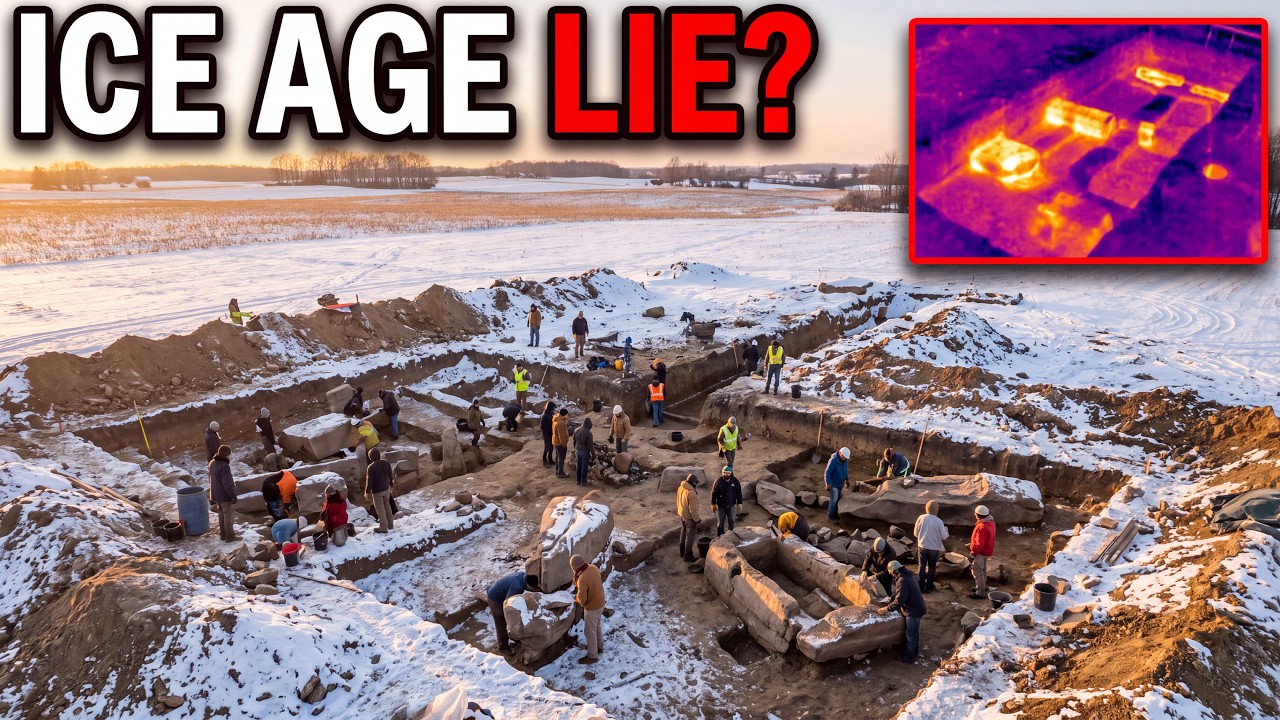
Radiocarbon dating of purified bone collagen placed the kill at approximately 14,500 years ago. This date is nearly a thousand years earlier than the Clovis culture, long considered the first human presence in the Americas, was believed to have existed. For most of the 20th century, the Clovis-first model held that hunters carrying distinctive fluted stone points crossed into the continent around 13,000 years ago. Claims of older human activity were routinely dismissed as contaminated samples or disturbed stratigraphy.
The Schaefer site was not the only such discovery in the area. A neighboring farmer, John Hebior, had kept a mammoth femur in his shed since the late 1970s. After the Schaefer excavation, the property was investigated, and researchers recovered the most complete mammoth skeleton ever found in North America, roughly 85 to 90 percent of an adult male preserved intact. The bones showed similar cut and pry marks consistent with butchery, and stone tools, including a biface and a chopping tool, were recovered from the same layer. Two radiocarbon dates on purified collagen placed this animal at roughly 14,500 to 14,800 years ago.
Two additional Kenosha County mammoths, known as Mud Lake and Finsky, returned dates even older, around 15,500 calendar years ago. However, neither site contained stone tools, and researchers have interpreted the marks on their bones as consistent with scavenging by animals after death rather than confirmed human hunting. Only the Schaefer and Hebior sites contain both tools and cut marks in the same sealed layer.
Archaeologist David Overstreet, who led the Hebior excavation, proposed that these finds belonged to a broader pre-Clovis culture, which he named the Chesrow complex after a distinctive style of stone point found in the region. That theory has faced a significant obstacle. Most Chesrow points are surface finds collected by farmers over the decades without documented stratigraphy or direct dates, and no confirmed habitation site has been found to connect the toolmakers to the mammoth kills.
The interpretation of the sites has also drawn criticism from specialists. Gary Haynes, a researcher at the University of Nevada, Reno, who specializes in mammoth bone taphonomy, has argued that many of the marks may be mimics created by trampling, carnivore gnawing, or chemical abrasion rather than human activity. Donald Grayson and David Meltzer, influential figures in the pre-Clovis debate, dropped Hebior from their list of convincingly human-linked sites in a 2015 review. Stuart Fiedel has expressed similar doubts.
Joyce and Overstreet maintained their position, citing the undisturbed stratigraphy and the presence of stone tools directly against cut bone in the same layer. Overstreet defended the interpretation for the rest of his life. He died in Milwaukee in January 2025 at age 82, with the argument still unresolved.
The Wisconsin finds are part of a larger pattern of evidence that has eroded the Clovis-first model over recent decades. In southern Chile, the Monte Verde site has been accepted by many researchers as roughly 14,500 years old, though a 2025 paper has again challenged that date. In Florida, the Page-Ladson site has produced evidence of butchered mastodon remains dated to about 14,550 years ago. In Washington State, a bone projectile point was found embedded in a mastodon rib dated to roughly 13,800 years ago. At Cooper’s Ferry in Idaho, stemmed points suggest human occupation beginning between roughly 15,300 and 16,500 years ago. At White Sands in New Mexico, fossilized human footprints have been dated to between 21,000 and 23,000 years ago using multiple independent dating methods. Ancient DNA studies also indicate a population movement into the Americas along a coastal route more than 16,000 years ago.
For descendant indigenous communities, these shifting dates change how the deep history of the continent is understood. The older narrative was developed without broad consultation, and each revision affects how that history is presented and received.
There is also a cautionary example in the region. A mastodon skeleton displayed at the University of Wisconsin for over a century was long presented as a single animal with evidence of human hunting. In 2015, an archivist and curator discovered the display was actually a composite of two separate animals, the Boaz and Anderson Mills mastodons. The mistake had never been disclosed to visitors.
Today, the Schaefer, Mud Lake, and Finsky bones remain in the Kenosha Public Museum’s collection. The Hebior skeleton, the most complete mammoth ever found in North America, is held by the Milwaukee Public Museum, which acquired it in 2007. Kenosha County displays a replica. A Wisconsin Historical Society marker has stood near the Schaefer site since 1999.
As of late 2025, the debate continues. Researchers Gary Haynes and Katherine Krasinski published a peer-reviewed review in the journal PaleoAmerica examining older-than-Clovis mammoth and mastodon sites across North America, weighing which evidence holds up under scrutiny. The disagreement over the Wisconsin sites ultimately turns on how much certainty can be assigned to marks on ancient bone, and what kind of proof is required to establish human activity. The bones themselves sit behind museum glass, their labels offering no mention of the unresolved argument they represent.






