The three massive stones known as the Trilithon at Baalbek in Lebanon have long posed a difficult question for engineers and historians. Each of the three blocks weighs roughly 800 tons, heavier than a fully loaded Boeing 747, and they are set about six meters above the ground as part of the platform for the Temple of Jupiter. The standard explanation credits Roman engineers with using wooden cranes and sheer manpower to place these stones, but the arithmetic and the physical evidence at the site complicate that account.
The most capable crane known from the Roman world, the Polypastos, had a maximum lifting capacity of about 60 tons under ideal conditions. Lifting an 800-ton block would have required at least fourteen such cranes working together, assuming each could operate at its theoretical limit and the load was evenly distributed. Each crane required a working area roughly 20 to 30 meters in diameter, with guy ropes anchored 10 to 20 meters out from the mast. Fitting fourteen of these machines along the western face of the podium, which is about 60 meters long, would have been impossible. The ropes would have crossed, the anchors would have had no stable ground, and the podium itself sits at the edge of a natural terrace with only a narrow strip of level ground before the terrain drops toward the valley.
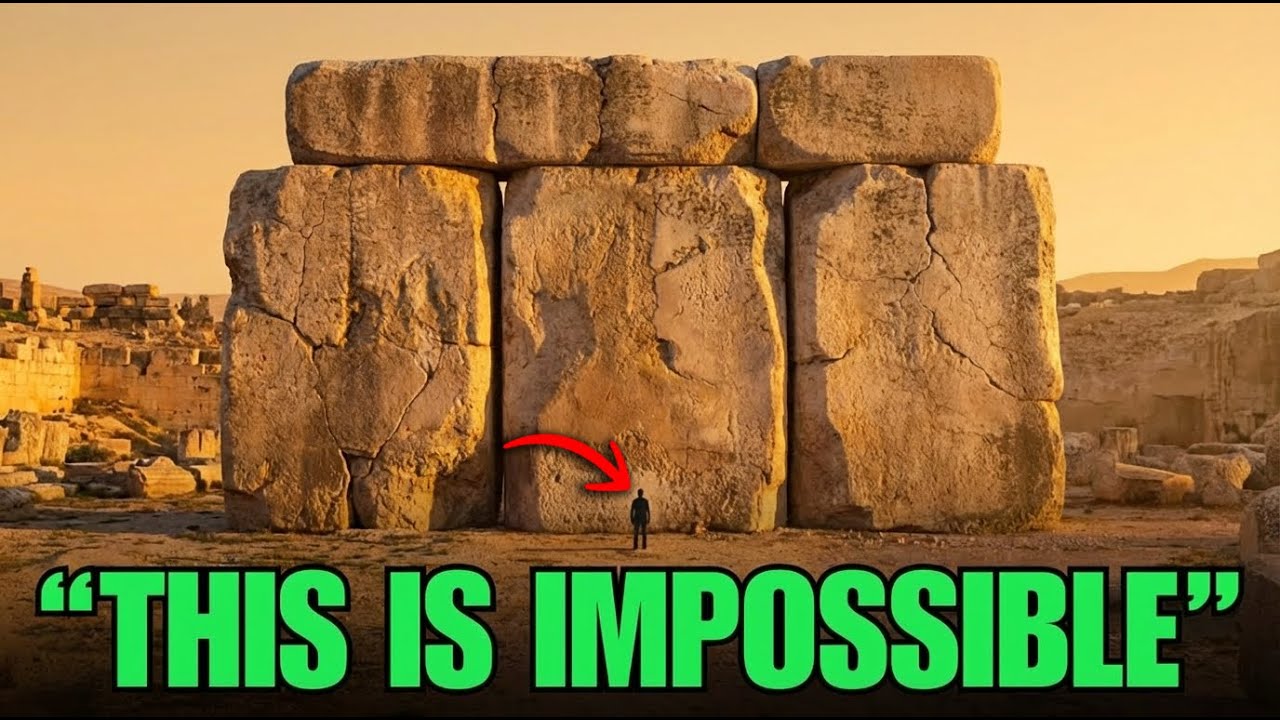
No archaeological trace of a staging yard, crane platform, or anchor points for such an operation has been found at the site. The geometry of the terrain alone rules out the crane theory on practical grounds.
Further evidence against the Roman crane explanation comes from the absence of Lewis holes on the Trilithon blocks. Roman construction sites typically left a clear signature wherever heavy stones were lifted: dovetail-shaped sockets cut into the top of a block to hold iron lifting keys. These Lewis holes appear throughout the upper courses of the Baalbek complex, including the columns and decorative blocks, which weigh from a few tons to several dozen tons. The Trilithon blocks, however, show no such sockets. Their upper surfaces are smooth and unbroken, and the joints between the stones are so tight that a knife blade cannot pass between them. The absence of Lewis holes is difficult to reconcile with the claim that Roman cranes placed these stones.
The quarry southwest of Baalbek also presents a scale of ambition that exceeds anything documented in the Roman world. The so-called Stone of the Pregnant Woman, still in the quarry, is over 20 meters long and weighs close to 1,000 tons. In 2014, a team from the German Archaeological Institute excavated beneath that block and found a second monolith still attached to the bedrock, nearly 20 meters long and weighing an estimated 1,650 tons. No other known stone quarried by human hands comes close to that size. The quarry is about 900 meters from the temple site, over uneven ground with only a modest elevation change.
The favored academic explanation for moving such stones involves timber rollers and teams of laborers, but the physics of that method also present problems. An 800-ton block rolling on cedar logs would exert pressures well beyond what the wood can withstand across the grain, causing the logs to deform and sink into the soil. The ground would need a continuous, rock-hard causeway to survive the repeated weight. No evidence of such an engineered road between the quarry and the podium has been found.
Another striking feature of the site is the weathering difference between the lower megaliths and the upper Roman construction. The Trilithon blocks show deep vertical channels and fluting carved by centuries of water runoff, with surface loss measured in centimeters or even decimeters. The Roman masonry above, including columns and ornate capitals, retains sharp detail and has weathered only millimeters, consistent with a much shorter period of exposure. Both layers are carved from the same Cretaceous limestone, which reduces the likelihood that differences in stone quality explain the gap. The visual evidence suggests the lower platform existed for a long period before the Roman temple was built on top of it.
The precision of the Trilithon adds another layer of difficulty for any proposed method. The blocks fit together with tolerances measured in fractions of a millimeter over nearly 20 meters, with no mortar or filler. They rest on a bedding course of stones that themselves weigh 300 to 400 tons. Achieving this level of accuracy at a height of six meters above ground requires not only enormous force but careful geometry and load distribution.
Alternative explanations have been proposed, though none has firm support. One theory suggests the blocks were cast in place using a form of ancient geopolymer concrete. Thin-section petrography and chemical analysis, however, show the natural microstructure and fossil content of Cretaceous limestone, with no trace of chemical binders or casting layers. Other ideas, such as acoustic levitation, remain untested thought experiments with no supporting physical evidence.
The lever and crib method, where blocks are jacked incrementally using wooden beams and stacked supports, is mechanically plausible in principle. Modern riggers use similar techniques for heavy loads. But this method leaves trace evidence, including anchor sockets, fulcrum scars, and counterweight pits. None of these have been documented at Baalbek. Their absence does not prove the method was never used, but it leaves the question unresolved.
Further research could clarify the issue. Suggested steps include high-resolution petrographic analysis, ground-penetrating radar along the quarry-to-podium route, targeted excavation for engineered causeways or anchor points, and digital simulations of the proposed methods. Each approach would provide data that could test the competing explanations.
The Trilithon remains a physical puzzle that existing histories do not fully explain. Whether the answer lies in techniques that have been lost or in infrastructure that has not yet been found, the evidence needed to settle the question is still on the ground.






