In the mountains of Washington state, biologists have spent more than a decade moving beavers into streams that were losing water. The animals, once considered pests, have rebuilt wetlands, stored millions of gallons of water, cooled rivers for salmon, and created natural firebreaks across dry landscapes.
The work began in 2007 in the Methow Valley, where streams feeding the Eastern Cascade Mountains were thinning each year. Snow that once lasted into July was melting by May, and summer water supplies for salmon, farms, and forests were disappearing. Traditional solutions like pipes, pumps, and concrete reservoirs were too slow and too expensive to address the problem.
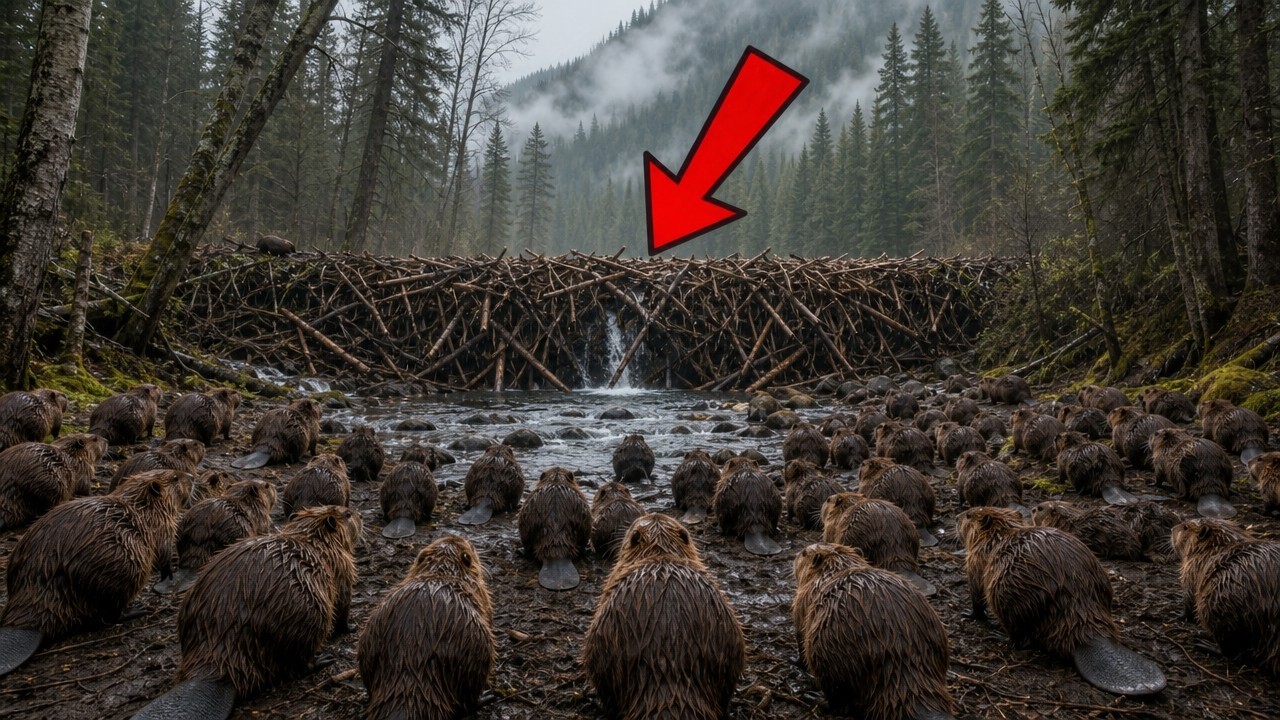
The root cause went back centuries. Before European settlers arrived, North America held an estimated 60 million to 400 million beavers. The fur trade changed that. For roughly 300 years, trappers hunted beavers for their dense pelts, which were made into fashionable felt hats. By the 1840s, the population had fallen from hundreds of millions to about 100,000 survivors.
When the beavers disappeared, so did their dams. Those structures had worked like a continental plumbing system, slowing water, spreading it across floodplains, and allowing it to soak into the ground. Without them, streams cut deeper, water tables dropped, and wetlands dried into meadows. Climate change then made the situation worse by shrinking the snowpack that had served as the region’s natural reservoir.
For most of the last century, beavers were viewed as nuisances that flooded basements, plugged culverts, and chewed ornamental trees. The Methow Beaver Project took a different approach. Instead of killing nuisance beavers, the group captured them alive and moved them to high headwater streams that needed dams.
Relocation required care. Beavers do not adapt easily to new places, and a lone animal often wanders off within a day. The team built a holding facility where captured animals could rest, and lone beavers were paired with potential mates. Family groups were released together, because a beaver with a family has a reason to stay and build. Alexa Whipple, the project’s director, has said the program holds one of the highest success rates of any beaver relocation effort in the country.
The engineering behind a beaver dam is simple but effective. A beaver builds a leaky structure of interwoven branches and mud that lets some water pass while backing the rest up into a pond. The pond spreads across the floodplain and soaks into the soil, raising the water table for hundreds of meters. The deep pool also gives the beavers a predator-proof home with an underwater entrance.
Scientists call animals like this ecosystem engineers. A beaver wetland becomes a nursery for fish, a hunting ground for birds, a drinking hole for deer and elk, and a breeding pool for frogs and insects. Removing beavers, researchers found, removes the entire habitat they support.
The results of the relocation came quickly. Within days of release, beavers were dragging branches and packing mud into stream channels. A bare trickle of water backed up into a pond within days, not years. At five long-term sites, relocated beavers built 14 dams. A 2019 study found that beavers relocated by the Tulalip project created a pond roughly the size of a backyard swimming pool for every 328 feet of stream they settled into.
By the time the project had run for more than a decade, about 240 beavers had been relocated to 51 sites across the Methow watershed. Since 2008, those animals had created more than 300 acres of new wetland.
Benjamin Dittbrenner, an ecologist, measured the impact in the Skykomish River Basin. Between 2014 and 2016, his team relocated 69 beavers to 13 upstream sites. The average new pond stored more than a quarter of a million gallons of surface water, and the saturated soil around each pond held back more than 600,000 gallons of groundwater.
The dams also cooled the water. In one summer after the beavers arrived, water downstream of the new dams cooled by about 2 degrees Celsius. For salmon, which struggle when water gets too warm, that difference can be critical. Downstream of the new ponds, researchers counted far fewer days when water crossed the deadly temperature threshold for salmon, dropping from more than nine dangerous days per site to almost none during the most critical window of the season.
The science is not entirely one-sided. Some studies have found that water can warm as it sits in large shallow ponds under summer sun. But the larger body of research, including the Washington relocation work, points toward dams buffering extreme temperatures and cooling water downstream where it matters for fish.
Dittbrenner framed the bigger implications simply. If the mountains no longer hold as much snow, the West needs another way to keep water locked high in the landscape until dry months arrive. A chain of beaver ponds does almost exactly the job the vanishing snowpack used to do, holding water as high up as possible and releasing it slowly through the summer.
The most surprising discovery came during wildfire season. Researchers noticed that the lush, soggy corridors created by beaver ponds were not burning. In the Methow Valley, the Twisp River fire killed nearly all above-ground vegetation in the area, but along the edges of beaver ponds, the burn marks stopped. Sometimes land was scorched on one side of a pond and untouched on the other.
The mechanism is straightforward. A landscape dotted with beaver ponds is a patchwork of soaked, green, fire-resistant ground. When flames sweep through, they stall at those wet patches. Emily Fairfax, an ecohydrologist, has documented the pattern across the West, showing that areas with active beavers stayed green even as surrounding land burned.
The work has become visible from space. Engineers at Google trained a machine learning program called Eager to recognize beaver ponds and dams in satellite imagery, and California’s wildlife department uses the algorithm to count beavers and plan restoration projects.
Biologists have estimated that a single living beaver provides roughly $3,000 in habitat restoration value, a significant contrast to the $20 a pelt once fetched. A beaver dam also repairs itself. When a flood damages a section, the beavers rebuild it the same night.
Washington passed a law in 2012 formally recognizing that beavers play a significant role in keeping watersheds healthy. But for years, it was illegal to relocate a beaver on the west side of the Cascade Mountains. Nuisance beavers trapped there had to be killed or moved across the mountains to the drier east side. The Tulalip Tribes won the right to move beavers onto their own lands in 2014 by relying on tribal sovereignty.
For tribal nations leading much of this work, the beaver carries cultural significance. When the Cowlitz Indian Tribe began reintroducing beavers into the Gifford Pinchot National Forest in 2018, into an area where the animals had been absent since the 1930s, they framed it as restoring balance to ancestral homelands and waterways.
Relocation is not always successful. The Tulalip Beaver Project has reported a success rate of around 40% in getting beavers to settle at a release site. Sometimes the animals leave the next day, and biologists are left uncertain what went wrong. It is trial-and-error work with quiet failures behind each success.
Despite that, the programs have grown. In December 2024, Washington’s beaver relocation effort became a permanent state project. The Cowlitz Indian Tribe now runs the largest beaver relocation program in the state, moving around 70 beavers each year. The Tulalip Beaver Project has relocated more than 260 beavers across three watersheds and housed nearly 400 animals at its hatchery. The Wenatchee Beaver Project has moved 42 beavers onto public land, and tribes as far away as the Yurok in California have launched their own programs. A University of Washington study found that in the Skykomish watershed alone, around 73% of suitable beaver habitat still sits empty.
The beaver is not a glamorous animal, but the structures it leaves behind will last long after the biologists retire and grant money runs out. The dams will still be slowing water, cooling streams, and holding back fire. Across the American West, valleys are being rebuilt not by machines or engineers, but by an animal working through the night with mud and sticks.






