In October 2014, a research vessel carrying a team from Oregon State University traveled to the Mariana Trench in the western Pacific Ocean. The group lowered an underwater drone equipped with sensitive listening equipment roughly seven miles into the trench, into a region known as the hadal zone, named after Hades, the ancient Greek underworld.
The drone took about three hours to reach the bottom. Two hours into the mission, its sensors picked up a sound that no one on the ship expected to hear. It was a combination of a low moan and a sharp metallic screech, as if two different sounds had merged into one call. Scientists later named the recording the “bioduck” for the distinctive quality of the sound.
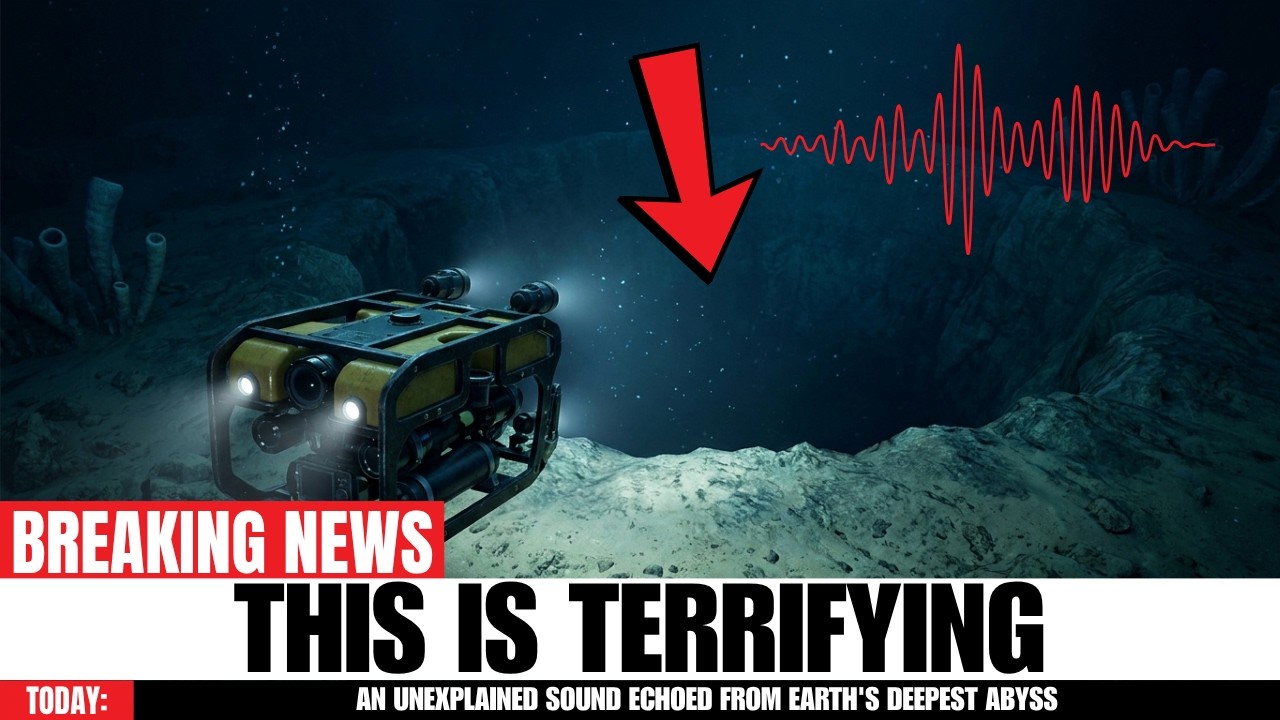
The crew posted the recording online that same week, hoping someone outside their team could identify it. No one could. In a place where almost nothing large enough or loud enough to be heard from that distance was thought to exist, something had clearly made the noise.
At the time, deep-sea environments were widely considered to be nearly lifeless, too dark and too hostile for much to survive. The team investigating the signal tested that assumption while searching for an explanation. Video pulled from unmanned submersibles mapping the trenches showed creatures found nowhere else on Earth. Crustaceans more than a foot long moved across the seafloor in near-total darkness. One animal, nicknamed the “ghost fish,” had colorless eyes and pale, almost translucent skin, and was built to withstand pressure roughly a thousand times greater than at the surface.
The listening equipment that captured the mystery signal also recorded other sounds over the following months: the low hum of ships passing above, the calls of whales moving through open water, and once, the muffled roar of a hurricane churning on the surface miles away. But none of the small creatures found in the trench could reasonably explain the original sound. The crustaceans buried in the seafloor mud lacked the size needed to produce a call loud enough to carry that distance. The source had to be something larger than anything that had been identified so far.
The location itself raised another possibility. The Mariana Trench sits within the Pacific Ring of Fire, a region that contains about 75 percent of the planet’s active volcanoes and 90 percent of all recorded earthquakes. When rocks shift and crack under the seafloor, they produce vibrations known as seismic waves. Investigators pulled seismic data from the exact time of the recording and compared it directly to the mystery sound. They found no match. Earthquakes produce low-frequency sound waves that remain steady in pitch from start to finish. The recording from the trench moved through a wider and more complex range of frequencies than any single earthquake could realistically produce.
When analysts broke the signal down piece by piece, they found several distinct sections that rose and fell across different frequencies in sequence, each ending with a sharp metallic ring unlike any natural geological sound. That final part of the recording, the part that sounded manufactured rather than natural, led investigators to consider a human-made source.
The trench sits relatively close to the island of Guam, which hosts one of the largest U.S. naval bases in the Pacific region. At the time, reports described a quiet but real underwater technology race between global powers. The U.S. military was reported to be investing heavily in unmanned underwater vehicles, while China was said to be deploying its own advanced remotely operated drones in disputed areas of that part of the ocean. Analysts studying the signal wondered whether the recording might be evidence of military equipment operating far below the surface.
But when investigators examined how modern military sonar actually works, the theory fell apart. Sonar signals used to help drones identify targets are designed to be regular, repeatable, and almost rhythmic. The mystery sound was erratic and inconsistent, never repeating in the same pattern across multiple recordings. A weapon designed to guide a machine toward a target would not typically produce such a sound.
If the sound was not geological and not man-made, it was almost certainly produced by a living creature, and a very large one at that. This led investigators back to the water to look for a biological source.
Paleontologist Darren Nash matched the metallic portion of the recording against a large library of known marine animal sounds. Certain species of whales around the world are known to make complex, extended calls that sound almost mechanical and travel remarkable distances underwater, since sound moves about four times faster through water than through air. One such call, nicknamed the “Star Wars” sound, had previously been attributed to dwarf minke whales living in different parts of the ocean. Whales within a species develop variations in how they call each other, similar to separate dialects passed down through generations. The partial match was enough to keep the whale theory alive.
Oceanographer John Hildebrand looked at the location where the sound was originally recorded and offered a different candidate: Bryde’s whales, a rarely seen species. Hildebrand pointed to an existing recording taken north of the trench that matched several characteristics of the mystery signal, particularly the low-frequency portion at the start. But he was open about a gap that remained unresolved. The low-frequency part matched known Bryde’s whale calls well. The rest of the sound, the higher, stranger, more metallic sections that gave the recording its unsettling quality, did not match anything documented at the time.
For years, that gap remained completely unresolved, and some researchers quietly wondered whether an undocumented species lived somewhere inside the trench, a creature shaped by pressures and conditions no other animal on the planet has to endure.
The breakthrough came from simple observation: watching whales directly while listening to them at the same moment, rather than relying on recordings alone. During a month-long survey across the Mariana Islands, a team from the National Oceanic and Atmospheric Administration (NOAA) spotted ten groups of Bryde’s whales in the same waters where the mystery signal had first been recorded years earlier. Nine of those ten groups were tracked while making the very call researchers had been chasing. One sighting could be coincidence. Two might be luck. Nine left little room for doubt.
Still, the team wanted to be certain before closing a case that had remained open for a decade. They worked with engineers at Google, who built an artificial intelligence system and used it to search more than 200,000 hours of archived ocean recordings from the Mariana archipelago. The pattern held every time. The call always appeared in association with a specific season and always traced back to a single group of Bryde’s whales found only in the western Pacific. Genetic testing later confirmed they were biologically distinct from Bryde’s whales elsewhere.
Bryde’s whales are not small animals. A fully grown adult can reach more than 55 feet in length. Yet the species remains among the least studied and least observed whales on the planet, which explains why it took a decade to catch one making the call on camera. Researchers now believe the call likely functions as a communication signal. Whales calling in open water, hoping another whale will answer, like a giant game of hide-and-seek stretched across miles of ocean. No one has confirmed this theory with certainty, reflecting how much remains unknown in modern marine science.
A signal that once seemed like a weapon, a machine, or evidence of something undocumented turned out to be nothing more than a whale communicating quietly in the dark, hoping someone was listening.






