Invasive Burmese pythons have caused significant ecological damage in the Florida Everglades since they first appeared there in the late 1970s and early 1980s, likely after escaping or being released by pet owners. Over the decades, their presence has led to dramatic declines in native mammal populations, with surveys showing near-total losses of rabbits and foxes in some areas and severe drops in raccoon, opossum, and bobcat numbers.
Efforts to control the python population have included contracted hunters paid by length, public hunting competitions, and radio-tracking programs that use male “scout” snakes to locate breeding aggregations. These measures have removed thousands of pythons over the years, yet estimates of the total population still range from tens of thousands to hundreds of thousands spread across a vast wetland area that is difficult for humans to access.
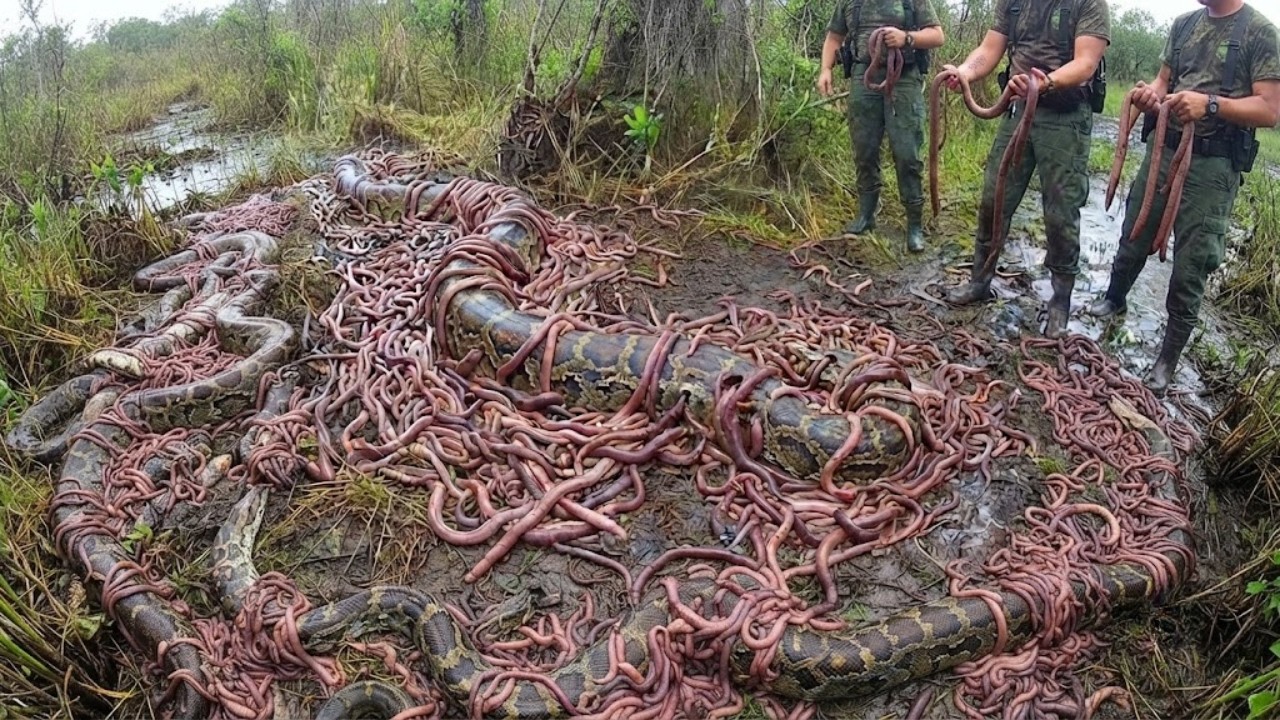
Last season, hunters noticed something unusual. They were catching fewer live pythons than the previous year. While this initially seemed like positive news, the tracking data told a different story. Radio transmitters attached to more than 60 monitored snakes continued to send signals from the same coordinates for weeks, which typically indicates the snake had died. When biologists went to investigate, they found multiple deceased snakes gathered in the same shaded areas of the marsh.
The deaths were not distributed randomly, and there were no external signs of injury. There were no claw marks, bite wounds, or any indication that predators had attacked the snakes. Necropsies revealed the cause. The lungs of the deceased pythons were filled with thin, pale parasites clustered together in dense masses. The snakes had effectively suffocated from the inside over a period of weeks, with their lung tissue thickened and scarred around the parasite masses.
The culprit is a parasitic lung worm that evolved alongside Burmese pythons in their native range in Southeast Asia. In that environment, the worm typically acts as a harmless tenant rather than a killer, because the host and parasite have adapted to each other over long evolutionary timescales. In Florida, however, the parasite has found new hosts.
The transmission cycle does not require direct contact between pythons. Adult worms release eggs that pass through the snake’s waste. Flies land on that waste and pick up the eggs. Frogs eat the flies, and native snakes eat the frogs. Each step is normal wetland behavior, but the parasite now reaches new species that have no prior exposure or immunity. Native snakes such as cottonmouths, rat snakes, and several rattlesnake species have been found with severe and often fatal infections.
The parasite has spread well beyond the python’s main range, with infected animals found hundreds of miles to the north. This means the lung worm no longer depends on Burmese pythons to survive. Even if every python disappeared from Florida, the parasite would continue to circulate through the native snake population.
Genetic testing of captured pythons has revealed another complication. A small but real number of individuals carry DNA from the Indian python, a closely related species that also entered Florida through the pet trade. Hybrids of the two species may inherit the ability to survive in both wetland and drier forest habitats, potentially expanding the range these snakes can occupy. A single female python can also be fertilized by multiple males in one reproductive cycle, mixing genetic material from several parents in a single clutch of eggs.
Additionally, pythons that consume fruit-eating animals pass viable seeds through their digestive systems and deposit them miles from where the meal was eaten, gradually altering plant distribution across the landscape.
Amid these challenges, there is one development researchers describe as a quiet success. The eastern indigo snake, the longest native snake species in North America, is showing signs of recovery in parts of its former range. The species is immune to the venom of pit vipers and can hunt rattlesnakes and cottonmouths. Its decline over the twentieth century was largely tied to habitat loss and the destruction of gopher tortoise burrows it relied on for shelter.
A conservation program began breeding indigo snakes in captivity and releasing them roughly a decade ago. The work involved not just releasing snakes but restoring whole habitats, including managed fire regimes and rebuilding tortoise populations. Recently, trail cameras captured two wild-born juvenile indigo snakes, the first confirmed wild reproduction of the species in that region in over fifty years. Subsequent surveys confirmed that previously released animals are surviving and joining breeding populations, including one adult male recorded at around two meters in length.
The recovery of the indigo snake, however, faces uncertainty. The lung worm spreading northward moves in the same general direction the indigo snake is expanding, and the indigo snake’s venom immunity offers no known protection against an unrelated parasite. If the lung worm reaches indigo snake habitat before the population reaches a stable size, the recovery could be affected before it is fully established.
Researchers note that large-scale biological invasions can rarely be fully reversed by human intervention. What occurs instead is a new balance, an ecosystem with different rules and different species occupying roles no one assigned them. The Everglades as it existed forty years ago will not return regardless of what happens to the pythons. The ongoing question is what the marsh will become instead.






