In 2021, Dominic Buscall had spent two years restoring wildlife at Wild Ken Hill when a trail camera in the marsh recorded a young beaver moving through water his parents had created in wetland once marked as farmland on old survey maps. The last confirmed beaver born in Norfolk lived before the reign of Elizabeth I. Buscall’s family had farmed these fields for 150 years, and no one in Norfolk had seen a beaver kit before. There was no record in any British archive of what one sounded like. After roughly 600 years, there was one on camera.
When Buscall announced in 2019 that he would take a thousand acres of Norfolk farmland out of production—a quarter of the 4,000-acre estate—locals assumed it was a hobby disguised as science. The nearest wild beavers were in Scotland. By 2024, the land showed measurable change. Plant species per survey plot rose from an average of seven in the former arable fields to 32 within three years. Three curlew chicks raised at Wild Ken Hill returned to breed in the wild, a species whose UK numbers had fallen by 48%, in a country where only six curlew chicks had been confirmed fledging across all of southern England in the year the project began.
What surprised botanists most was that no one had planted anything. The seeds were already in the soil. This is what happened when one landowner decided to stop and let the land reclaim its original identity.
British farmland covers 71% of the UK. When farming industrialized after World War II, that transformation happened across three-quarters of the country using tools designed for productivity without measuring what they were quietly eliminating. The State of Nature report for 2023 reported that farmland bird populations fell by 58% between 1970 and 2020. The report described the UK as one of the most nature-depleted countries in the world.
Three quieter collapses were happening underneath. Herbicide systems targeted broadleaf weeds—the wildflowers that grew in the margins and fields of every farm in eastern England. Those plants formed the base of the food web. Removing them reduced the insects and birds that depended on them. Fifty years of deep plowing and synthetic fertilizers stripped the soil of its organic matter. And the money was changing too. British farms had been protected by the European Union’s Common Agricultural Policy, a subsidy that stabilized income in difficult years. After the UK voted to leave the EU in 2016, that support began to fade.
The Buscall family farm near Snettisham on Norfolk’s west coast was losing money one year in five because the business model itself had stopped working. Buscall noticed what few in Whitehall would say publicly: the environmental and financial collapses were actually one collapse. In 2018, after five years at a management consultancy in London, he took six months off and returned home to think. He mapped every field based on profit per hectare, not area but money. When he placed the profit map next to the natural habitat map, they matched exactly. The land losing money was the same land with the highest environmental potential—acid bogs, poorly drained fields, and wet corners that had been recorded as marsh on old survey maps.
The plan had three parts: rewild the worst 1,000 acres; farm the best 2,000 acres more efficiently using regenerative methods focused on soil improvement; and manage 500 acres of coastal marsh on the edge of the tidal estuary known as The Wash under traditional protection.
Before cutting any hedgerow, the farm documented more than 2,000 species already living there, a baseline against which all future change would be measured. In May 2021, Wild Ken Hill applied to Natural England for a license to release up to 60 white-tailed eagles, Europe’s largest bird of prey, which had been extinct in England since the last pair raised a chick on the Isle of Wight in 1780. Local farmers opposed it, concerned about livestock predation. On the Isle of Wight, where a parallel project had begun in 2019, no lamb loss had been documented. The eagles’ actual diet consists mainly of fish and waterbirds. The license was approved, but five months later Wild Ken Hill withdrew, without full public explanation.
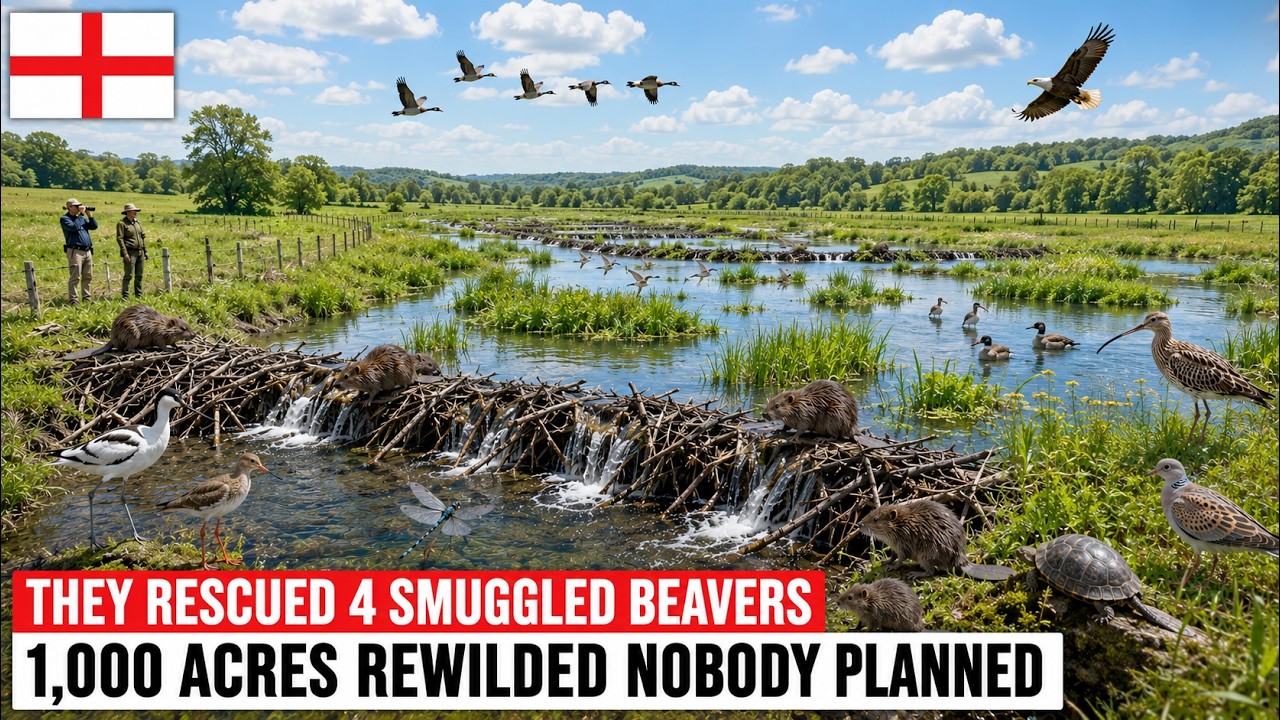
While the eagle license was being negotiated, the actual restoration had already begun. Ecologists call beavers a keystone species. In temperate wetlands, beavers build dams that slow water flow, raise groundwater levels, and create standing ponds that attract aquatic invertebrates, then fish, then birds. One animal mechanically changes the hydrology of an entire drainage basin, without any plan. Beavers are vegetarian, feeding on willow bark, poplar, and aquatic plants. To reach food, they cut selected trees at the water’s edge, opening sightlines and letting in sunlight.
Under British law, the Eurasian beaver was classified as non-native until 2022, despite archaeological evidence that they lived in England until the 12th century. The animal had been gone so long that official documents had forgotten it was native. The Wild Ken Hill beavers came from wild populations in Tayside, central Scotland, not from captive breeding. In the same year, about 20% of Scotland’s wild beavers were legally killed on Scottish farmland. The Tayside animals were rescued from persecution.
Two adult females, unrelated and between two and three years old, were released in March 2020 at dusk from wooden boxes lowered into the reserve. Neither had bred. The original plan called for releasing two breeding pairs, but the 2020 lockdown stopped the second half. In September, two brothers from the same Tayside lineage were released into the territories the females had established. Given the usual Eurasian beaver gestation period, the first kits arrived in early summer of the following year, in front of cameras.
The enclosure fence made the place look more like a Jurassic Park than Wild Ken Hill. On paper, the enclosed area was dry woodland. On maps 250 years old, it was classified as marshland, drained in the 1940s. Within two years, the water had returned. Dams, channels, standing ponds, and a raised water table, without any conversation with an engineer.
Wild Ken Hill, with the neighboring Sandringham estate, became a national release site for curlews, using a technique called headstarting. Every summer, biologists visit airfields where curlews nest on open ground and where eggs are destroyed for flight safety. Eggs are collected and incubated in a specialist facility, chicks are raised through their most vulnerable weeks, then released into acclimatization pens beside restored habitat. In the first year, 79 chicks were released across the two Norfolk sites combined. The curlew’s downward-curving beak evolved to search for earthworms in soft, moist, lightly grazed grassland. If the habitat is dry, plowed, or heavily grazed, that shape becomes useless. Restore the habitat or the bird disappears.
The third intervention was the least dramatic. On 500 acres of coastal marsh stretching toward The Wash, Wild Ken Hill raised the water level by about one foot. That extra inch is the difference between a field a bird can feed in and one it cannot.
Ecologists distinguish between passive rewilding—stopping the plow and letting natural succession happen—and active rewilding, which reintroduces species that cannot return on their own. Wild Ken Hill does both. The rewilding expectations for 1,000 acres in Norfolk were cautious by professional standards. They were wrong. When botanist Graeme Lyons repeated the estate’s plant survey in 2022, the average number of species per plot in the rewilded areas nearly doubled, from 16.8 to 33.2. One plot recorded four species in 2019 and 48 three years later. Lyons is an independent botanist working for neither Wild Ken Hill nor the estate, using fixed-square surveys at identical GPS coordinates across the years. He described the change as statistically highly significant.
A 2024 survey documented 875 invertebrate species on the estate, up from 814 at baseline. Sixty-one new species in five years, at a site that already had the highest number of invertebrates Lyons had ever recorded. None were seeded, planted, or purchased. Under every arable field in England lies what ecologists call a seed bank—the soil itself, holding dormant seeds of every plant that grew there before it was plowed, sprayed, and drained. Corn marigold seeds can remain viable for 40 years. Some seeds wait even longer. A field that looks empty is only empty if measured in the language of the current crop. In the language of the archive beneath it, it is full.
In the same year, the estate produced roughly 800 tons of carbon dioxide equivalent and sequestered about 4,000 tons—a net positive of around 3,200 tons. These figures were modeled, not audited, but the scale aligns with what soil restoration science predicts.
Standing at the edge of the beaver enclosure today, the dividing line is visible. On one side of the fence, an ordinary Norfolk wood, dry and quiet, arranged the way commercial forestry is arranged. On the other side, an animal rebuilt a wetland that had been drained in the 20th century. Standing water, dams, channels, water voles, dragonflies, and ducks that had never bred on the estate. One species, one fence, two different versions of the environment in the same square mile.
Down at the coastal marsh, 500 acres of open water and grazing land come alive in April with avocets and redshanks. Above them, during migration, come the birds that make The Wash internationally important: dunlin, bar-tailed godwits, and brent geese. Wild Ken Hill sits directly on the flight path between two continents. What happens on these acres extends through a migration network spanning Africa, Europe, and the Arctic.
The estate’s own numbers make the shift tangible. Gross margin on the rewilded land rose from £375 per hectare to £550, partly due to countryside stewardship payments, the way Britain pays landowners for ecosystem services the market does not price. The workforce grew to six and a half full-time positions. The pheasant rearing operation was closed, and the gamekeeper was retrained as a wildlife warden. Wild Ken Hill now runs tours, beaver watching, and regenerative agriculture workshops. Springwatch and Winterwatch have used the estate as their England base for three consecutive years. Local businesses in Snettisham report visitors asking how to reach the rewilded farm.
It remains a working farm. A thousand acres are in regenerative production. Cattle graze rotationally. Wheat, barley, and legumes grow on the fertile land. The farm did not stop farming.
There are plans for further reintroductions, expanded ecotourism, and continued curlew restoration. But the story is not universal. Twenty miles from Wild Ken Hill, estates of similar size still run the same monoculture cycles that emptied East Anglia of birdsong. To the east, tenant farmers on 150-acre holdings cannot do what Wild Ken Hill did. They do not own the land, cannot absorb the costs, and cannot forgo income during the transition. Some critics have described rewilding land allocation schemes as policy for landowners with thousands of acres and private income. That criticism has merit. Wild Ken Hill is partly successful because the finances could support the transition period. A tenant farmer cannot.
In July 2022, a heatwave-driven fire burned 33 hectares. That was not a failure so much as a reminder that restored ecosystems live within a changing climate, and that fire in a rewilded landscape is a management category, not an anomaly. None of this means the mechanism does not work. It means it cannot alone substitute for a national plan.
What Wild Ken Hill demonstrates is narrower than the headlines suggest and more useful. When the plow stops, the seed bank opens. A keystone species behind a fence can rebuild what a century of drainage erased. A curlew chick collected from an airfield runway can, after four years, become a breeding wild bird. The numbers can move in the same direction without pretending that farming and biodiversity are enemies. If nature can recover this quickly once we step back, what were we protecting it from all along, if not ourselves?






