In 2014, the British government learned that wild beavers had been living and breeding on the River Otter in Devon. Their origin was unknown. The government initially planned to remove them, but a wildlife charity successfully proposed monitoring them instead. Eight beavers were released back onto the river as part of a five-year experiment. The changes they brought to the water, wildlife, and surrounding landscape influenced conservation policy in England.
The Eurasian beaver was once common across Britain, inhabiting major river systems from the Scottish Highlands to southern England. For thousands of years, beavers shaped the landscape by felling trees, building dams, and creating ponds and wetlands that supported many species. Human hunting for fur, meat, and castoreum led to their extinction, with the last record of a beaver in Britain dating to Scotland in the 1500s.
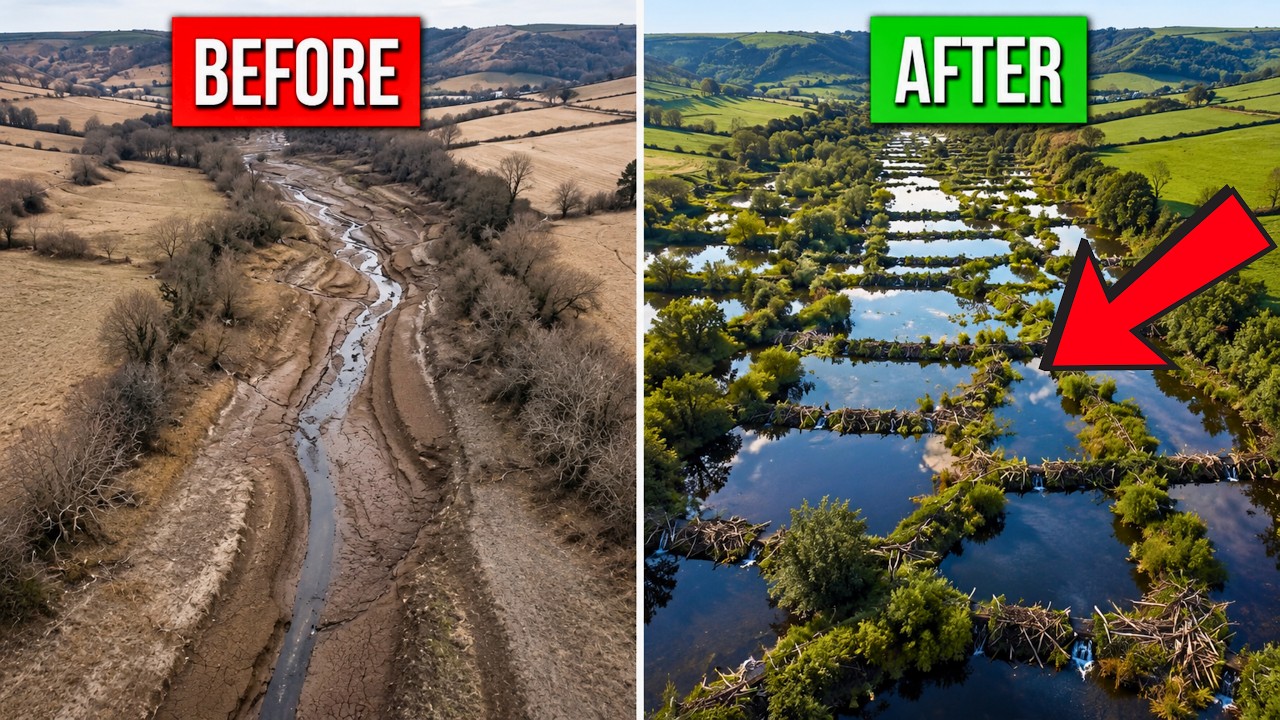
For four centuries, British rivers flowed without beavers. Streams ran faster and straighter, wetlands dried out, and floodwater moved more quickly into towns. Pollutants from farms entered waterways unchecked. Many natural ponds disappeared, removing habitat for amphibians, insects, and wetland birds. Today, only a small percentage of English rivers meet good ecological health standards.
Around 2008, residents near the River Otter began reporting sightings of large animals with flat tails. By 2013, trail camera footage confirmed that a female beaver had given birth, marking the first time in over four centuries that wild beavers had bred in an English river. The likely explanation was that someone had released captive beavers illegally.
The government’s initial response was to capture the animals. Devon Wildlife Trust argued against removal, suggesting the beavers be studied instead. After negotiations, the charity received a license to run a five-year monitoring program. The beavers were tested, microchipped, and released back into the river in February 2015 in two family groups totaling eight animals.
The River Otter Beaver Trial was led by Devon Wildlife Trust with the University of Exeter and other partners. Professor Richard Brazier oversaw scientific monitoring, with equipment installed to measure changes in water flow and quality. Baseline data had been collected before the beavers were reintroduced.
The beavers built dams along smaller tributaries feeding the River Otter. On one stretch of the River Tale, a family constructed 13 dams along 180 meters. The resulting ponds held roughly one million liters of water that had not been stored there before. Water that once moved through in under 15 minutes took over an hour to pass.
Beavers are Europe’s largest rodent, weighing up to 30 kilograms. They work mostly at night, using their continuously growing teeth to fell trees and drag branches into the water. Trees cut by beavers often regenerate from the stump, producing new growth that serves as food and building material. The beavers were effectively coppicing the riverbank, a technique used by woodland managers for centuries.
Evidence of flood reduction emerged early. Upstream of the village of East Budleigh, a family built six dams across a tributary. Monitoring showed significant reductions in peak flood flows through the village during heavy rain. Across multiple dam sites, the dams reduced average flood peaks by up to 60 percent during monitored storms.
The dams also improved water quality. Sediment, nitrogen, phosphorus, and agricultural fertilizers were trapped in the still water behind the dams. At the site with 13 dams, researchers concluded the beavers were playing a meaningful role in filtering pollutants. Water stored behind dams also continued to seep downstream during dry periods, maintaining base flow in the stream when rain had not fallen for weeks.
The wetlands created by the beavers supported more species. Fish abundance was 37 percent higher in beaver-created pools than in comparable stretches without dams. Minnow and lamprey populations increased, and gravels below dams created spawning habitat for juvenile trout. Researchers observed trout leaping over dams during high flows, indicating the dams did not block fish movement.
Amphibian numbers rose sharply. At the site with 13 dams, common frog spawn clumps increased from 10 in 2011 to 681 in 2017. Water voles, an endangered species, benefited from new marshy habitat. Dippers, kingfishers, teal, and other riverine birds moved in and began breeding. Otters thrived because of increased fish populations, and dragonflies colonized the new ponds.
The science report, overseen by Professor Brazier’s team, concluded that beaver engineering had delivered significant ecological benefits, including new wetland habitat with documented gains for amphibians, wildfowl, and water voles. Mark Elliott, who led the trial for Devon Wildlife Trust, said the animals had shown an ability to thrive in wetland ecosystems and an unmatched capacity to bring new life to rivers in poor health.
The beavers also generated economic benefits. Guided watching tours along the River Otter became a popular wildlife experience, bringing visitors from across the country. The trial’s economic analysis found that benefits, including ecotourism revenue and ecosystem services such as flood alleviation and water purification, outweighed management costs.
By the end of the trial in February 2020, the original eight beavers had grown to an estimated 15 family groups throughout the River Otter catchment. They had built dozens of dams and established themselves without further human assistance. Costs were modest, with occasional flooding of small farmland areas, a few gnawed trees, and one dam blocking a culvert. Devon Wildlife Trust worked with 42 landowners to address issues as they arose.
In August 2020, the government announced the beavers could stay permanently, with the right to spread naturally into other catchments. It was the first legally sanctioned reintroduction of an extinct native mammal to England. Tony Juniper, chair of Natural England, called the trial a success, and Environment Minister Rebecca Pow said it had shown that beavers improve biodiversity, water quality, and resilience to climate change.
On February 28, 2025, the government announced that beavers could be released into the wild in England with a license for the first time in centuries. Five days later, the National Trust released four beavers at Little Sea Lake in Dorset, the first official wild release in England since the 16th century. By 2026, Natural England had received 39 expressions of interest for wild beaver releases, including proposals for some of the country’s largest river systems.
An estimated 500 beavers already live wild in England, from licensed enclosures, trial populations, and unofficial releases. The National Trust has released beavers in Somerset and Hampshire. Researchers at the University of Exeter found that four wild beaver territories in Devon collectively store more than 24 million liters of water. Farmers in the catchment are now paid through government environmental schemes to make space for beavers.
Sam Bryant-Evans, head of agriculture at Clinton Devon Estates, described the new wetland as a habitat for a wide range of insects and birds, with land once used for cattle grazing now colonized by otters, kingfishers, and other species.
Four centuries after beavers disappeared from England, a small population on one Devon river demonstrated measurable effects on flooding, water quality, and biodiversity. The outcomes of that trial led to the first licensed wild releases in the country since the 16th century.






