For roughly 12,000 years, a recurring symbol has appeared in ancient art across three continents: a solid container with a curved handle, resembling a modern handbag. Carved by the Sumerians, the builders of Göbekli Tepe, and the Olmec of Mesoamerica, the object appears in sacred contexts but its contents are never depicted.
The symbol first appears in Mesopotamian art, where figures known as the Apkallu carry it. The Apkallu were described in Sumerian and Babylonian texts as semi-divine sages who served as intermediaries between gods and humans. They were credited with bringing writing, mathematics, agriculture, and law to people after a catastrophic flood. In surviving art, they appear as winged humans, eagle-headed figures, and fish-men. The Babylonian priest Berossus described one such figure, Oannes, as having a fish body with a human head and feet, who came ashore during the day to teach humans the arts of civilization before returning to the sea at night.
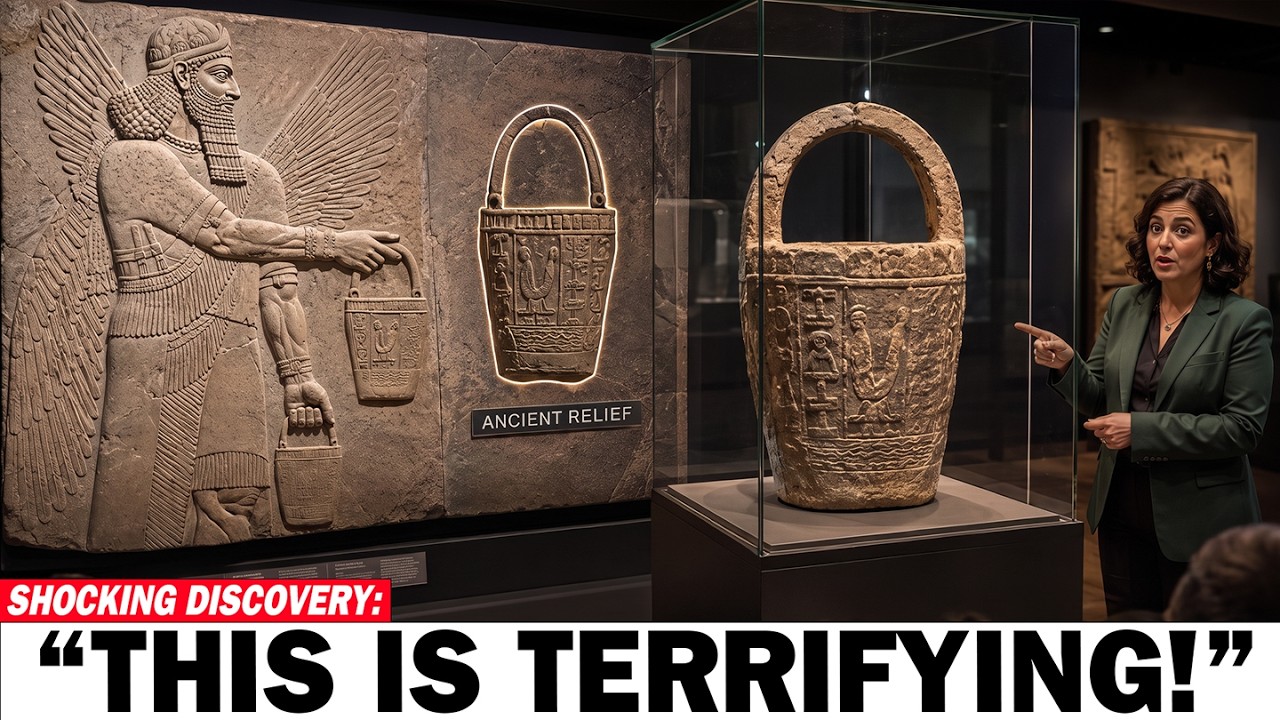
In Mesopotamian reliefs and cylinder seals, these figures consistently hold a container with a curved handle in one hand and a cone-shaped object in the other. The official archaeological interpretation identifies this container as a “banduddu,” a ritual bucket used for purification ceremonies. Under this reading, the cone would have been used to sprinkle holy water or oil.
The interpretation faces several problems. The figures carrying it are not priests but foundational civilizational figures. The container’s shape does not resemble a wide-mouthed bucket but a rigid, handled case. And the same object appears in places with no known connection to Mesopotamian religion.
The most significant of these is Göbekli Tepe in southeastern Turkey. The site, excavated beginning in 1994 under the German archaeologist Klaus Schmidt, consists of massive T-shaped limestone pillars arranged in circles and decorated with animal reliefs and abstract symbols. Dating to more than 12,000 years ago, the complex predates agriculture, pottery, and permanent settlement as they have been traditionally understood. Schmidt argued that the site suggests organized ritual preceded and enabled the development of civilization, rather than the reverse. The site was deliberately buried around 10,000 years ago. Among the carvings is the same handled bag symbol found in Mesopotamian art 7,000 years later.
The symbol also appears in Mesoamerica. At La Venta, an Olmec site in Veracruz, a monument known as Stela 19 depicts a figure interacting with a feathered serpent while holding what appears to be the same container. The Olmec are considered the parent civilization of Mesoamerica and developed independently from the ancient Near East. Some researchers affiliated with Mexico’s National Institute of Anthropology and History have disputed this identification, arguing the object may be a stylized incense bag used for burning copal resin, a distinct type of object documented separately in later Mesoamerican iconography. The debate remains unresolved among specialists. Later Toltec figures at Tula hold similar objects in a posture resembling that of the Mesopotamian Apkallu. A comparable structural parallel appears in Maori tradition, in which the god Tane returns from the heavens with three baskets of knowledge, a concept that could not have traveled between the Pacific and the Middle East.
Scholars have offered several theories about what the object might have meant. The most archaeologically grounded is the seed-storage hypothesis. Göbekli Tepe was built at the boundary between the last ice age and the current geological epoch, a period of rising sea levels and collapsing ecosystems. A portable container holding seeds and agricultural knowledge would have been essential for survival and rebuilding, which fits both the site’s timeline and the Apkallu narratives about beings who taught farming after a global catastrophe.
Other theories remain more speculative. One suggests the object was a portable power source, based on debates about how ancient peoples achieved the precision evident in their architecture. Another, grounded in creation myths that describe gods biologically shaping humans, proposes the bag held materials used in such intervention. A fourth theory suggests it contained something intended to alter human consciousness, a notion connected to interpretations of altered states during ritual practice.
The symbol eventually faded from major use in later civilizations. One simple explanation is that the figures carrying it completed their task and withdrew, leaving the object as a cultural memory that diminished over time. Another possibility is institutional suppression: organized priesthoods had an interest in minimizing traditions that attributed civilization’s origins to beings outside their own theological frameworks. The documented destruction of knowledge throughout history, including the burning of Maya codices in 1562 and the repeated destruction of the Library of Alexandria, shows that such erasure occurred.
A broader theory holds that the figures holding the bag were survivors of a civilization that predated the end of the ice age and reached a level of development not accounted for in the standard historical timeline. Göbekli Tepe has demonstrated that monumental construction existed far earlier than traditional models allow. Underwater surveys have identified submerged structures at depths consistent with coastlines that existed before sea levels rose roughly 120 meters. Climate research has independently shown that the end of the ice age involved rapid, catastrophic events rather than gradual change. The Younger Dryas impact hypothesis, which proposes that a fragmented comet struck the Laurentide ice sheet around 12,800 years ago, remains genuinely disputed in mainstream geology, with peer-reviewed critiques offering alternative explanations for the platinum and nanodiamond evidence.
Within this framework, the bag becomes a relic of what was saved from a disaster. Survivors would have carried knowledge, technology, and biological materials to scattered groups and helped them rebuild. Later peoples remembered them as divine beings who came from the sea or sky, because their capabilities exceeded what the people they met could otherwise explain. The repeated pattern across cultures suggests a shared memory preserved in the only form available to pre-literate societies.
The timeline of Göbekli Tepe coincides with the Younger Dryas period. The site was built at its beginning and deliberately buried as conditions worsened. Flood and destruction myths in many cultures describe a prior world ending not only as a natural disaster but as a consequence of humanity’s misuse of knowledge or power. On this reading, the bag functions less as a symbol of pure gift-giving and more as a warning carried by survivors who had already experienced the consequences of misused capability.
Modern developments in artificial intelligence, genetic engineering, and energy technology raise the question of whether humanity is approaching a threshold that earlier civilizations may have reached and passed with severe consequences. The symbol carved into stone at a 12,000-year-old site that was deliberately buried, carried by figures who appear after catastrophes to teach rebuilding, appears across continents believed to have had no contact, and whose contents were never shown, may encode a warning rather than a gift. The answer, if it exists, may still lie within the stone.






