In August 1948, a twin-engine plane lifted off from a small airstrip in McCall, Idaho, carrying eight wooden crates. Inside were 76 live beavers. The pilot climbed to about 700 feet over the Chamberlain Basin, a remote valley in the mountains of central Idaho, and the crew pushed the crates out one at a time. Each crate had a parachute strapped to the top. When the last parachute settled, 75 beavers had landed safely in one of the most isolated corners of the American West.
That was 78 years ago. Today, the valley sits deep inside the Frank Church River of No Return Wilderness, 2.3 million acres of Idaho backcountry with no roads, no towns, and no motor vehicles. For a century before the drop, fur trappers had stripped beavers from streams across the West, and much of the land had dried out without them. For 78 years, the descendants of those 75 beavers have been putting the water back, damming creeks, cutting willow and aspen, flooding meadows, and spreading ponds across the valley floor with almost no one there to interfere.
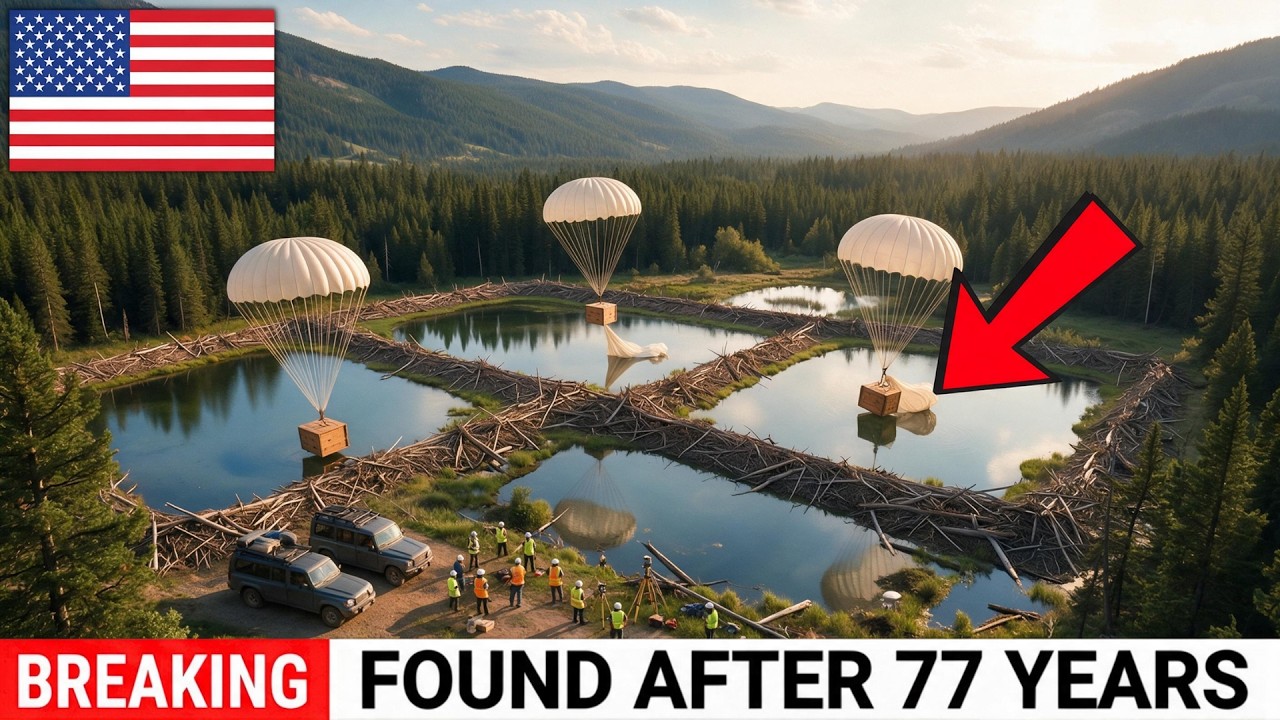
Everyone remembers the parachutes. Almost nobody talks about what the beavers did next, how it happened, why it worked, and what that valley looks like today.
The strangest thing about the airdrop is that it worked, and then nobody ever did it again. Idaho went back to trucks and traps, and nobody has parachuted beavers since. So why would a state game department throw beavers out of an airplane in the first place? And what did those beavers leave behind in the Idaho backcountry?
The answer starts with the animal inside those crates. Every crate held a pair of North American beavers, the second largest rodents on the planet, usually 35 to 60 pounds of muscle, fat, and waterproof fur. A beaver’s front teeth are orange because the enamel is reinforced with iron, and they never stop growing, which is handy for an animal that cuts down trees for a living.
The reason Idaho wanted beavers in its backcountry comes down to a strange quirk in how a beaver hears water. In the 1960s, a Swedish zoologist named Lars Wilson wanted to know whether beavers learn to build dams or are born knowing how. He raised young beavers away from adults and away from rivers. When he played a recording of running water through a hidden speaker, they piled sticks and mud on top of the speaker until the sound stopped. Then he let water leak silently through a clear pipe right in front of them and played the sound somewhere else. The beavers ignored the leak they could see and buried the speaker instead.
That experiment explains most of this story. A beaver isn’t trying to build a pond. It’s trying to make the sound of moving water go away. A pond is what happens when it wins. Every dam slows a creek down. Slow water soaks into the ground, raises the water table, and spreads out across the meadows. It also drowns some of the trees along the banks, and those gray trunks standing in a beaver pond can look a lot like a dying forest.
First, the beavers had to come back because by 1900, they were almost gone. Estimates for North America before the fur trade range from 60 million to 400 million beavers. Their fur, pressed into felt, made the waterproof hats Europe wore for roughly two centuries, and trappers followed the beavers west until the streams ran empty.
In Idaho, the trapping went beyond fashion. From the 1820s into the 1840s, the Hudson’s Bay Company ran what historians now call the fur desert policy. Britain and the United States were jointly claiming the Oregon country, and the company’s governor, George Simpson, figured that if the Snake River country had no beavers left, American trappers would have no reason to come west. In an 1824 journal entry, he wrote that for political reasons, the region’s beavers should be destroyed as fast as possible. Brigades led by a trader named Peter Skene Ogden spent years doing exactly that, stream by stream across southern Idaho and eastern Oregon. Even the valley Idaho later picked for its beaver drop carries a trapper’s name. Chamberlain Basin is named after a trapper, John Chamberlain.
When the beavers vanished, their dams rotted, the ponds drained, and creeks that used to spread across wet meadows cut down into narrow, eroded trenches. If you’ve ever driven through the West and seen a creek running at the bottom of a deep, raw ditch with dry sagebrush right up to the edge, there’s a decent chance you were looking at a stream that lost its beavers. The water still flows. It just races straight through and never gets the chance to spread out and soak in.
By 1900, the continent was down to an estimated 100,000 beavers. Then states started trying to bring them back. By the 1940s, Idaho had the opposite problem. After World War II, families poured into McCall and the shores of Payette Lake in west-central Idaho. The local beavers had recovered nicely, and they did what beavers do. They flooded roads, chewed through orchard trees, and plugged irrigation ditches. The complaints landed on the desk of Idaho Fish and Game.
The agency didn’t want to kill them. It wanted to move them somewhere they’d be useful. The best target was the Chamberlain Basin, a wide valley of meadow grass and lodgepole pine deep in the mountains northeast of McCall with no road in. No road meant no trucks, so moving beavers meant pack horses and mules, and that went badly. Beavers are built for cold water and strapped onto a sweating horse for a long summer ride through the mountains. They overheated, stopped eating, and sometimes died. The horses hated it, too. One official later wrote that horses and mules became spooky and quarrelsome when loaded with a struggling, smelly pair of beavers.
There was also a clock running on every move. A beaver released in late summer has a few weeks to build a lodge and sink a pile of branches into the pond bottom before ice seals the surface for winter. That underwater wood pile is its food until spring. A beaver that showed up exhausted from a mule ride might not finish its food cache before the first hard freeze. In the high country of central Idaho, that means starving under the ice.
Fish and game needed a faster way in. The fix came from a game warden named Elmo Heter, who worked out of the fish and game office in McCall. He noticed two things. Small planes were already landing in the Chamberlain Basin, and after World War II, the government was sitting on piles of surplus parachutes. Heter wondered whether a beaver could make the trip by air.
The hard part was the box. His first design had ends made of woven willow, which turned out to be a poor idea for passengers that eat wood. The beavers started chewing their way out early, which is the last thing you want happening inside a small airplane over the mountains. The design Heter settled on was two lidless wooden boxes hinged together like a suitcase, each drilled with one-inch air holes, big enough for two beavers and only a few inches larger than an airline carry-on bag.
The clever part was the rope. In the air, the weight of the box hanging from the parachute kept the ropes tight and the suitcase shut. On the ground, the parachute collapsed, the tension disappeared, and the box fell open by itself, so nobody had to hike out to a meadow to let anyone go. Heter worked out the height, too. His report says 500 to 800 feet was the sweet spot, high enough for the chute to slow the box before it hit and low enough to hit a chosen meadow without snagging in the trees.
All he needed now was a test pilot. The test pilot was Geronimo, an old male beaver. After trials with dummy weights, the crew dropped him onto the airfield over and over. Every time the box popped open, he scrambled out. Somebody grabbed him, and up he went again. Heter’s report has one line about him. He called him a poor fellow and described how Geronimo finally gave up fighting it. Whenever the crew walked over, he’d crawl back into the box on his own, ready for another flight. A newspaper column that August claimed he’d come to enjoy it, which was the newspaper talking. His reward for all that testing was a seat on the first real flight into the Chamberlain Basin along with three young females.
There was a practical reason for his placement. Heter liked dropping about four beavers at one spot, which is a starter colony, enough animals to build a dam fast and beat the winter clock. That August, the real flights began. Each plane carried a pilot, a conservation officer, and up to eight crates. Over that fall, 76 beavers came down under white parachutes into the meadows of the Idaho backcountry.
From the ground, each one would have looked like a white canopy sinking over the treetops. Then a thump in the meadow grass, then a wooden suitcase falling open, and a very confused beaver heading for the sound of the nearest creek. Seventy-five of them walked out. The one that didn’t was undone by a piece of rope. On an early drop, the crew used lightweight linen lashings. One broke in midair, and the beaver inside nosed its way out and climbed on top of its own box. Heter wrote that if it had stayed put, it would have been fine. Instead, about 75 feet above the ground, it jumped or fell. After that, the ropes got heavier.
There was also the price. Heter put the cost at roughly $30 to move four beavers, and that dropped by half when the parachutes came back. They did come back because ranchers, forest rangers, and backpackers who found old chutes in the mountains kept returning them to fish and game. Idaho’s cheapest wildlife relocation was being recycled by hikers.
Within about two weeks of the first drop, newspapers were already reporting fresh dam building in the landing area. By the time Heter wrote up the project, he could report that the beavers had built dams, put up lodges, and stored food, and were well on their way to forming colonies. They beat the clock. That speed is the Wilson experiment playing out in the wild. A young beaver comes preloaded with a whole routine. It hears moving water in a meadow it’s never seen, and it starts stacking sticks. A beaver that falls out of the sky is ready to work the moment the box opens.
Time and Popular Mechanics ran stories about the flying beavers. Then the whole thing faded so completely that the film fish and game shot sat forgotten in the agency’s archives for decades. Around 2015, a fish and game historian found it. The internet found Geronimo, and the parachuting beaver became an Idaho icon on shirts and even a Boise brewery’s logo.
That’s usually where the story ends, with a funny clip and a happy landing. But the clip leaves out two things. The first is that the Chamberlain Basin was already protected when the beavers landed. In 1931, the Forest Service set the area aside as the Idaho Primitive Area, and pilots had been landing at Chamberlain Meadows since 1928, which is exactly why Heter could fly there at all. Primitive area status was a Forest Service rule, though, the kind an agency can rewrite whenever a road or a timber sale looks more important.
Then in July 1980, President Jimmy Carter signed the Central Idaho Wilderness Act, locking that land up for good as the River of No Return Wilderness. In 1984, Congress added the name of Senator Frank Church, who had sponsored America’s Wilderness Act back in 1964. He died a few weeks later. At about 2.37 million acres, it’s the largest contiguous wilderness in the lower 48, nearly one and a half times the size of Delaware. There are no roads into it, but one way in never got banned, and it’s the same one the beavers used. The 1980 law let the old backcountry airstrip stay open. To this day, small planes still touch down on a backcountry airstrip in the Chamberlain Basin.
The second thing is the uncomfortable part. Ask the state’s wildlife agency where the beavers still live where Geronimo landed, and the honest answer is that nobody knows. In 2023, the agency told the Idaho Statesman that it doesn’t run precise beaver counts because Idaho’s numbers are stable. It can’t confirm beavers remain at the landing site. It can’t say whether any beaver there today descends from the parachute crew either. Its spokesperson admitted beavers might have recolonized the basin on their own. Even the drop map is fuzzy. Heter’s report never pinned down the sites, and an Associated Press story from September 1948 placed a dozen of the parachuting beavers in a different wilderness altogether, the Lochsa and Selway country near Lewiston.
That sounds like bad news for the story, but it points to a better question, which is what a valley like this looks like when beavers, any beavers, get to work undisturbed. So how do we know what those beavers built? We look at what is well documented, which is what beavers do to western valleys when they’re left alone. That research turned up three surprises.
The first surprise is fish. Chamberlain Creek winds through the basin and drains toward the Salmon River, the same river system where chinook salmon and steelhead swim hundreds of miles inland from the Pacific to spawn. In Oregon’s Bridge Creek, a tributary of the John Day River, researchers ran a 7-year experiment. They drove wooden posts into a badly eroded creek to give beavers an easy anchor for dams. The state closed the creek to beaver trapping, and they compared it to a similar creek where nothing changed.
The beavers moved in fast. Four years after the first posts went in, juvenile steelhead production in the beaver creek was up 175% compared to the creek without them. Beaver ponds give young fish deep, slow water to hide in, cooler pockets in summer, and more insects to eat. Picture that effect running for decades in a protected basin where nobody tears the dams out. The same slow water helps the land through drought. A scientist named Emily Fairfax measured streamside plants on ranch land in northern Nevada and found that stretches with beaver dams were about twice as productive as nearby stretches without them. They stayed green through dry years because the ponds kept the water table high long after the snowmelt was gone.
The second surprise is fire. Several big wildfires have swept through the Chamberlain Basin in recent decades, and a burned lodgepole forest is about as close to a dead forest as the West gets. In 2020, Fairfax and a colleague used satellite images to study five large wildfires across the western United States. They compared streams with beaver dams to similar streams without them. Where there were no beavers, the streamside plants lost about three times as much of their green during the fire. The dammed stretches stayed green while the hillsides around them burned, wet ribbons of living plants running straight through the fire. For a frog or a nesting songbird, a ribbon like that can be some of the only unburned ground nearby.
There’s a catch, though. The year after each fire, the plants bounce back whether the beavers were there or not. So beaver ponds work as a shelter during the fire itself, a place where anything that can’t outrun the flames has a chance. A fish and game spokesperson made a similar point about the basin. Fires or no fires, wherever you find meadows, marshes, and slow creeks lined with willows, there’s a good chance beavers are living there.
Which brings us back to those drowned trees and to a place where beavers really did leave a dead forest behind. The third surprise happened two years before Idaho’s drop at the bottom of South America. In 1946, Argentina flew 10 pairs of Canadian beavers from Manitoba to Tierra del Fuego, hoping to start a fur industry. Same species as the Idaho beavers, and the same basic plan of moving them somewhere wild and letting them go. It went badly wrong.
Tierra del Fuego has no wolves or bears to keep beavers in check, and its forests are dominated by southern beech trees that never evolved alongside beavers. Those beeches don’t resprout after they’re cut, and they can’t survive their roots being flooded. Today, estimates put the beaver population across Tierra del Fuego and Patagonia at 70,000 to 110,000, and a 2019 count found more than 70,000 dams on the Argentine side of the main island alone. An ecologist there called it the biggest change to those forests since the last ice age. Where the beavers have moved through, stands of gray drowned trunks rise out of still water. Argentina and Chile are now trying to wipe the beavers out, and researchers priced clearing them from just the Argentine side at about $31 million over 17 years.
So why did the same animal dropped into Idaho build something useful? Because Idaho streamside plants grew up with beavers. Willows and aspens send up new shoots from a chewed stump, so a cut thicket grows back. Idaho also has the predators that keep beaver numbers in balance, cougars, bears, and since wolves were released back into central Idaho in 1995, wolves, too. Those resprouting willows and aspens are exactly what beaver restoration crews in the West look for before they move a single animal.
There’s one more twist, and it’s back in McCall. The journalist Ben Goldfarb, who wrote the book “Eager,” points out that pulling beavers out of good habitat mostly advertises an empty home to the next beaver family. So the 1948 removals may simply have made room for new beavers along Payette Lake. What changed is how people handle them. Today, plenty of beaver conflicts get solved with a pipe run quietly through the dam, so water drains without making a sound. Wildlife crews call them flow devices. One popular design goes by the name “beaver deceiver.” It’s Wilson’s speaker experiment turned into a tool. The beaver hears nothing, stops building, and the road stays dry.
Goldfarb also gives Heter’s crew credit for something bigger than parachutes. In 1948, plenty of places would have simply killed nuisance beavers. Idaho moved them to a valley where their engineering could do some good. That idea, beavers as workers you place where water needs holding, sits behind beaver restoration projects across the West today.
Heter wrote his report like a supply manual, rope weights, drop heights, and cost per beaver, with one soft spot for an old beaver who kept climbing back into the box. Nobody can say where Geronimo’s colony ended up or whether his descendants are still working Chamberlain Creek. What we do know is what that valley needed and what a beaver does when it gets the chance. Seventy-six beavers, eight crates at a time, surplus parachutes from a war, a box that opened itself, and a valley named after a trapper. Seventy-eight years later, wherever water runs slow through the Chamberlain Basin, something is still stacking sticks against the sound.






