A wildlife researcher tracking invasive Burmese pythons in the Florida Everglades has documented what appears to be a significant shift in the ecosystem: seven native predator species are independently preying on pythons in ways not previously recorded.
Dr. Elena Marsh had conducted systematic python density surveys in the Big Cypress National Preserve for seven years under a contract with the University of Florida. Her methodology, grid layout, and results had remained steady over that period, with python presence staying stable or increasing in every monitored area.
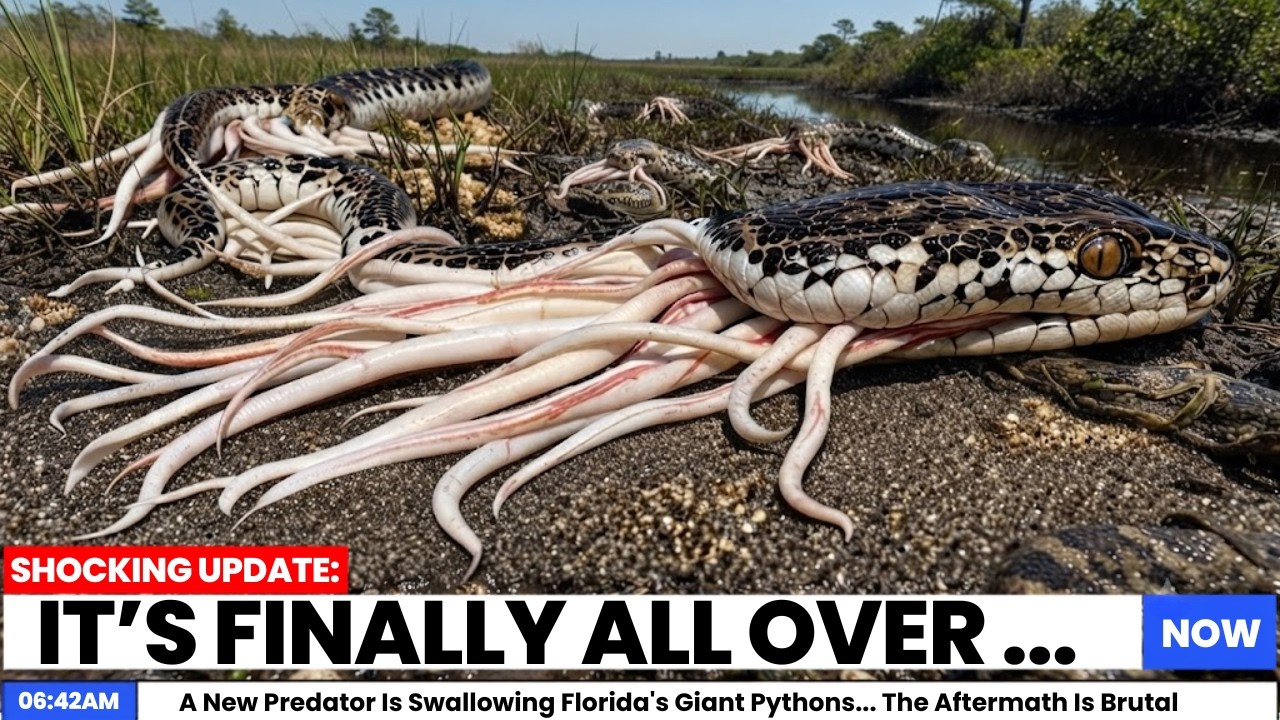
Over four consecutive field seasons, however, three specific zones within the Fakahatchee Strand management unit began producing numbers her dataset had never registered. Detection rates were trending downward in a measured, consistent pattern across data returns.
Marsh spent three months ruling out alternative explanations. No new removal program had targeted those areas. Hunting pressure had not increased. Seasonal rainfall had not altered habitats in ways that would affect detection probability. When standard variables were exhausted, she reviewed four years of trail camera archives with a different question in mind: not where pythons were, but what was happening around them.
**The context of the python invasion**
To understand the data, one has to consider what pythons have done to the ecosystem over four decades. Burmese pythons arrived through the exotic pet trade in the 1980s, and the situation worsened after Hurricane Andrew in 1992, which destroyed commercial breeding operations along the Tamiami Trail.
Conservative estimates from the U.S. Geological Survey place the current population between 100,000 and 300,000 animals across the greater Everglades region. No one can provide a reliable count because the animals are extraordinarily difficult to locate. Full-grown pythons remain motionless for weeks, and their patterns blend with sawgrass, mud, and cypress shadows so effectively that they are practically invisible at a distance of three meters. Trained hunters have walked within two meters of adults without detecting them.
The ecological impact has been severe. Raccoon populations in the python’s main range have collapsed by more than 99 percent, and opossum populations by 98 percent. Bobcat numbers have declined by roughly 90 percent in affected areas. Researchers have confirmed 24 native mammal species and 47 bird species as documented prey. The Everglades provides clean water for more than 9 million people, and as the food web connecting that system began to break down, effects have reached hydrology and vegetation structure in ways still being documented.
Florida launched a python elimination program in 2017. More than 14,000 animals have been removed since then. The annual python challenge removed 294 pythons in 10 days in its most recent edition. Researchers state openly that this is not enough. A single breeding female can produce up to 100 eggs at a time, and the population absorbs removal efforts within one reproductive cycle.
When Marsh’s detection rates moved in a direction her data had never shown, her colleagues’ first question was not how to celebrate. It was: what are we missing?
**Seven predators targeting pythons**
When Marsh reviewed the camera archives specifically for activity around the snakes rather than activity of the snakes, a pattern emerged that data alone would not have revealed. Seven distinct native species were exploiting different biological windows, each developing different attack strategies. None were funded or coordinated with each other. Together they were contributing to a change no removal program had achieved in four decades.
**Bobcats**
The bobcat appeared first in the archive review and remains the most counterintuitive finding. A Florida bobcat weighs between 7 and 14 kilograms. A breeding-age Burmese python weighs between 20 and 40 kilograms. No existing literature had suggested that a cat of this size could pose real predatory pressure on a large constrictor with significant muscle mass and strike speed.
The Big Cypress footage contradicted that assumption. In 2021, a camera at a monitored nest site recorded a bobcat systematically destroying fertilized eggs. When the female python returned, the cat held its ground. The snake was about 4 meters long, far larger than the cat facing it. The bobcat kept shifting position on a shallow arc, staying outside the snake’s effective striking range, reading each movement, and eventually drove a snake five times its weight away from the nest entirely.
Wildlife biologist Ian Bartoszek reviewed the footage and stated publicly that an 11-kilogram bobcat confronting a 40-kilogram python was not something the scientific literature had prepared anyone to expect. By 2024, documented interactions had escalated to direct kills of adult pythons. One bobcat successfully killed a snake nearly 4 meters long and twice its own body weight, cached the carcass, and returned to feed over several days.
Cold vulnerability was a decisive factor. When south Florida temperatures drop below 50 degrees Fahrenheit, python muscle function approaches paralysis. Strike speed slows. Coiling response nearly disappears. The bobcat was not attacking healthy animals; it was reading the scene for thermally compromised targets.
**River otters**
River otters had not appeared in any discussion of snake management before Marsh’s archive review. Nothing in their behavioral profile linked them to large constrictors. But in waterway areas adjacent to the three declining monitoring zones, otter groups of 4 to 12 individuals appeared on camera in contexts no model predicted.
Newly hatched Burmese pythons measure 40 to 60 centimeters long. They swim slowly and have almost no defensive capability against coordinated aquatic predators. A single river otter weighs 5 to 14 kilograms and has jaw strength far exceeding what its size suggests, using a spinning technique that generates torsional force on captured prey. Documented otter groups approached from multiple angles to pull young snakes underwater. In areas with consistent otter activity, first-year survival rates for young pythons fell below 15 percent across three consecutive hatchling seasons.
Nest predation was the discovery that changed the scale of otters’ impact. When otter groups located an unguarded snake nest near water, they did not take individual eggs; they emptied the entire nest. Between 60 and 100 eggs consumed within minutes. These were not incidental encounters but systematic elimination of entire reproductive cohorts before any offspring reached the breeding population.
**Coyotes**
Coyotes had been building a predation pattern in Everglades and Big Cypress monitoring areas since roughly 2019, unnoticed until Marsh reviewed the archive with a different question. The distinguishing feature was not the kill itself but the carcasses.
The Florida Fish and Wildlife Conservation Commission had been recording a recurring trait in snake carcasses over five years: adults found decapitated. The heads were removed in a manner inconsistent with alligator attacks and not eaten in the pattern associated with large felid kills. The removal was precise, leaving the rest of the body nearly untouched.
Bite-force forensics on recovered skull fragments produced consistent results. Jaw angle, bite force modeling, inter-tooth distances, and wound geometry all pointed to an animal in the 11-to-16-kilogram range. A coyote.
The cameras eventually captured the mechanism. Burmese pythons have three documented windows of deep physiological vulnerability. During digestion after feeding, blood flow redistribution reduces effective muscle function to near zero, and constriction ability disappears entirely for several hours. During egg incubation, the female maintains a fixed position with forward-focused attention, creating a consistent approach angle from behind. During skin-shedding cycles, the snake’s eyes cloud completely and visual awareness drops to almost nothing.
In each window, a coyote approaching in an arc 30 to 45 degrees behind the snake’s head, where the snake’s lateral eye placement creates a genuine blind spot, can deliver a single precise bite to the skull with minimal defensive risk and disappear before any response is possible. The snake’s defensive response takes about 0.88 seconds to initiate from a static coil position. In the specific vulnerability windows, that response time degrades significantly. The brain is the most energy-dense tissue in the snake’s body, and the caloric return is substantial.
Coyotes did not arrive in Florida knowing this. The behavior appeared gradually in archival footage. Individual animals experimented with adults experiencing thermal problems, discovered that a head strike at the right angle during the right window involved low risk and high reward, and repeated it. Other coyotes observed and adopted the behavior. The number of documented decapitated snake carcasses increased annually from 2021 through 2024 in direct parallel with the spread of this behavioral knowledge through the coyote population.
**American alligators**
The American alligator has been part of the python story from the beginning, but the full structure of that relationship has often been misunderstood. The image that entered public awareness was a snake ripped open on a levee road with a two-meter alligator partially visible inside the torn body. That portrayal framed the relationship as a confrontation between equals.
Continuous observation data shows something different. Against pythons under two meters long, alligators function as effective predators. Their bite force exceeds 2,000 pounds per square inch, and their leathery hide cannot be compressed by a snake of that size. The death roll turns grip strength into a mechanical advantage beyond what alligator mass alone would suggest. Camera data from water-edge zones showed alligators initiating attacks on sub-adult snakes at rates representing meaningful suppression of animals before they reached breeding size. The threshold in the data consistently sits around 3 to 3.5 meters. Below that threshold, the alligator is not a competitor to the snake; it is a predator of the snake.
**Black bears**
Florida black bears brought a different element. Black bears in south Florida weigh between 100 and 200 kilograms. Marsh’s transmitter records included four cases where a tracked snake’s signal moved from regular movement to permanent silence, followed by confirmation of bear activity at those coordinates. Two of the four cases occurred on nights above 60 degrees Fahrenheit, ruling out thermal weakness as a factor. Bears can flip the palmetto piles where resting snakes take shelter, and that behavior has been documented. Recovered camera footage showed the encounter was brief. The bear’s mass applied at initial contact, before the snake could coil, left no opportunity for the snake to turn the encounter into a constriction contest. The force was applied faster than the snake’s defensive response time.
**Florida panthers**
The Florida panther provided the most unexpected data. With fewer than 200 individuals remaining, the panther is among the most endangered large mammals on the continent. Cameras in Beacon Strand in late 2023 recorded a panther attacking and killing an adult female snake approximately 4 meters long. The attack was faster and more decisive than the bobcat’s methodical approach, targeting the skull directly and ending the encounter before the snake’s defensive response could materialize. A panther capable of hunting an adult python represents predation pressure at the top of the python size range, the segment responsible for the largest broods and the most significant reproductive output.
**Vultures**
The seventh pressure came from above. Black and turkey vultures had been present across the Everglades throughout the python invasion. Their shift toward active nest predation did not appear in observation records until 2021.
Python nesting creates a specific vulnerability. The female coils around her clutch throughout incubation and does not leave to feed. Any forced displacement opens the clutch to a vulture group working the periphery. Camera data showed vultures positioning at observation points near active nests and moving precisely during any period when the female shifted position. This was not scavenging. It was targeted predation on the reproductive output of a species with no developed defense against an aerial threat aimed at its nest.
The behavior spread through vulture groups in the same observation-and-repetition pattern documented in coyote kills.
**A converging system**
What Marsh’s archive review produced was not a map of seven isolated outcomes but a map of a converging system forming across the same landscape at the same time, without any participant knowing the others existed. Seven species, each independently discovering different vulnerability windows in the biology of an animal that had spent four decades behaving as though it had none.
Bobcats work the cold margins. Otters remove cohorts at the water’s edge before hatching. Coyotes read the blind spot and the biological clock simultaneously. Alligators pick off sub-adult snakes before they surpass the size threshold. Bears apply force before a defensive response can begin. Panthers target the largest females. Vultures take eggs while the female is displaced.
Together they target the snake at every stage of its life cycle and across every physiological vulnerability window it possesses. In the three monitoring zones where this convergence developed most fully, detection rates moved in a direction they had not moved in seven years of prior data.
**Current status**
This does not mean the python crisis is over. Population numbers remain very large, and reproductive capacity still exceeds any current combination of natural pressures and human removal to produce rapid decline. Removal programs should continue. The problem remains enormous.
What the Big Cypress data shows is something that did not exist in any observation record four years ago: a new trend. Multiple native species, operating without coordination and without awareness of each other, have found gaps in the defenses of what was assumed to be an unstoppable predator. No one planned it. No one funded it. It is working anyway.






