In 1991, volunteers in northern Scotland planted some of the first new trees to grow in parts of the Caledonian forest in two centuries. The work was part of a 250-year restoration plan announced by Alan Watson Featherstone in 1986. Over the following decades, more than two million native trees were planted across dozens of sites in a Highland landscape that had been treeless for so long that many visitors assumed the bare hillsides were natural.
They were not. The landscape was the result of centuries of clearance and overgrazing. By 2025, monitoring data from the restoration sites showed results the original model projected would take a century to achieve. Trees were establishing more quickly than expected. The understory was thickening. Native species were returning to ground that had been degraded for generations. In 2020, a golden eagle successfully raised a chick at a site where no eagle had bred since 1980.
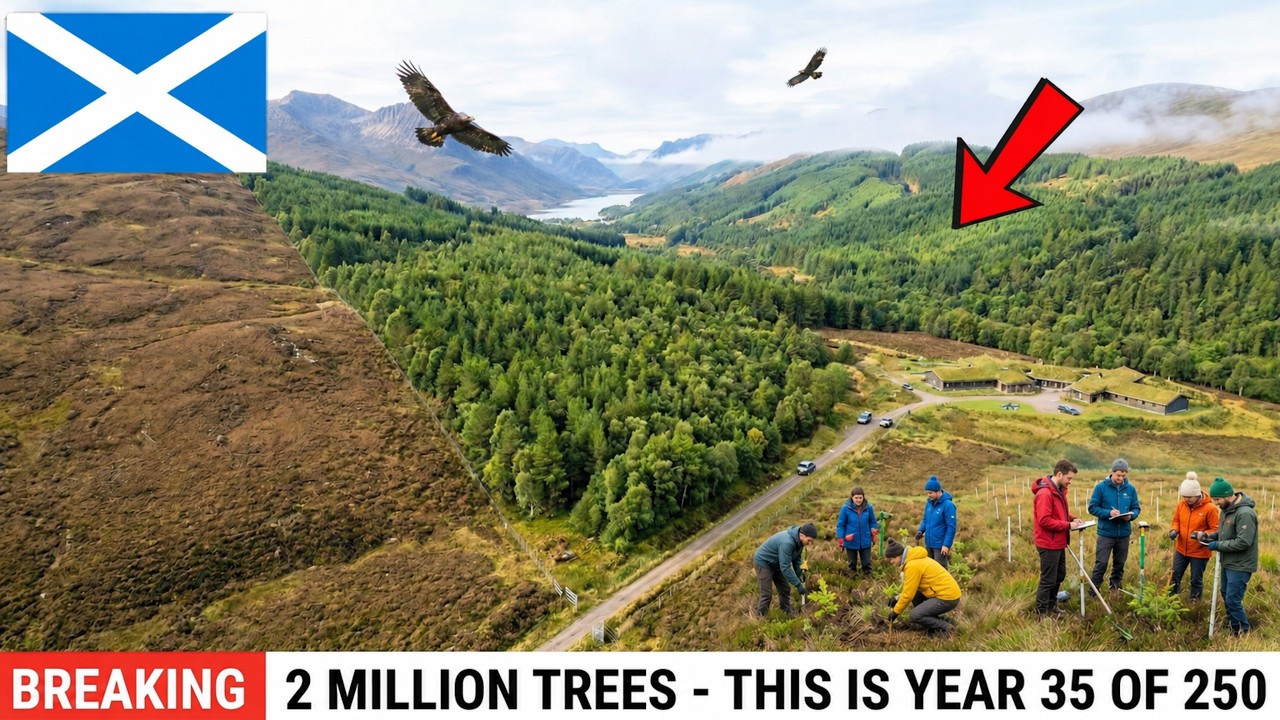
Trees for Life, registered as a charity in 1993, began practical work in 1989 with tree guards protecting Scots pine seedlings from deer browsing in Glen Cannich. The early approach relied on volunteers, negotiations with the Forestry Commission, and hand-planting seedlings in difficult terrain. The 250-year vision was explicit from the start. The goal was not simply to plant trees but to restore a specific ecosystem with its full range of species and ecological functions.
That ambition required land. In 2008, the organization purchased the 10,000-acre Dundreggan estate in Glen Moriston, a former deer stalking estate. The land held a small remnant of ancient woodland, heathland stripped bare by overgrazing, and rows of commercial conifers. The estate employed one person at the time of purchase.
The central obstacle was deer. Red deer in the Highlands were browsing tree seedlings before they could establish. Ecologists estimate that a density of about five deer per square kilometer allows natural regeneration. In many areas, the actual density was closer to 20 deer per square kilometer. Managing deer was complicated because the animals move across multiple private estates, and neighboring landowners whose income depended on deer stalking had little incentive to reduce their populations.
Trees for Life proceeded by reducing deer on its own land through targeted culling, opening dialogue with neighbors, and erecting deer-proof fencing around critical regeneration zones. The organization also tried unconventional methods, including deploying bagpipe-playing volunteers as nocturnal deer scarers.
Monitoring was consistent. Permanent vegetation plots, annual tree survival counts, wildlife transects, and soil chemistry samples tracked whether the ecosystem was rebuilding. As deer pressure dropped behind the fences, seedlings grew beyond ankle height, and the data began to compound.
Dundreggan now supports 1,000 hectares of native forest and more than 4,000 species of plants and animals. When the land was purchased in 2008, it was managed largely as a monoculture for deer. Species including pine martens, red squirrels, black grouse, rare lichens, fungi, and invertebrates have been recorded at the site that were not previously present.
In 2015, a team from Trees for Life and conservationist Roy Dennis descended a cliff face at Dundreggan to build an artificial golden eagle nest at a site where an old eyrie had not been used for 50 to 60 years. A tree had grown in front of the original location. Dennis cut it out and rebuilt the structure. Then the team waited. Eagles were seen regularly over the estate, but they did not nest. Year after year, estate manager Doug Gilbert checked the cliff, and year after year, the nest sat empty.
In the summer of 2020, five years after the eyrie was built, a pair of golden eagles successfully reared a chick at Dundreggan for the first time in 40 years. The last confirmed breeding had been in 1980. The recovering woodland had become home to an increasing number of black grouse, a food source for eagles. Gilbert described the outcome as a rewilding success beyond expectations.
Below ground, something unexpected was also happening. Mycorrhizal fungi live on tree roots in a relationship that has evolved over 400 million years. Many tree species depend on them. In degraded landscapes, these fungal networks had been largely destroyed by centuries of overgrazing. Trees for Life developed an inoculation program, collecting 59 species of fungi from Dundreggan’s old-growth remnants and introducing them to newly planted trees.
The scientific literature suggests that mycorrhizal networks typically take decades to reach meaningful extent in severely degraded soils. At Dundreggan, the combination of retained old-growth remnants, active inoculation, and deer-fenced regeneration zones appears to have accelerated the process. The above-ground evidence suggests the underground networks are reconnecting faster than predicted, although the full extent of the reconnection has not yet been quantified.
The restoration also brought economic changes. Carbon credit buyers approached Trees for Life proactively, paying premiums for ecosystem restoration. A portion of that revenue was directed to local community organizations, including the West Glenmoriston Community Company and the Glenmoriston Improvement Group. In April 2023, the Dundreggan Rewilding Centre opened, the first facility of its kind. The estate, which employed one person as a sporting estate, now has multiple full-time staff and seasonal nursery jobs. The centre includes exhibition space, a cafe, accommodation, forest play areas, and all-ability trails.
Not all estates have joined the initiative. Some continue to operate as deer stalking businesses, and their income depends on maintaining deer populations at levels incompatible with forest regeneration. Trees for Life has chosen to demonstrate results rather than debate the issue.
In 2021, the organization launched the Affric Highlands Initiative, a 30-year program spanning more than 200,000 hectares from Loch Ness to Scotland’s west coast. The United Kingdom and Scottish governments recommended it for United Nations World Restoration Flagship status in 2022. By late 2024, agreements with 19 estates covered more than 58,000 hectares. In 2025, Affric Highlands launched as an independent charity.
At the western edge of the Affric landscape, a cluster of 57 Scots pines remains, the remnant of a forest that once filled an entire glen. The oldest has been dated by the University of St. Andrews tree ring laboratory to at least 1458, making it more than 565 years old and possibly older. It was already ancient when the first European settlers crossed the Atlantic and grew through the Jacobite rebellions, the Highland clearances, and two world wars.
In late 2023, Trees for Life erected 1.5 kilometers of deer-proof fencing around this woodland, with materials helicoptered in. For the first time in decades, young seedlings can grow beneath the ancient trees without being eaten. The old pine now has the chance to produce offspring that might survive it.
The restoration plan formally ends in 2236. None of the people who started the work will see its completion. But the golden eagle returned, the soil is rebuilding itself, and the forest that Scotland spent five centuries destroying is, for the first time, growing faster than it is shrinking.






