Burmese pythons in Florida can swallow an adult deer whole. The snakes have severely reduced raccoon, rabbit, and fox populations in the southern Everglades, and for years no native predator appeared able to stop them. Then researchers implanted radio transmitters in young pythons and followed the signals. Some of the pythons died, but their transmitters kept moving through the black water inside another animal. The predator was one that had nearly disappeared from the United States decades earlier.
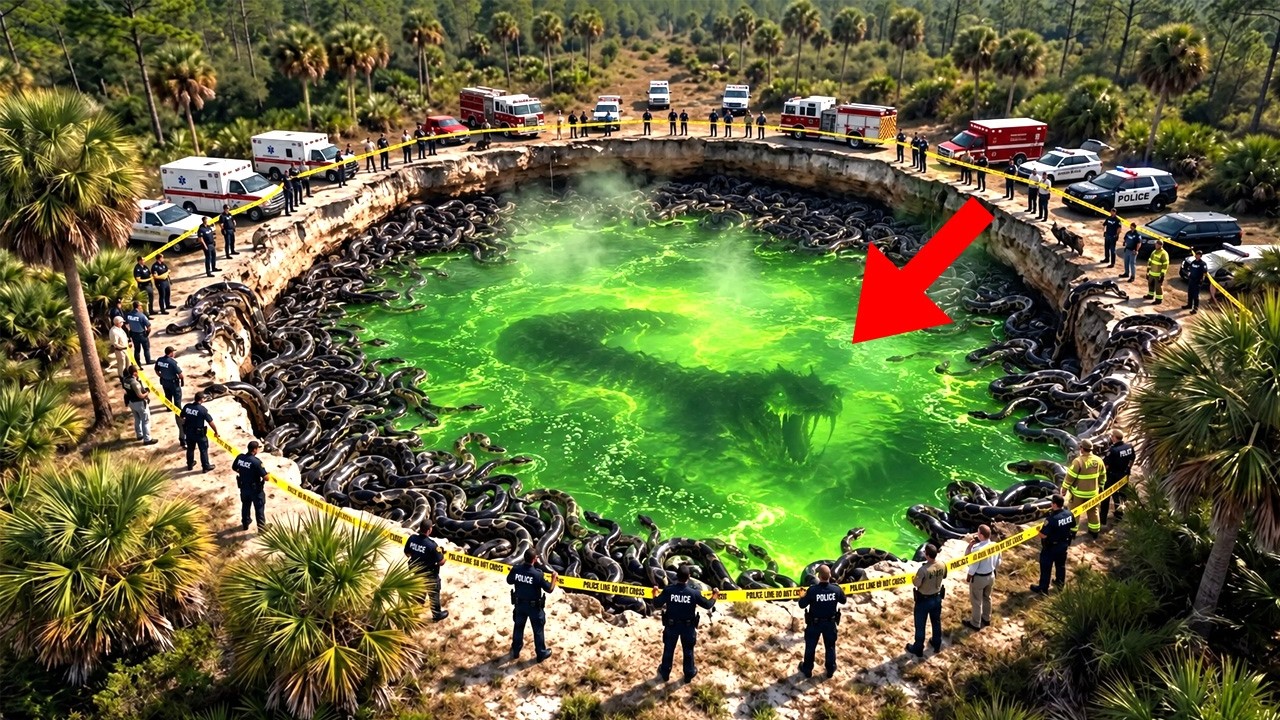
In December 2021, a female Burmese python was removed from Picayune Strand State Forest in southwestern Florida. It measured about 18 feet long and weighed 215 pounds, making it the heaviest python ever documented in the state. Inside the snake, a team from the Conservancy of Southwest Florida counted 122 developing eggs, another state record. In its stomach they found deer hooves. Its last meal had been an adult white-tailed deer.
White-tailed deer are the primary prey of the endangered Florida panther. The python had consumed what would otherwise have been food for one of the rarest large cats in North America. Most Burmese pythons removed from Florida are between 6 and 9 feet long, so this snake was an outlier. But in an invasion, outliers matter most, because a single large female can carry more than 100 eggs.
The story begins with the pet trade. More than 144,000 Burmese pythons were imported into the United States and sold as exotic pets. A snake that starts at about two feet long can grow to 7 to 9 feet within two years. The first Burmese pythons in the Florida wild were likely released or escaped around 1979. For roughly 20 years, park staff spotted one occasionally, an oddity but not yet a concern. In 1992, Hurricane Andrew swept through South Florida, damaging homes, businesses, and animal facilities. More snakes may have escaped in the chaos.
The turning point came in 2000, when scientists confirmed that Burmese pythons in Everglades National Park were not just surviving but breeding. Since then, the snakes have established themselves across more than 3,000 square miles of South Florida. In 2012, researchers published a study in the Proceedings of the National Academy of Sciences that quantified what park staff had been observing for years. Between 2003 and 2011, a research team drove roughly 35,400 miles of Everglades roads at night, counting every mammal they saw, and compared those counts with similar surveys from the 1990s, before the snakes were established.
In the southern part of the park, raccoon sightings had dropped by 99.3 percent, opossum sightings by 98.9 percent, and bobcat sightings by 87.5 percent. No marsh rabbits or foxes were seen at all during nine years of driving. The same study offered evidence for why these species disappeared so quickly. Raccoons and opossums forage at the water’s edge, which is where Burmese pythons lie in wait, partially submerged and motionless for hours. Florida mammals evolved without giant constrictor snakes, so they had no instinct for this kind of threat.
To confirm that pythons were responsible, researchers from the University of Florida and the U.S. Geological Survey designed an experiment. They fitted marsh rabbits with radio collars and released them inside Everglades National Park. They released more collared rabbits at control sites outside the park where pythons were rare. Over 11 months, pythons were responsible for 77 percent of rabbit deaths inside the park. At control sites, pythons killed none. The lead researcher, Robert McCleery, said that when the team tracked the rabbits, they found them inside the snakes. After a year, no rabbits remained in the study areas.
Rabbits are small prey, but Burmese pythons can handle animals much larger. In 2024, researchers from the Conservancy of Southwest Florida and the University of Cincinnati measured the jaws of three large females and recorded a mouth opening of 10.2 inches, the widest ever documented for the species. One of those snakes, about 15 feet long, was filmed swallowing a 77-pound white-tailed deer. The meal filled about 93 percent of the snake’s maximum mouth opening. The Conservancy has now documented Burmese pythons feeding on at least 85 different species in Florida.
The question became whether any native animal could turn the tables and kill the python itself. The answer was alligators. The American alligator nearly disappeared from the United States by the early 1960s, driven to the edge of extinction by a century of hide hunting and habitat loss. In 1967, the species received federal protection. Hunting was restricted, habitat was protected, and the population recovered slowly. By 1987, the U.S. Fish and Wildlife Service declared the American alligator fully recovered. Florida is now home to roughly 1.3 million alligators.
In the Everglades, alligators also serve a function no other animal performs. During the dry winter season, alligators dig ponds known as gator holes, which retain water long after the surrounding wetlands dry out. Fish, turtles, and wading birds gather in these ponds until the rains return. When a python eats a young alligator, it removes an animal that helps keep much of the Everglades alive during the dry months.
In September 2005, biologists working in a remote corner of Everglades National Park found a 13-foot Burmese python that had burst open, with the rear half of a 6-foot alligator protruding from its midsection. The python’s head was missing, and both animals were dead. Investigators found alligator skin fragments inside the python’s body. What happened exactly remains unclear. One theory holds that the alligator tore the python’s stomach from the inside. Another suggests a second alligator appeared and bit off the python’s head while it was stuck mid-meal.
Frank Mazzotti, a wildlife professor at the University of Florida, said at the time that there had been some hope that alligators could control the snakes. A python capable of killing an alligator ended that hope. But that encounter was not the only one. Scientists have documented four confrontations between the two species in recent years. In one, an alligator and a python remained tangled together for 24 to 30 hours before the alligator released its grip and both animals survived.
Park biologist Skip Snow noticed a pattern when reviewing incident records. Alligators tended to win when they were large and faced a large python. Size was the deciding factor, and pythons kept getting bigger. In 2009, a live Burmese python more than 15 feet long and weighing 162 pounds was captured in the Everglades with a 6-foot American alligator inside it. Alligators in South Florida tend to be smaller than those in northern parts of the state. Females here reach about 3 meters, and large males rarely exceed 4 to 4.5 meters. Young alligators grow quickly, sometimes more than 30 centimeters per year in their first four years, but many spend years within the size range a large python can swallow.
For smaller alligators, a giant python is not prey but a predator. For large alligators, the situation is reversed. Visitors have captured this on camera at Shark Valley in Everglades National Park. In December 2023, a photographer passed a 3- to 3.3-meter alligator with the head of a large python in its mouth. In November 2024, a tour guide at the Shark Valley observation tower filmed an alligator nicknamed Godzilla standing on a large dead python. In August 2025, an 8- or 9-foot alligator was seen swimming with a headless python in its jaws.
These videos cannot show how often such encounters occur, or whether alligators kill pythons or merely eat ones that are already dead. To get a clearer picture, a team from the U.S. Geological Survey surgically implanted radio transmitters in young Burmese pythons in Big Cypress National Preserve and released them back into the swamp. Each transmitter had a mortality sensor. If the python stopped moving, the signal changed, and biologists went to investigate.
Between May 2021 and February 2022, 19 young pythons died. For five of them, the radio signal led directly to an American alligator. The team tracked the signals as they moved with the alligators over several visits, sometimes using underwater cameras to confirm. Most of those alligators were about 1.5 to 2 meters long, with one closer to 3 meters. They were ordinary alligators doing what alligators do.
Alligators were not the only killers. Three young pythons were killed by Florida cottonmouth snakes, and three others by medium-sized mammals. One python died trying to overcome a hispid cotton rat that was 106 percent of its own size, the largest predator-to-prey size ratio ever recorded for a python of that size. The researchers titled their 2023 paper “Natives Counterattack” and described these cases as among the first confirmed instances of young pythons being killed by animals other than humans.
In 2021, biologists documented a bobcat killing an adult male python. Later, trail cameras recorded a wading bird attacking a python nest. In 2023, researchers recorded for the first time a Florida kingsnake eating a young python. Kingsnakes feed on other snakes, and researchers suspect they encounter young pythons frequently. A Miami zoo x-rayed a cottonmouth and found a python inside it with a tracking device. A 2026 study reported that vultures fed on a python nest in the Everglades. In another tracking study, 28 young pythons were monitored, and only eight survived to be recaptured. Predators included mammals, alligators, and a native indigo snake.
Wildlife officials still describe adult Burmese pythons as occupying a high position in the food chain with few natural predators in South Florida. Most documented predation of pythons by native animals has involved young snakes, and researchers do not yet know how often this occurs across the Everglades. The young-python phase may be the key to the conflict. The python that dies small never grows into an 18-foot adult, never carries 100 eggs, and never swallows a deer meant for a panther. Once a python grows large, the list of animals that can kill it narrows considerably.
Cold weather is another factor. Burmese pythons come from tropical regions, and South Florida is warm most of the year, but cold fronts occasionally reach the south. In January 2010, a record cold snap hit South Florida. Researchers were monitoring 10 radio-tracked pythons in Everglades National Park at the time. Nine of the ten died. Some tracked pythons tried to bask in the open instead of hiding in a warmer spot, a fatal mistake as temperatures kept falling. Alligators tolerate cold much better. Their natural range extends as far north as North Carolina.
The python invasion has also affected alligator food sources indirectly. The same 2012 mammal surveys that documented the collapse of raccoon, opossum, rabbit, and fox populations describe animals that are part of the alligator’s diet. The South Florida Water Management District has said that python predation deprives native predators, including alligators, of their main food sources. As larger mammals disappear, other animals such as Florida panthers, bobcats, and birds of prey compete for the remaining food.
There is also a curious counter-effect. Raccoons are among the most common predators of reptile nests, and the National Park Service lists them as predators of young alligators. Female alligators guard their nests and respond when their young call for help, but a raccoon needs only one moment of inattention. The researchers who documented the raccoon collapse noted that this may increase nesting success for turtles, birds, and alligators. The python that steals alligator food may also protect alligator nests. Researchers have raised this as a possibility, not a confirmed result.
Humans remain the most effective force against adult pythons. The Conservancy of Southwest Florida implants radio transmitters in male pythons, called scout snakes. During the mating season, from roughly November through April, males move directly toward the largest females in the area. A biologist named Ian Bartoszek, who runs the program, compares it to finding a needle in a haystack with a magnet. One scout snake named Inesis led the team directly to the 215-pound female described at the start of this story. Since 2013, the program has removed more than 40,000 pounds of pythons from the wild and prevented an estimated 20,000 eggs from hatching.
The state has also created its own python contractor program. It began in 2017 with a pilot project of 25 hunters. Contractors with the South Florida Water Management District are now paid $14, $20, or $30 per hour depending on the region, plus $50 for each python up to 4 feet long, $25 for each additional foot, and $200 for each confirmed active nest. A $1,000 bonus goes to the hunter who catches the most pythons in a month. A married couple working as contractors caught 87 pythons in one July, including a nest full of hatchlings and a 14-foot, 92-pound snake. For comparison, Everglades National Park recorded 95 python removals for all of 2005.
State contractors have removed more than 19,000 pythons since 2017. More than 23,500 pythons have been removed from natural areas in Florida between 2000 and April 2025. The work is demanding. One contractor said he might go out 50 times and not see a single snake.
The Florida Python Challenge takes place each summer. In 2026, over ten days, 97 hunters from 30 states, Canada, and Vietnam removed 280 pythons, slightly below the record of 294 from the previous year. The winner, Tom Rahill, caught 96 pythons alone. The longest python in the competition measured 16 feet 5 inches.
By comparison, the U.S. Geological Survey conservatively estimates that tens of thousands of pythons live in the greater Everglades region, and some researchers place the number as high as 300,000. A single female can carry 122 eggs. Hunters alone cannot solve the problem, which is why the young-python studies matter. In the study of 28 hatchlings, predators killed 12 of them. Native animals are beginning to consume each new generation before hunters ever see them.
Humans are best at finding large pythons, those big enough to spot, track, and remove from the swamp. The swamp itself is best at finding small pythons, hidden in grass and shallow water where hunters will not look. The two approaches work from opposite ends of the population pyramid. The radio signals that led to alligators, cottonmouths, and bobcats proved something that had not been documented before: the Everglades are beginning to consume this invader, starting with its young.






