In the sawgrass wetlands of southern Florida, an estimated 300,000 Burmese pythons now live. For scale, that is roughly the population of a city like Orlando. The snakes, which can grow to 16 feet and are capable of swallowing a full-grown deer, have spread across the Everglades largely out of sight. For more than two decades, they were considered nearly unstoppable.
The python’s hunting method is straightforward: it waits, strikes, wraps its body around its prey, and squeezes until the animal dies. This approach has reduced populations of raccoons, opossums, bobcats, and dozens of other native species by more than 90 percent in some surveyed areas.
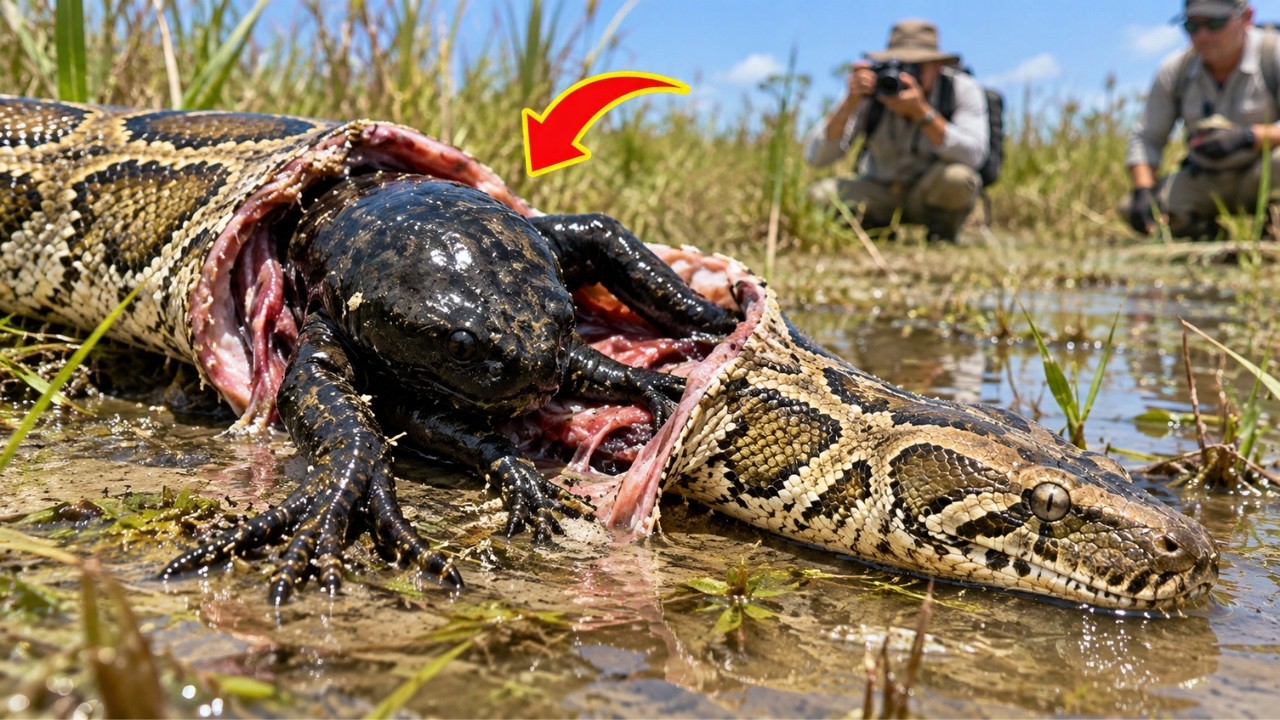
In 2025, researchers monitoring a group of young pythons observed one attacking a small animal in the brush. The encounter followed the usual pattern of a successful hunt. But the data showed something unexpected: the python did not complete the kill. The snake itself ended up dead.
The attacker was not an alligator, a bobcat, or a Florida panther — the predators experts assumed might be large enough to fight back. It was an animal small enough to fit in the palm of a hand. The event contradicted long-standing assumptions about the python’s place at the top of the Everglades food chain.
**How the pythons arrived**
The Burmese python is native to wetlands in Myanmar, Thailand, and Indonesia. One widely accepted explanation for its arrival in Florida points to August 1992, when Hurricane Andrew struck southern Florida as a Category 5 storm. The hurricane killed dozens of people and caused billions of dollars in damage, and it also destroyed reptile-breeding facilities that housed captive pythons. An unknown number of snakes escaped into the surrounding wilderness during the chaos.
The U.S. Geological Survey has also traced evidence of a breeding population back to the early 1980s, suggesting a second, quieter source. During the 1970s and 1980s, tens of thousands of Burmese pythons were imported and sold in the exotic pet trade. Buyers often had little idea how large the snakes would become. When a python outgrew its owner’s patience or enclosure, many were released into canals or drainage ditches instead of being surrendered to shelters.
What turned a handful of escaped or released pets into a full-scale ecological problem was Florida itself. The python’s native habitat shares nearly identical climate characteristics with the Everglades: year-round heat, long rainy seasons, shallow standing water, and dense vegetation. The pythons were not invading hostile or unfamiliar terrain. They were entering an environment very similar to the one they had evolved in for millions of years.
For years, biologists assumed occasional python sightings in the wetlands were just transient escaped pets, not evidence of a self-sustaining wild population. By the time it became clear that pythons were breeding on their own, the invasion had already passed the point of realistic early containment.
The snakes are also extremely difficult to spot. Researchers estimate that a person’s chance of finding a python in open ground is about 1 in 20, and the odds drop sharply once the snake is wrapped in dense grass or tangled mangrove roots.
**Impact on native wildlife**
Once established, pythons proved remarkably unselective in their diet. Researchers examining python stomach contents have found remains of more than 70 different native species, ranging from small rodents and wading birds to raccoons, white-tailed deer, and in at least one case, an adult American alligator.
The damage went beyond direct predation. As raccoon and opossum populations collapsed, these animals could no longer raid turtle and ground-nesting bird nests at their former rates. Species several steps removed from the python in the food web began to shift in unexpected ways.
Today, pythons occupy more than a thousand square miles of southern Florida, covering the entire Everglades National Park and stretching from coast to coast. No one has an exact population count, because the terrain is nearly impossible to survey completely and the snakes are designed to avoid detection. Official estimates put the total at around a quarter-million animals.
**Ongoing control efforts**
Florida’s response has been continuous, expensive, and only partially effective. The annual Python Challenge attracts hundreds of volunteer hunters who compete to remove as many snakes as possible within a set period. In 2024, 857 participants spent ten full days searching and returned with 195 pythons. In 2025, nearly a thousand hunters caught 294 snakes. Against a population in the hundreds of thousands, that removal rate is almost negligible — roughly equivalent to treating a serious infection with a dose too small to slow it down. Surviving snakes continue to breed, and their numbers recover faster than any organized hunting campaign can reduce them.
Nature itself delivered one significant setback to the snake population. In January 2010, southern Florida experienced an unusually long cold spell. Among a sample of radio-tracked pythons being monitored by researchers, roughly nine out of ten died from the cold. Necropsies of other snakes found later showed a similar mortality rate. The survivors simply hid in turtle burrows, drainage channels, and other insulated spaces that stayed above the lethal temperature threshold.
Modern tracking methods have become more sophisticated without solving the core problem. Researchers implant radio transmitters in captured male pythons and release them during mating season. The males lead biologists directly to reproductive females and to breeding aggregations where multiple snakes gather. The technique removes real snakes, but it is slow, labor-intensive, and impossible to scale across the entire invaded region.
Environmental DNA sampling — testing water for microscopic traces of skin, mucus, or waste — can confirm a python’s presence in a given area with over 90 percent accuracy. But confirming presence is not the same as catching a snake. The python may have passed through hours earlier, or it may be sitting twenty feet away under the mud.
Researchers have also tried synthetic bait made from a blend of rabbit urine, droppings, and combed fur, hoping to attract pythons to camera traps without the costs of live animals. The effort did not work. Camera traps recorded nearly identical low levels of snake activity at both scented and unscented sites. The likely explanation lies in basic python physiology. They are ambush predators with very slow metabolisms, capable of going months between meals. They have no evolutionary incentive to expend energy pursuing a scent trail alone. Successful hunting depends on a full sensory package — movement, the infrared heat of a living body, and a recognizable silhouette. A scent trail is only an incomplete part of that picture.
**An unusual finding inside pythons**
In 2025, researchers dissecting captured pythons to examine them for diseases and parasites began finding hard foreign objects lodged outside the digestive tract. In some cases, these were full bird beaks embedded in the snake’s body cavity.
The mechanism was strange. A python swallows a bird whole. As its stomach contracts with great force to break down the meal, soft tissue dissolves quickly, but a sharp, hard beak does not. Under sufficient pressure, the beak can pierce the stomach wall and move deeper into the snake’s body. For most animals, a perforated stomach would be fatal. In these pythons, the immune system simply isolated the foreign object inside a dense protective capsule, preventing infection. The snakes carrying embedded beaks showed no external signs of illness. They were healthy, active, and hunting normally, apparently unaffected by having been pierced from the inside by their own meal.
**The animal that fought back**
While tracking small mammal populations across areas with high and low python density, researchers noticed one species behaving almost exactly as it had before the pythons arrived. All other medium-sized mammals in the same habitat had collapsed. This species was unchanged. Survival rates for tagged individuals were essentially identical whether the surrounding marshes were full of pythons or nearly empty of them. When biologists examined recorded deaths among this species, they found pythons were responsible for only a small fraction. Most were still taken by the predators that had always hunted them — hawks, owls, and native snakes.
This observation led to a more precise question: had this animal simply failed to recognize the python as a threat, or did its behavior mean it had recognized the danger?
Researchers ran a direct comparison. They presented raccoons and this small mammal with a series of taxidermy models: a wolf representing a familiar threat, a native rattlesnake, a Burmese python, and a neutral object unrelated to any predator. They then measured anxiety levels during food-seeking and avoidance behavior — how long the animal hesitated nearby and how far it detoured to avoid the model entirely.
Raccoons reacted strongly to the wolf, reducing their foraging time and keeping their distance, but largely ignored both snakes, treating the python as background scenery and foraging right next to it without hesitation. The smaller animal reacted to all three predators — the coyote, the rattlesnake, and the python — as genuine, immediate threats. It froze, changed direction, and reduced foraging time around all of them in statistically identical ways.
That kind of recognition does not appear from nowhere in the roughly thirty or forty years the Burmese python has been in Florida. It must come from a much older origin. For this species, the answer goes back millions of years of evolutionary history spent living alongside North American snakes as one of their regular prey animals. When a huge, unfamiliar reptile appeared from the other side of the planet, this animal’s nervous system did not need to know its origin. The long body, the distinctive smell, and the smooth movement on the ground all fit the category of threat. The species was programmed to recognize these dangers long before Florida had a name.
The animal in question is the hispid cotton rat, an ordinary native rodent. It is not a specialized predator or an invasive species, and nothing about it would normally make headlines. This is the animal that a young python attacked and did not survive.
**How the cotton rat killed the python**
When the python struck and began to wrap, the cotton rat did not freeze. Cotton rats have unusually powerful jaws and sharp incisors capable of tearing tough tissue. In the recorded encounter, the rat delivered a series of severe bites directly to the snake’s head and neck during the struggle. The python died at the scene from those wounds.
Cotton rats are built for exactly this kind of fight. They are stocky, with coarse fur, adapted for speed through dense grassy cover, and they move through complex networks of hidden runways maintained among thick vegetation. They have acute hearing and a strong sense of smell tuned to detect an approaching reptile through rustling grass or chemical signals. But their real advantage is reproductive speed.
The gestation period for a cotton rat is about 27 days. A single litter can produce up to 15 young. Females reach sexual maturity within 30 to 40 days of birth and can become pregnant again within a day of giving birth. Practically speaking, the species operates almost like a continuous production line, where individual losses barely affect the rate of new production.
Cotton rats are a foundational part of southern Florida’s food web, converting plant material into food for hawks, owls, bobcats, panthers, wolves, and several native snake species, all of which have exerted enormous predation pressure on this species for far longer than Florida’s current climate has existed.
In short, the Burmese python finally encountered prey that could fight back directly and replace its losses faster than the snake could inflict them. A python that eats 100 cotton rats in a season makes barely a dent by the time the next breeding cycle closes that gap. Unlike the raccoons and opossums that nearly disappeared from python-dominated areas, cotton rat density in heavily invaded zones has not shown a similar collapse.
**A new set of problems**
This does not make the cotton rat a perfect solution, and researchers are cautious about saying so. There is no shortage of this rodent that needs addressing. Under good rainfall conditions, cotton rat numbers increase on their own, and the consequences of that increase are serious. The species is officially classified as one of the most destructive agricultural pests in the Everglades farming district. They gnaw through sugarcane stalks at the base until whole sections of fields collapse, strip bark from young citrus trees until the trees die, chew through drip irrigation lines, and burrow into canal banks until surrounding soil erodes and weakens the embankments.
In large numbers, cotton rats invade ground nests, eating the eggs and chicks of northern bobwhite quail, wild turkeys, and rails, and directly compete with other native wildlife for available seeds.
There are also public health concerns. Cotton rats carry hantavirus, which can cause severe lung disease in people exposed to airborne particles from their droppings or dried urine. They can contaminate standing water with bacteria linked to leptospirosis. They also serve as a primary natural host for a virus that can cause encephalitis in both humans and horses. Researchers have traced a worrying connection back to the snake invasion itself. As raccoon, opossum, and rabbit populations fell sharply across large areas of the Everglades, local mosquitoes lost a significant portion of their usual blood sources and shifted toward feeding on cotton rats instead. This shift has measurably increased the proportion of local mosquitoes carrying that virus, along with the risk of transmission to humans and livestock across the region.
**An unstable adaptation**
Four decades after the first pythons established themselves in the Everglades, the wetlands have moved from full ecological shock toward something closer to an unstable adaptation that remains incomplete. Younger snakes increasingly appear as prey rather than pure predators, eaten by alligators, larger native snakes, and bobcats. Cotton rats hold their ground through immense reproductive capacity and, in rare documented cases, through direct combat. None of this amounts to a solution. Scientists still lack an effective way to clear the wetlands of snakes, and deliberately encouraging cotton rats to fight that battle would replace one serious problem with several others — agricultural losses, ecological disruption, and viral disease risks.
What is actually happening in the Everglades now is not a decisive victory for either side. It is a slow, ongoing renegotiation between an invasive predator that arrived without natural population checks and a native species that happened, through evolutionary historical coincidence, to know exactly what it was facing. Whether that awareness will grow into something that measurably slows the snake population, or remain a small and curious exception within a larger ecological collapse, is a question researchers cannot yet answer with confidence.
The significance of the cotton rat discovery is not the death of a single snake. One dead python among a quarter-million changes nothing by itself. What it changes is the assumption that underpinned twenty years of python research without anyone fully questioning it: the idea that this snake had no natural enemies in its new environment, and that evolution simply had not had time to produce anything capable of challenging it.
Cotton rats did not need thirty or forty years to catch up. They arrived already equipped with millions of years of accumulated wariness toward anything that looks like a snake. That wariness apparently crossed continents in a way none of the invasion timelines predicted. This raises a difficult question for every other species still losing habitat in the Everglades: how much of the damage truly comes from the snake’s size and appetite, and how much depends on which animals already had the right instincts when it arrived?






