In 1902, archaeologists Flinders Petrie and Margaret Murray arrived at Abydos, Egypt, expecting to examine a routine part of the mortuary complex of Seti I, a pharaoh of the Nineteenth Dynasty known for his ambitious building projects. Instead, after removing several meters of sand, they uncovered a large sunken structure made of granite columns rising from a water-filled pit about 30 feet below the desert floor.
The layout matched nothing known from the New Kingdom period. The structure used massive granite blocks weighing between 100 and 200 tons, a scale not associated with construction from that era. Petrie’s surviving notes describe the site as anomalous and suggest the structure appeared older than the temple built above it, possibly predating Egyptian civilization itself. Some of these observations were omitted from official publications.
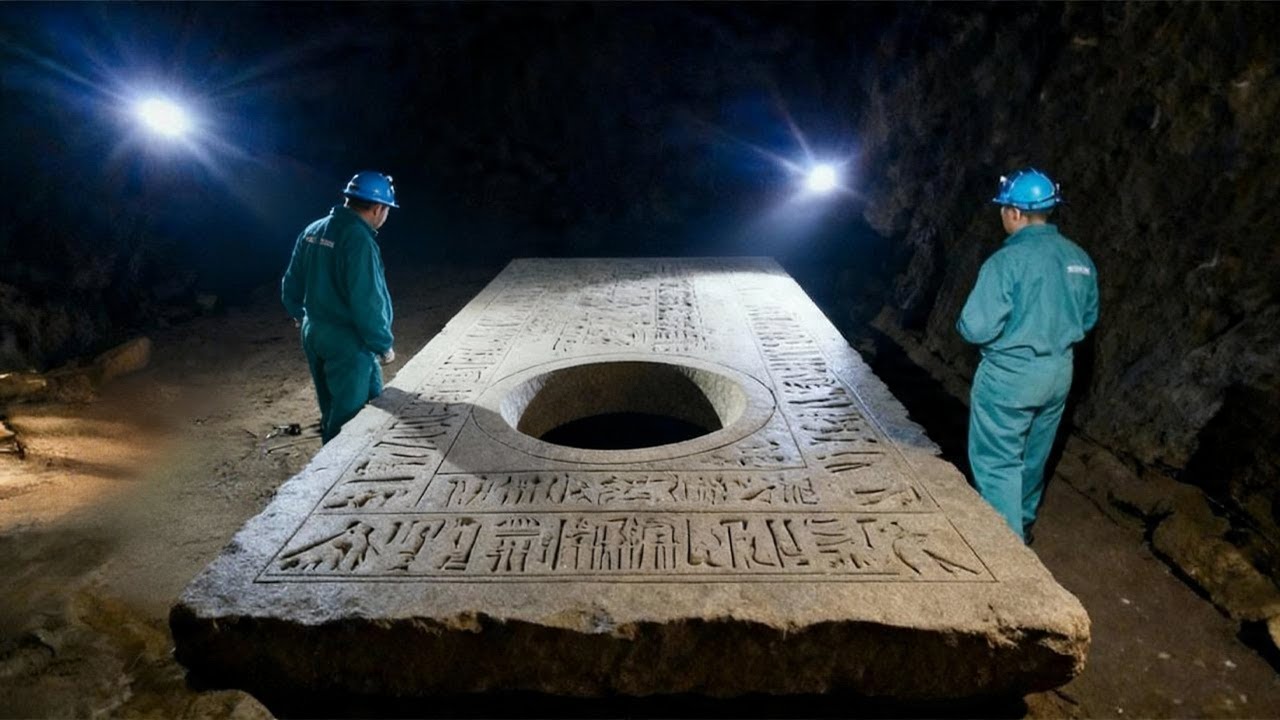
The engineering posed unresolved questions. Moving and cutting granite of that size would have required techniques not documented in Egypt until roughly 1,500 years later. Researchers also noted circular scraping marks on the stone, similar to marks later identified at the Serapeum at Saqqara and the subterranean chamber of the Great Pyramid. These marks suggest continuous rotary cutting, a method not associated with copper chisels or stone hammers available at the time.
The chamber was found already filled with groundwater, despite the surrounding desert being dry. Water had entered through channels cut into the bedrock, indicating the flooding was deliberate. The structure appeared designed to interact with moving water as part of its function, possibly for pressure, cooling, or another process.
One notable feature is the absence of any inscriptions. No cartouches, dedication texts, or prayers appear on the columns, walls, or surfaces. This is unusual for a structure associated with a pharaoh’s temple complex. Some priestly texts from the Ramesside period refer to Seti finding a “house of the first time,” a term used for locations believed to predate human kingship in Egypt. If Seti recognized the structure as predating human rule, he may have chosen to leave it unmarked rather than claim ownership of something considered sacred and older than humanity.
Later excavation reports noted that the structure appeared to have been carved from the inside out, as though workers had removed material to reveal a pre-existing structure rather than building a new one.
Modern surveys conducted between 2018 and 2023 produced additional findings. Ground-penetrating radar revealed geometric voids beneath the granite columns, arranged in patterns reflecting the symmetry of the columns above. A gravity survey indicated a network of narrow channels extending deep below the floor, designed to direct moving water through controlled paths. Some engineers compared the arrangement to hydraulic resonance chambers used to control vibrations in modern mechanical systems.
In 2019, researchers from Cairo University conducted acoustic tests inside the structure. They placed speakers on the central platform and gradually raised the frequency. When the sound entered the range of 110 to 118 hertz, the water in the pool formed wave patterns that did not match the speaker rhythm, and the granite columns showed measurable movement. Granite from Aswan contains significant quartz, which responds to vibration and pressure. Several team members reported physical discomfort during the test, including dizziness and a sensation of pressure. Medical staff attributed these reactions to infrasound resonance, which can affect balance and perception.
Examination of the lower submerged levels revealed additional evidence. Divers found layers of dark burn marks on granite surfaces that appeared to result from heat far beyond what ancient furnaces could produce. A thin metallic dust coated submerged stone. Laboratory analysis found it contained iron, nickel, and cobalt, along with chromium and vanadium. These elements are not naturally combined in this way. The material appeared to have been fused by sudden, intense heat, similar to what would result from an electrical discharge or extreme internal pressure. The sample was later reported lost, and no additional details were provided.
Organic material found in one deep recess had decomposed in patterns not associated with natural decay or burial. The sample was also removed from storage and has not been seen since.
Some early excavation photographs show artifacts that are not present in museum collections today. These include a worked metal plate with scratch marks unlike Egyptian tool patterns, small engineering stones fused together as if exposed to extreme heat, and a hollow cylinder of unidentified purpose. Former staff members have said some discoveries were withdrawn from circulation after pressure from senior officials who considered them potentially controversial.
Ancient Egyptian texts describe a process in which the body is disassembled, purified, and reassembled in a chamber of water. Scholars have generally interpreted these as references to spiritual rebirth. The physical evidence at the Osireion has led a small number of researchers to reconsider whether some of these texts were describing a literal device that manipulated sound, water, and the human body.
Some texts contain warnings about structures from the “first time,” describing them as places where the body could be changed. One warning states that no one should sleep in the deep hall of Osiris, lest they return as someone else. These lines were once read as pure symbolism.
The acoustic testing confirmed that the upper chamber amplifies a narrow range of frequencies that penetrate human tissue. The lower chamber, with its sealed environment, conductive stone, and unusual metal alloys, may have been where a transformation process would complete. The arrangement of the structure directs vibration, water flow, and acoustic pressure downward into the lower room.
Surveys have detected a geometrically precise chamber directly beneath the Osireion, cut into the bedrock. Inside it, a dense metallic structure appears suspended above the floor. During resonance tests, sensors recorded increases in vibration and magnetic fluctuations near the lower levels when the frequency reached 110 to 118 hertz. The mechanism appeared to respond to the signal, suggesting it remains intact rather than nonfunctional.
The shaft leading down to this chamber was filled and sealed in antiquity, with warnings carved by priests. Their texts describe the device as a place where the body is reformed and warn that the chamber must remain closed.
There is no confirmed explanation for why the original builders created such a device. The evidence indicates that something happened inside the structure that produced extreme heat, fused metals, and left biological material in an unusual state. The outcome was apparently not controlled. Any attempt at transformation appears to have ended in failure, and the site was buried and abandoned.
The central mechanism remains in place beneath the Osireion, responding to specific frequencies. It has not been activated, but it is not inert.






