In January 2025, a team of scientists working in Antarctica recovered an ice core from 2,800 meters below the surface. The core contains a continuous climate record spanning 1.2 million years, including air bubbles that preserve the composition of the atmosphere at the time the ice formed. The samples predate the appearance of modern humans and extend significantly further back than any previous ice core.
The achievement is part of the Beyond EPICA project, a collaboration of 14 institutions from 10 European countries led by Italy’s National Research Council and Germany’s Alfred Wegener Institute. The new core reaches 400,000 years deeper than the previous record, which was established in the early 2000s by the original EPICA project at Dome C and covered 800,000 years of climate history.
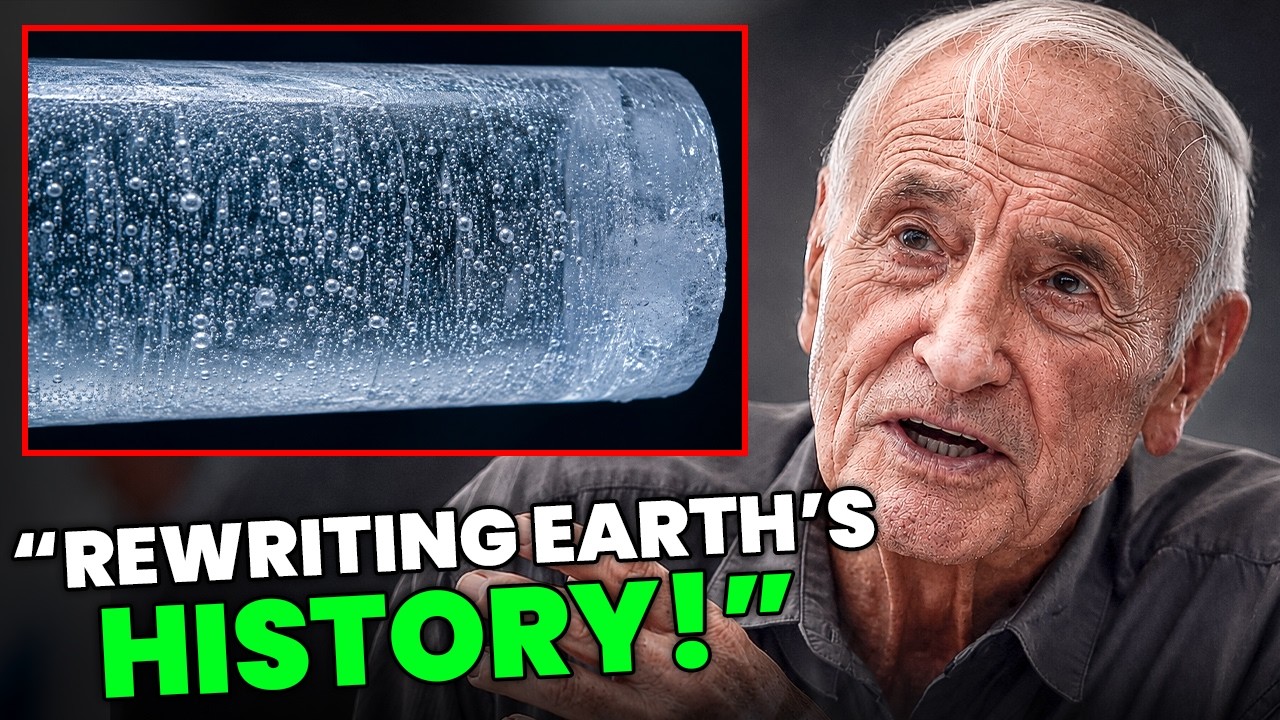
How ice preserves ancient air
In the interior of Antarctica, snowfall does not melt. Each year’s snow accumulates on top of previous layers, and over time the weight compresses the lower levels into glacial ice. During this compression, air between snowflakes becomes sealed in bubbles that do not exchange with the atmosphere above. These bubbles act as capsules of the air that existed when the snow originally fell.
Ice cores therefore contain direct samples of ancient atmospheres, including carbon dioxide and methane concentrations, dust from volcanic eruptions, salt from ocean spray, and isotopes produced by cosmic rays. This makes ice cores distinct from other climate archives such as ocean sediments, tree rings, or cave formations, which record indirect chemical signals rather than the atmosphere itself.
The challenge is that ice does not persist indefinitely. As an ice sheet thickens, its base approaches geothermal heat from the bedrock and eventually begins to melt. Older ice flows outward and disappears. In most of Antarctica, preserved ice is limited to somewhere between 400,000 and 1 million years old.
An unsolved climate puzzle
The original EPICA core stopped just short of a major scientific question. Around 900,000 years ago, the rhythm of Earth’s glacial cycles changed. For roughly two million years before that point, ice ages and warm periods followed a cycle of about 41,000 years. Afterward, the cycles lengthened to about 100,000 years. Climate scientists call this shift the Mid-Pleistocene Transition, and its cause remains unresolved.
The basic mechanism behind glacial cycles was identified in the early 20th century by Serbian geophysicist Milutin Milankovitch. He showed that Earth’s orbit around the sun changes in predictable patterns. The shape of the orbit varies between more circular and more elliptical on a cycle of about 100,000 years. The tilt of Earth’s axis wobbles between 22 and 24.5 degrees on a cycle of about 41,000 years. The orientation of the axis itself shifts on a 23,000-year cycle.
These orbital variations affect how much sunlight reaches different parts of the planet at different times of year. When northern high latitudes receive less summer sunlight, ice can survive the summer and glaciers expand. When the geometry shifts back, ice melts and the planet warms.
Before the Mid-Pleistocene Transition, glacial cycles matched the 41,000-year tilt signal, which has a clear physical connection to high-latitude summer sunlight. After the transition, cycles shifted to the 100,000-year eccentricity signal, which produces only a very small change in total solar energy received, roughly one-thousandth of the forcing from tilt or precession. By physical calculation, it should not be strong enough to drive ice ages, yet it has been doing so for nearly a million years.
Four main hypotheses have been proposed. One suggests that gradual erosion of continental bedrock in northern North America exposed harder rock, allowing ice sheets to grow larger and more stable. A second points to a long-term decline in atmospheric carbon dioxide, which would have made the planet progressively colder. A third involves changes in deep ocean circulation. A fourth concerns feedbacks between ice sheet size and the pace of glacial collapse.
Each hypothesis predicts different patterns in carbon dioxide, temperature, and dust across the transition. Until now, no ice core had reached far enough back to test them directly. The relevant atmospheric record was only visible through indirect ocean sediment proxies.
Finding older ice
To reach past 800,000 years, the Beyond EPICA team needed a location where the ice was older than any previously drilled site. Radar surveys identified Little Dome C, about 35 kilometers from the French-Italian Concordia Research Station on the East Antarctic Plateau. The site sits at 3,233 meters above sea level, with an average annual temperature of roughly minus 55 degrees Celsius and ice thickness between 2,700 and 3,100 meters. Pre-drilling surveys suggested the deepest ice could be more than 1.5 million years old.
Drilling began during the 2021–2022 austral summer, the brief November-to-February window when surface operations are possible. The team worked 16-hour days. The drill uses a non-toxic fluid designed to preserve the chemical integrity of the ice it passes through, avoiding the contamination problems that affected some earlier drilling operations.
By the end of the 2022–2023 season, the team reached 800 meters. By the end of the 2023–2024 season, they reached 1,836 meters. In January 2025, they announced they had reached 2,800 meters, recovering a continuous climate record spanning 1.2 million years.
Reading the deep ice
Analyzing the deepest layers requires techniques developed after the original EPICA core was drilled. Continuous flow analysis melts ice gradually and feeds the resulting water through chemical sensors. Laser ablation inductively coupled plasma mass spectrometry uses a focused laser to vaporize microscopic spots on the ice and identifies elemental composition at very high sensitivity. These methods allow researchers to read the core at resolutions of less than a year per measurement, even where 10,000 years of climate has been compressed into a single meter of ice.
Researchers are looking for sulfate ions from ancient volcanic eruptions, trace gases in the air bubbles, and beryllium-10 isotopes produced by cosmic rays, which record the state of Earth’s magnetic field at the time of deposition.
One particular signal is important for dating. About 780,000 years ago, Earth’s magnetic poles reversed in an event called the Brunhes–Matuyama transition, one of the most precisely dated events in geological history. Finding this signature in the ice core will provide an anchor for dating the layers to within a few centuries.
Preliminary analysis is underway. Results presented at the 2026 European Geosciences Union General Assembly have begun comparing carbon dioxide levels before and after the transition. Temperature signatures from oxygen and hydrogen isotopes are being mapped across the rhythm change. Dust layers are being measured to track continental aridity and atmospheric circulation. A complete picture will take several more years. The drill has not yet reached bedrock, which is not scheduled until the 2028–2029 campaign.
Relevance to the present day
The new record has direct relevance to current climate conditions. Modern atmospheric carbon dioxide has already exceeded any level recorded in the entire 800,000-year EPICA archive. The pre-industrial baseline was about 280 parts per million. Current levels exceed 420 parts per million and are rising.
To find a previous period with comparable carbon dioxide levels, scientists must look further back than the original core could see. The Beyond EPICA core provides the first direct view of an atmosphere from a period when carbon dioxide may have approached or exceeded modern concentrations, during a time when modern humans did not exist. If those deep ice layers contain evidence of temperatures, ice extent, sea levels, and circulation patterns under high carbon dioxide conditions, that data may provide one of the most useful natural records ever recovered for understanding Earth’s climate sensitivity.
The cores are now stored in cold room facilities in Italy, Germany, Switzerland, and France. Drilling at Little Dome C continues, with bedrock still ahead. The analysis has begun, and the transition between the two climate regimes, the 41,000-year world and the 100,000-year world, is now physically measurable for the first time.






