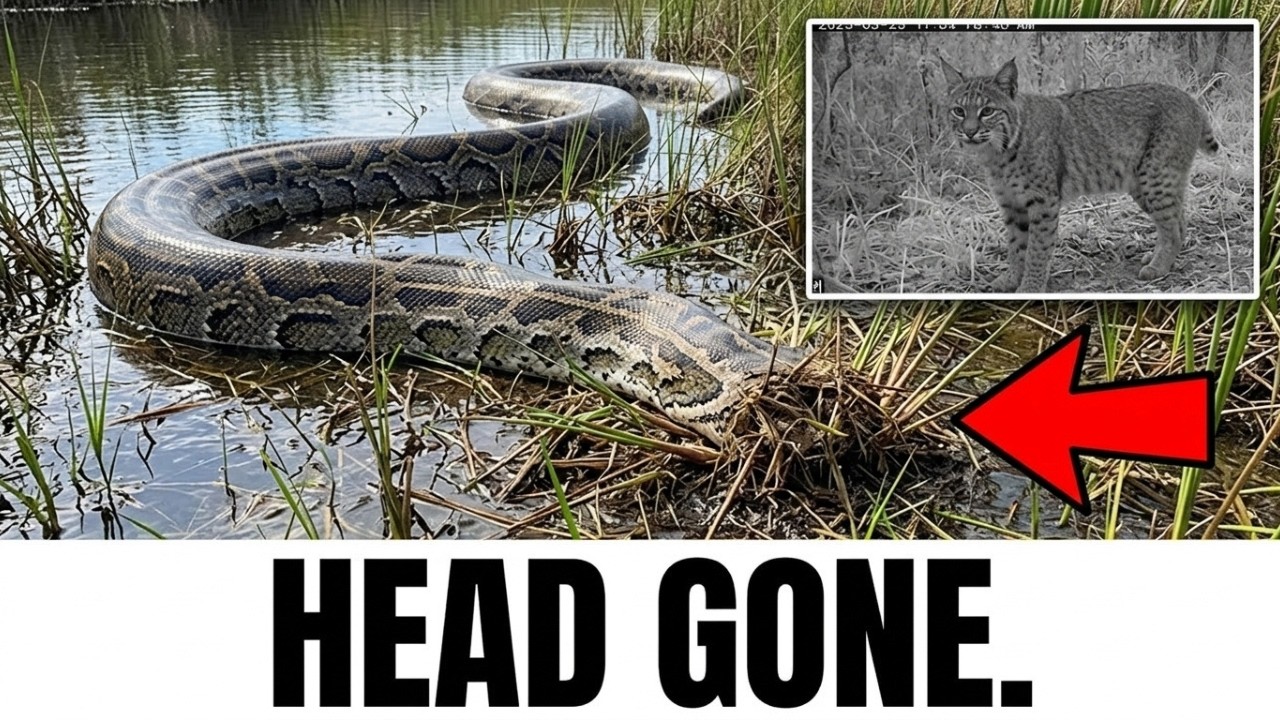
Biologists from the Conservancy of Southwest Florida found a 20-foot Burmese python dead in pine flatwoods at the edge of the Everglades. The snake’s head had been removed, and the carcass had been covered with pine needles and debris. The concealment indicated that an animal had killed the python and stored the body for later feeding. Trail cameras placed near the carcass identified the predator as an adult bobcat, an animal weighing roughly 25 to 35 pounds that had killed a snake believed to weigh over 100 pounds.
Burmese pythons are native to Southeast Asia and became popular in the American pet trade during the 1980s and 1990s. Adult snakes can exceed 20 feet in length, weigh more than 200 pounds, and live for 25 years or more. When owners could no longer manage them, some released the snakes into the wild. In South Florida, the climate and habitat allowed released pythons to survive and breed. The first confirmed wild python in the Everglades was documented in 1979, with breeding populations established by the 1990s.
The impact on native wildlife has been severe. Python predation contributed to steep declines in marsh rabbit, raccoon, and opossum populations, along with reductions in foxes, bobcats, and deer in affected areas. Researchers described the change as defaunation, with large portions of the Everglades losing much of their mammal population.
Florida has used professional hunters, volunteer programs, and radio tracking to remove pythons. Thousands are killed each year, but the population continues to grow, in part because a single female can lay 50 to 100 eggs annually over a reproductive life of two decades or more. Researchers generally agree that eliminating pythons from the Everglades is not realistic and that management focuses on suppressing numbers enough to allow native species to persist.
The bobcat discovery was notable because it showed a native predator actively hunting and killing an adult python. Bobcats are native to Florida and typically target smaller prey such as rabbits and rodents. A successful attack on a python far larger than the cat itself was considered unlikely, since a python of that size could constrict and kill a bobcat. According to researchers, the bobcat likely avoided the snake’s coils and attacked the head, which is a vulnerable point, before the python could defend itself.
The behavior documented in this case is consistent with what researchers call caching, in which a predator hides a kill to return to later. The missing head of the python is consistent with predators feeding first on the nutrient-rich tissue of the skull. The trail camera footage showed the bobcat returning to the carcass to feed over subsequent days.
The finding led researchers to review whether other native predators also kill pythons. Alligators have been documented killing pythons, though encounters between the two species have sometimes ended with the python consuming the alligator. Florida black bears, Florida panthers, and coyotes have also been considered as possible predators of pythons, and evidence has accumulated that these species occasionally kill them. Such predation is not common enough to control python populations, but it does occur.
The interaction between bobcats and pythons is not one-directional. Pythons have contributed to declines in bobcat populations in invaded areas, and the two species are capable of killing each other depending on size, condition, and circumstances. Researchers describe the relationship as complex, with outcomes varying by situation.
The discovery has implications for python management. Human removal efforts remain the primary tool for suppressing python numbers, but if native predators contribute to python mortality, even at modest levels, they could support those efforts. The combined effect of human removal and natural predation may help reduce python density in targeted areas.
The bobcat observed in this case did not require any intervention. It found the python, killed it, fed on it, and cached the remainder. Researchers are now expanding monitoring to determine how often such predation occurs. Other python carcasses have shown signs consistent with predation, though the frequency is not yet known. The event does not indicate that the Everglades ecosystem is recovering, but it does demonstrate that native predators are capable of responding to the presence of invasive pythons. The discovery adds a new element to the ongoing effort to manage the python population in South Florida.






