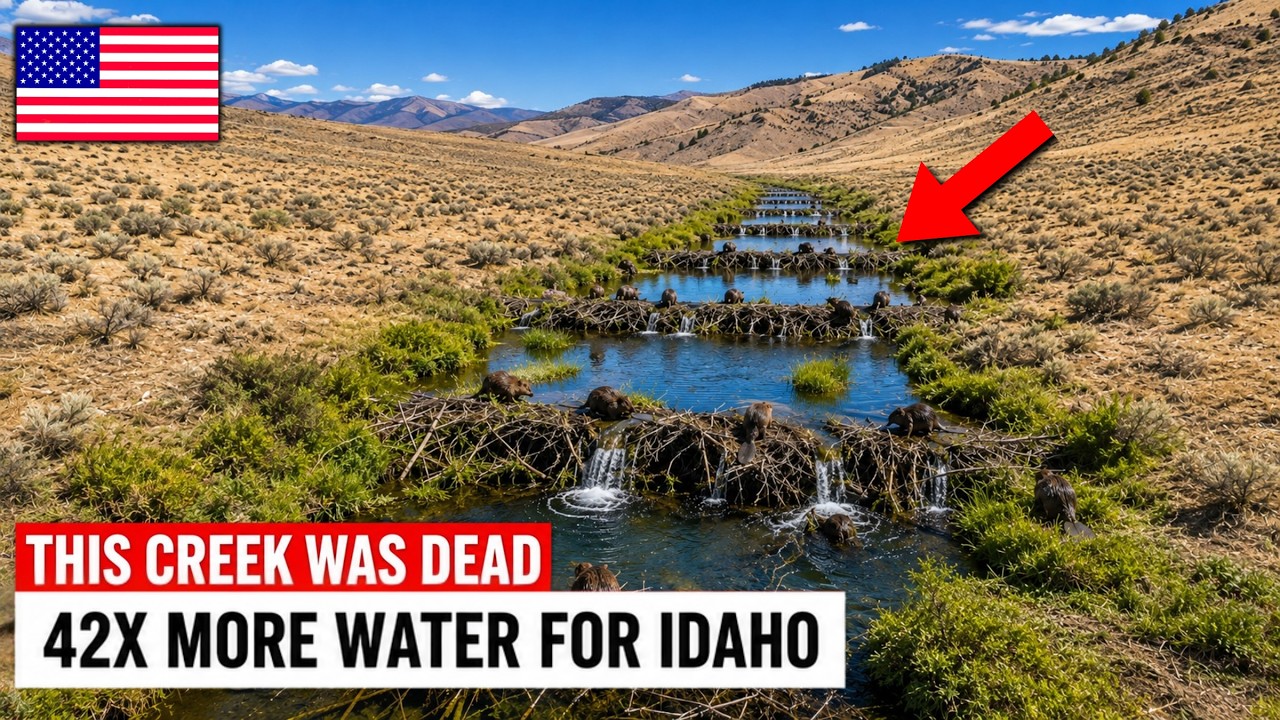
In the fall of 2015, fourth-generation cattle rancher Jay Wilde stood in a dry streambed in southeastern Idaho with a team of researchers. Together they drove wooden posts into the mud, wove willow branches between them, and released nine wild beavers into the area. There was no concrete, no heavy machinery, and no storage tanks. The only materials were sticks, mud, and a group of rodents weighing roughly 40 pounds each.
The stretch of Birch Creek they worked on had run dry every summer for two decades. Wilde had grown up hating beavers, as many ranchers did. To him, they were pests that blocked irrigation ditches and flooded fields. Years earlier, he had tried releasing some himself, and every one of them died. So when scientists proposed building small starter dams and letting the animals take over, the plan seemed like a joke.
As a boy in the 1950s, Wilde remembered Birch Creek as a cold, flowing stream that ran well into late summer. He swam in its beaver ponds. But when he returned in 1995 to manage the family ranch, the ponds were gone, the beavers were gone, and by June the creek had slowed to a trickle.
The nine beavers were not expected to change anything. Wilde had every reason to believe they would die like the others. But this time, they survived. Today Birch Creek flows year-round again. Native Bonneville cutthroat trout have returned in numbers roughly 50 times greater than before. This is one stream, not a solution for the entire American West, but the way it recovered is worth understanding.
To understand why Birch Creek dried up, it helps to know what was removed from the landscape long before Wilde was born. When European settlers first arrived in North America, between 60 million and 400 million beavers lived across the continent. Their dams, ponds, and wet meadows shaped countless valleys into a complex patchwork of saturated land. Then came the fur trade. By 1900, the beaver population had dropped from tens of millions to roughly 100,000.
What went largely unnoticed at the time was that water disappeared along with the animals. A beaver dam slows a stream and forces water sideways into the surrounding ground. Without dams, water stopped spreading and started cutting downward. Spring snowmelt rushed through channels with nothing to slow it down. The streambeds cut deeper into the earth, and the water table dropped like a slowly pulled drain. Snow still fell every winter and melted every spring, but it vanished within weeks. By June, nothing underground was left to feed the streams, and they went dry.
This is the paradox of many western streams today. The dry, incised channels that look natural are not natural at all. They are landscapes still missing the one ingredient that held them together for thousands of years.
When Wilde returned in 1995 to run cattle on about 200 head, he was standing in the middle of that wound. Cattle need food and water, but the water was disappearing. The beavers that might have helped had been nearly trapped to extinction a century before his birth.
For years, Wilde thought about the problem. Then, over coffee, the idea came to him: beavers. The deep, cool ponds he swam in as a child were beaver ponds. Removing beavers had removed the water.
In 2008 and 2009, he tried to fix things himself. He brought in beavers and released them. All of them died. This failure matters because it holds the real lesson. A beaver dropped into a shallow, small stream with no deep water and no existing dams becomes easy prey. A beaver cannot survive in the very environment it is supposed to repair. It needs deep water to feel safe. But deep water requires dams, and dams require beavers. Everything was stuck in a trap.
In 2014, Wilde read about researchers Joe Wheaton and Nick Bouwes at Utah State University, who had studied exactly this problem. He sent them an email. Two days later, they were standing on his ranch. Their idea was simple but solved the trap. A beaver needs two things to start: water and wood. Give it a little of both, and it will continue the construction work on its own for years. The plan was not to build the entire system by hand, but to provide enough of a start for beavers to take over and handle the rest.
In the fall of 2015, a team from Utah State University and a company called Anabranch Solutions began building what are called beaver dam analogs. Despite the technical name, they look like what they are: rows of wooden posts driven into the streambed, woven with willow branches, and packed with mud. The first four were built with a $3,000 materials grant from the Forest Service. That was the entire budget.
The team built 19 of these handmade dams that fall. The bigger question was where to find wild beavers. They are not sold in stores. A nearby family of beavers had been labeled a nuisance and was scheduled to be killed. Instead, Wilde, the Forest Service, and the Idaho Department of Fish and Game relocated them alive to Birch Creek. Five animals destined for lethal removal became a construction crew for a dying stream.
The beavers understood immediately. Within days they had moved into the new structures and started reinforcing them. The following year, a Natural Resources Conservation Service workshop brought in more than 40 specialists to build seven more dams, and four more beavers were released. That was the entire intervention: 26 starter dams and nine relocated beavers.
One obvious concern people raise is whether all this pooled water will flood fields and roads. This is a central reason beavers earned their bad reputation. The answer lies in location. The dams are built across wet meadows and pastures, away from ditches and canals. When the pond level rises, simple flow devices distribute water where it is wanted. The beaver sets the boundaries.
The reason this works is that a valley acts like a sponge. When a stream is lined with dams, spring runoff does not race downstream. The dams slow it and force it sideways into the floodplain and the ground beneath. Throughout the summer, that stored water seeps back slowly, keeping the stream alive during dry months. Slowing water, spreading it, and storing it is the entire trick.
Brad Higginson, a hydrologist with the Forest Service at Birch Creek, put it this way: what you cannot see is the storage underground. In late summer and fall, that hidden water continues to feed the stream, which is what keeps it flowing year-round. The beavers did not create new rainfall. They took the water that already fell and kept it from leaving.
Maintenance is another advantage. A concrete dam begins failing the day it is poured and requires engineers for life. A beaver dam comes with its own engineers. The animal repairs every leak quickly, not out of generosity but survival. Beavers build dams for one reason: to flood the land with deep water where they can hide from predators and raise their young. A beaver dam is deliberately leaky, designed to slow water and push it sideways. When a dam fails, the beaver rebuilds it the next night.
The scientists expected gradual growth. What happened was closer to an explosion. The initial 26 dams became a launching pad. Beavers kept building. By 2019, four years in, Birch Creek had 149 dams spanning nearly two miles of stream. By 2020, Utah State counted more than 165, and one researcher has since reported over 200. Unlike the failed releases of 2008, the beavers dug in, raised kits, and established a permanent colony. By 2018, kits were being born on the ranch.
Then the creek changed. Wilde had kept dated records of exactly when the water ran dry each year. Birch Creek now flowed about 42 days longer into the summer than it had before. From 2022 onward, it has run year-round again. The water that had been absent for a generation simply came back.
Then came the fish. Native Bonneville cutthroat trout, a threatened species, returned in numbers no one predicted. In sections where ponds had formed by 2019, counts were up to 50 times higher than a Forest Service survey of the same stream had recorded in 2000. The number rose from fewer than five fish per 100 meters of stream to roughly 153.
Two logical questions come up. First, do beavers eat fish? No. Beavers are entirely herbivorous, living on bark, leaves, and aquatic plants. They built the nursery the fish needed. Second, do dams trap fish? Native cutthroat trout evolved alongside beavers for thousands of years and generally move across dams, especially during peak spring flows. One study even found that dams slow invasive brown trout more than native fish, shifting the balance back toward the original species. The fish counts at Birch Creek confirmed this in practice.
If this were only one ranch, it could be dismissed as a fluke. A controlled study on Bridge Creek in Oregon tested the same approach on treated and untreated stream sections. Published in Scientific Reports, the results were substantial. Wetted area increased by 228 percent, side channels grew by more than 200 percent, juvenile cutthroat trout survival rose 52 percent, and production rose 175 percent. Researcher Nick Bouwes noted that habitat changes they expected to take a decade happened in one to three years. A small change to how the valley handled water and the whole system restarted itself.
Standing on Jay Wilde’s ranch today, the contrast is stark. Instead of a silent trench of dry rocks, there is a chain of ponds and green channels. Elk move between willows, ducks and songbirds nest along the banks, and Wilde’s granddaughter Emily, who studied natural resources at Utah State, has pulled native fish from the creek by hand. The water did not just refill a streambed. It brought back the entire ecosystem that water carries with it.
This is not unique to one ranch. Across the dry West, similar stories are appearing. In Nevada, rancher John Griggs showed that restoring meadows first allows beavers to revive seasonal streams even under severe drought. In Utah, relocated beavers helped bring water back to Price River and the town of Helper. And in wildfire-prone areas, researcher Emily Fairfax found that beaver-active corridors burned at roughly one-third the rate of those without beavers. Their wetlands are so saturated they act as natural firebreaks. As she put it, you cannot light a campfire with wet sticks.
The most striking part of this story may be the quiet one. The ranchers who once viewed beavers as pests are now building their own structures and inviting the animals back. The man who grew up hating beavers now travels the West encouraging people to bring them home. The creek he once needed for 200 head of cattle now runs every summer on its own.
A few caveats are worth stating plainly. Beavers move water through time, they do not create it. This was not new rainfall. It was spring runoff held back for summer. The result came from handmade structures combined with live beavers, not from dead wood alone. Pastures must be restored first. The location must be suitable, with enough water and willows. A dry desert wash or any place where flooding could damage roads, fields, or downstream water rights is not a candidate. None of this argues against the approach. It argues for doing it carefully.
Wilde says that when you finally see the results, it feels almost like magic, and it makes the effort worthwhile. But it was not magic. It was patience, science, and a willingness to trust. It involved a stubborn man changing his mind about an animal he had deeply disliked. For more than a century, the beaver was treated as a problem to remove. It turned out the beaver was the solution all along. Sometimes the strongest form of engineering is not a dam, a pipeline, or a huge reservoir. Sometimes it is simply the right animal, returned to the right place.






