
Florida’s new weapon against giant pythons is unlike anything before, and it’s not a bigger trap or a faster hunter. Wildlife officials are deploying a specialized team that tracks the invasive snakes in a way that’s never been attempted.
Florida wildlife officials have considered a large-scale method to reduce Burmese python numbers in the Everglades: dropping dead mice laced with acetaminophen from helicopters. The common painkiller is highly toxic to snakes, which lack the enzyme pathway mammals use to process it. Laboratory tests confirm it is effective against Burmese pythons.The proposal has not moved forward. One significant…

Researchers returned to the Everglades expecting scorched earth after the fires, but what they found instead stopped them cold. The flames had torn through the wetlands, leaving a landscape they thought would take decades to recover.
Everglades wildfires burn on a regular basis, but researchers have found that the aftermath of these fires offers an unusual opportunity to study an invasive species that has reshaped the region over the past few decades. When sawgrass burns away, the exposed ground reveals evidence that is normally hidden beneath dense vegetation and dark water. Survey crews have used these windows to document ne…
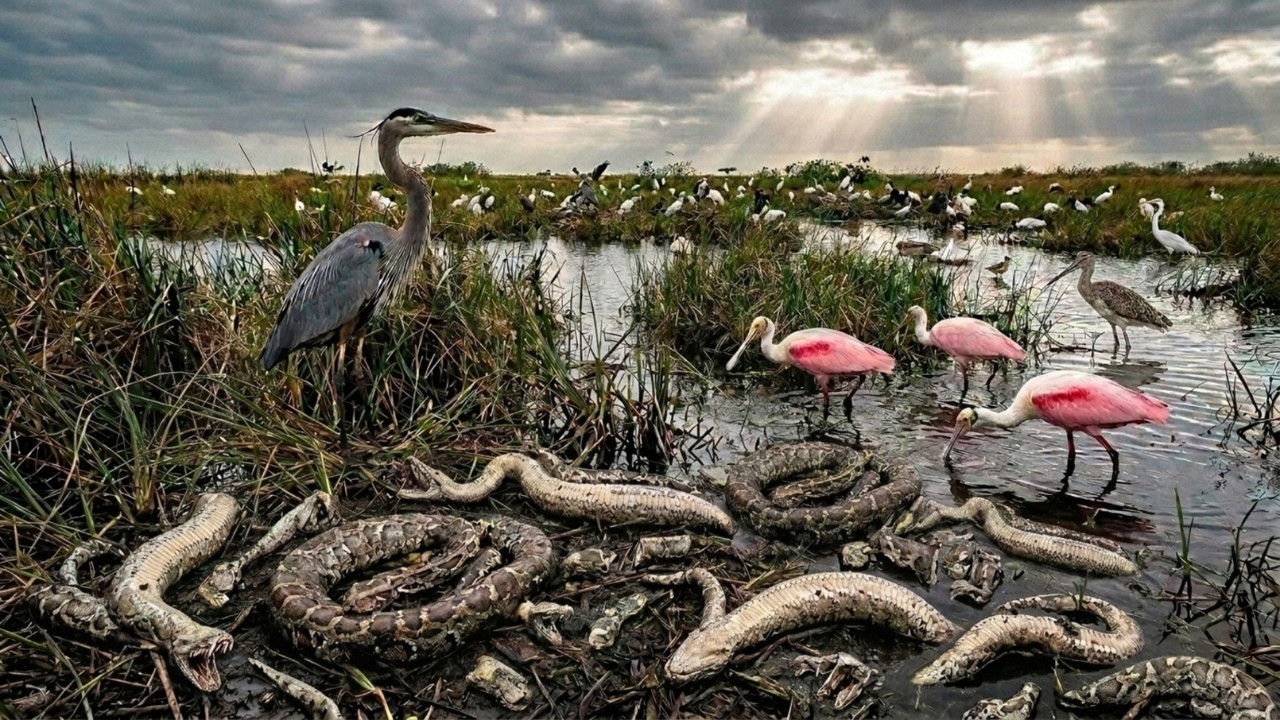
The Everglades’ invasive python collapse is silently reshaping the ecosystem, and scientists are finally tracking the true impact on wading birds. For decades, these massive snakes have decimated native wildlife, but new research reveals that the birds most affected are finding surprising consequences.
Margaret Hensley had spent 16 years counting nesting pairs at Corkscrew Swamp Sanctuary near Naples, and she knew the seasonal patterns of the wood stork colony well. During her March survey of the most recent nesting season, she recorded a colony larger than any she had seen in six years. The increase was significant enough that her usual measures of water levels, rainfall, and prey availability…

Florida’s crocodiles were vanishing for months, and researchers couldn’t explain why. The reptiles, once thriving in the state’s waterways, had seemingly vanished from their usual habitats, leaving scientists scrambling for answers.
The American crocodile is one of the most elusive large predators in the United States. Unlike its more common relative, the alligator, it typically avoids humans and has no documented fatal attacks on people in the country’s history. In recent years, however, a series of unusual deaths and disappearances in the Florida Everglades pointed to a new threat that researchers did not initially understa…
Florida’s invasive giant python population has been under attack—and scientists say a surprising hunter is responsible. Officials have tracked something killing massive pythons, leaving their bodies in ways no predator was expected to manage.
The population of Burmese pythons in the Florida Everglades has declined significantly in recent years. Governor Ron DeSantis attributed this reduction to a partnership with a Miami-based company that manufactures clothing and accessories from python skin. The pythons, an invasive species native to Southeast Asia, have caused extensive damage to the ecosystem of South Florida over the past four de…

The Everglades fires didn’t just scorch the grass—they dragged something hidden into the open, and it wasn’t only the snakes that had everyone talking. As flames tore through the dry marshland, authorities moved in expecting routine wildlife rescues, but what they started finding beneath the ash and smoke shifted the entire operation into something far more serious.
In 2011, researchers in the Florida Everglades found a 15-foot Burmese python that had consumed an 80-pound deer. While alligators are often considered the primary danger in Florida swamps, Burmese pythons have become a significant threat to mammal populations in the region. Since 2000, Florida has removed more than 23,000 of these snakes from the wild, and a single female can lay up to 100 eggs a…
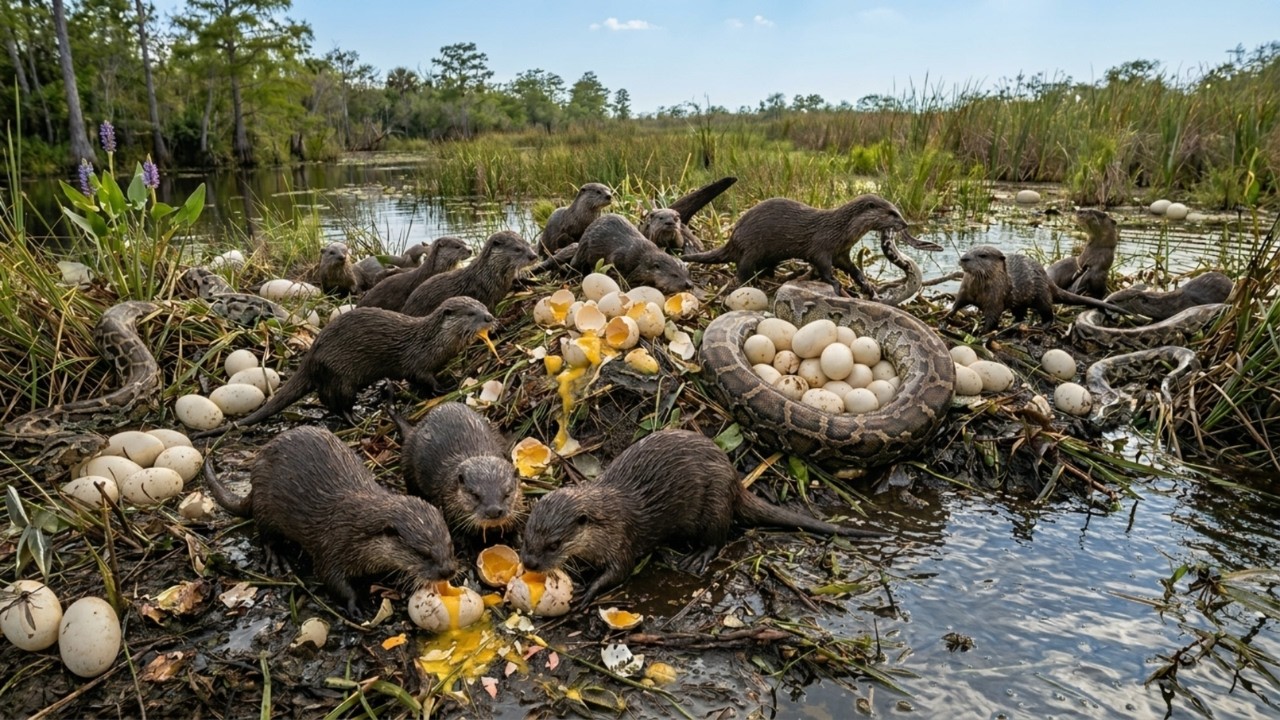
Scientists are watching Florida’s Burmese python nests vanish at an alarming rate, and the culprit isn’t what anyone expected. These massive invasive snakes, already notorious for devastating local wildlife, are suddenly seeing their eggs disappear before they can hatch.
A python nest camera deployed in the Loxahatchee River corridor of the Florida Everglades recorded 37 hours of footage during a single incubation window before the monitoring team reviewed it. The nest had been flagged six days earlier when a transmitter signal stopped moving in open water habitat where no python had previously remained stationary for that long. A graduate researcher pulled the fo…
A swamp full of hungry predators and giant pythons had Florida scientists desperate for a solution. For years, invasive Burmese pythons wiped out native wildlife across the Everglades, and typical removal methods simply could not keep pace.
Burmese pythons in Florida can swallow an adult deer whole. The snakes have severely reduced raccoon, rabbit, and fox populations in the southern Everglades, and for years no native predator appeared able to stop them. Then researchers implanted radio transmitters in young pythons and followed the signals. Some of the pythons died, but their transmitters kept moving through the black water inside…

Florida swamps are hiding something nobody expected, and newly released footage just exposed the aftermath in shocking detail. What the camera caught beneath the murky surface is drawing immediate attention—yet the full picture remains shrouded.
In the decades since Burmese pythons became established in the Florida Everglades, the region has seen a documented collapse in many native mammal populations. Recent camera footage from the swamps, however, suggests that the ecosystem is not entirely passive. Researchers are observing signs of native predators adapting to the invasion, alongside ongoing efforts to restore species that were lost l…
Invasive Burmese pythons have terrorized Florida’s Everglades for decades, wiping out mammals and baffling experts. Now, officials have unveiled a surprisingly simple new weapon against the massive snakes, which can grow over twenty feet long.
The Everglades in Florida have seen a significant decline in wildlife over the past two decades, a period during which the Burmese python has become a dominant invasive species. The large constrictor snakes, which can weigh nearly 90 kilograms and exceed six meters in length, have been linked to a reduction of over 90 percent of small and medium-sized mammals in certain marsh areas. For a long tim…